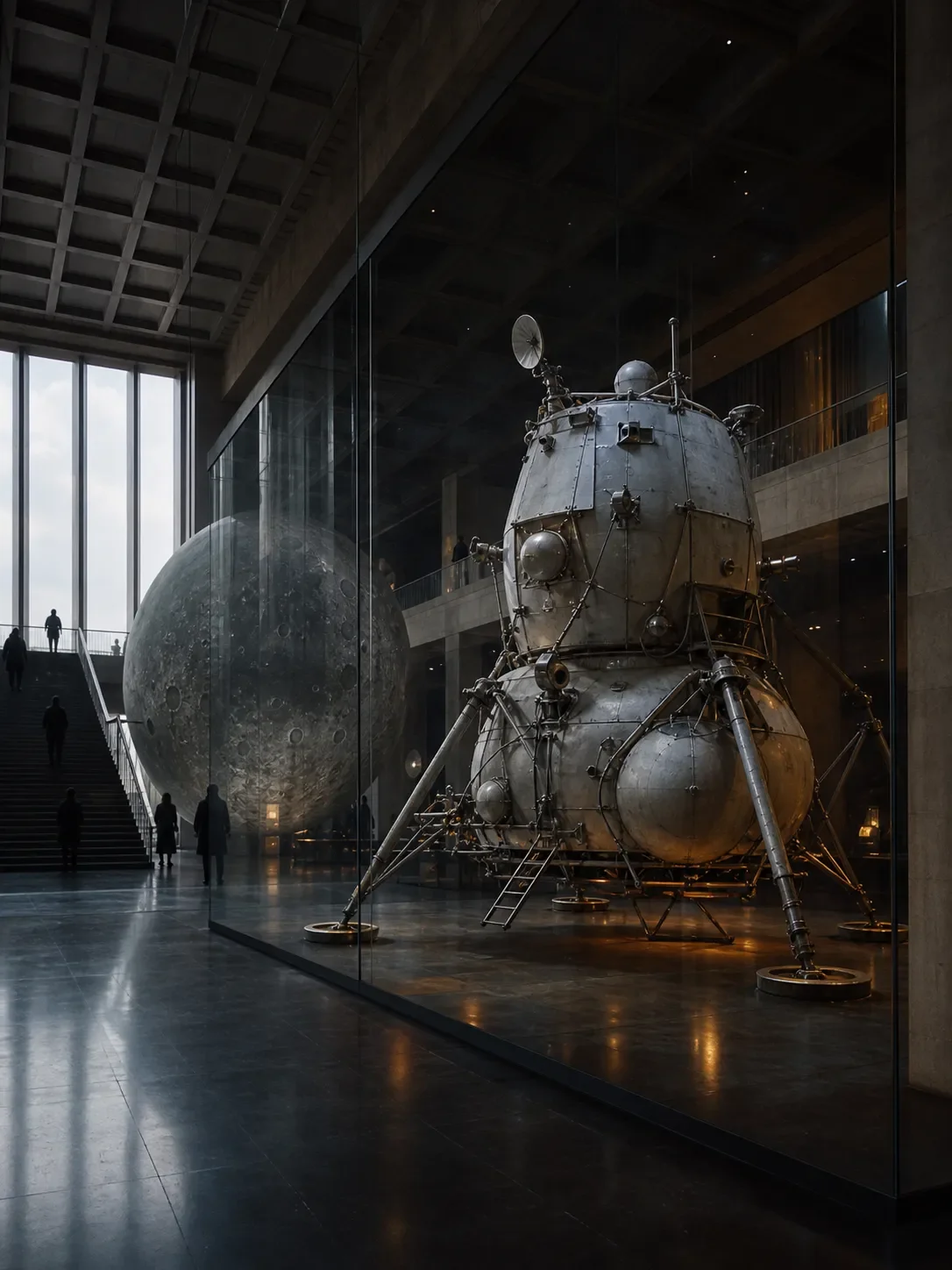

Fictional and AI-generated images. This is a speculative alternate-history scenario, not a real photograph or historical record.
The N1 works once. A Soviet cosmonaut steps onto the Moon in 1969, ahead of Apollo. By 2026, lunar stations, launch museums, and civic monuments all trace their lineage to the landing that made Moscow first.
The real-world fork is narrow. NASA records Apollo 11 as the first human landing on the Moon, on July 20, 1969. 1 The Soviet N1/L3 program had the hardware for a competing landing, but its N1 rocket never launched successfully: four attempts failed between 1969 and 1972, and the program was canceled in 1974. Britannica describes the machine as a 112.8-metre rocket whose first stage used 30 engines. 2
The premise is not invented from nowhere. A June 2026 HistoryExtra essay imagines Alexei Leonov becoming the first human on the Moon and asks how that prestige victory might alter the Cold War. 3 A public alternate-history forum takes a neighboring branch in which the US lands first, then the Soviet program follows with its own crewed mission in 1971. 4 We borrow the question, not a guaranteed political outcome.
- The landing becomes an inheritance. A 2026 museum is built around the vehicle that made the Soviet Union first.
- The launch complex keeps working. In this branch, one successful N1 flight buys the lunar program time, money, and a reason to keep rebuilding the machinery around it.
- The Moon enters ordinary civic life. Universities, transit halls, and public displays treat lunar engineering as local history rather than a distant American chapter.
- The outpost is the long bet. A lunar research room carries the first landing forward through spare parts, worn handrails, and instruments that still need someone to repair them.
The first landing changes the prestige calendar. It does not, by itself, guarantee that the Soviet state survives; even the alternate-history discussion that popularizes this fork treats that claim as uncertain. 3 The landing is history. The 2026 world pictured here is fiction.
References
- 1NASA Moon Exploration
science.nasa.gov
- 2Space exploration — Race, Moon, Astronauts
britannica.com
- 3What if the Soviets had won the space race?
historyextra.com
- 4
Comments