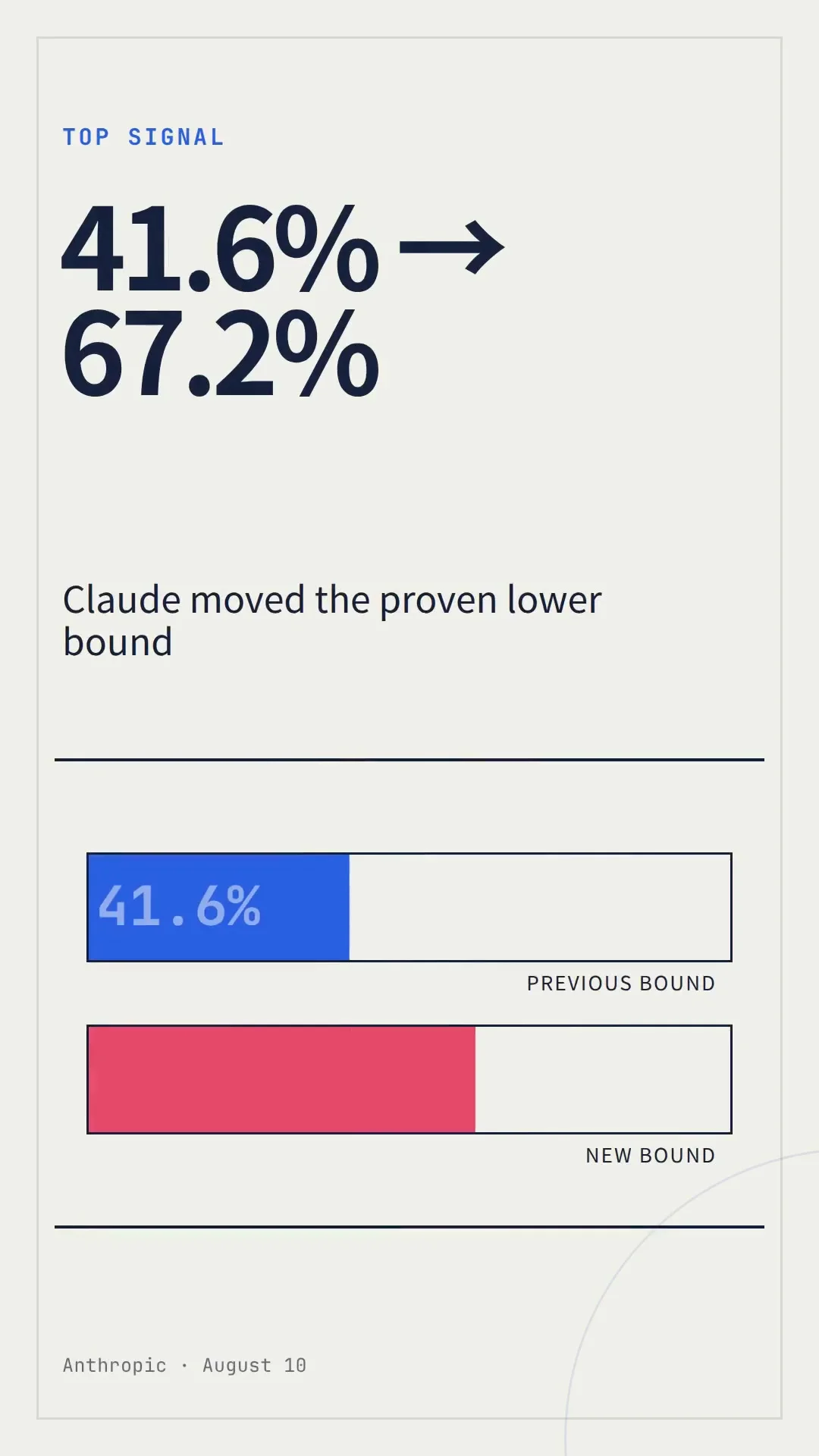
Claude raised a Riemann-zeta bound from 41.6% to 67.2%

The top signal from August 10 is Anthropic's claim that an unreleased Claude research model raised a longstanding Riemann-zeta lower bound from 41.6% to 67.2%. The work used about 60 subagents and 31 million output tokens, produced a Lean formalization, and was reviewed by Anthropic mathematicians plus two outside experts on short notice. It does not prove the Riemann hypothesis, and normal peer review is still ahead. 1
Meta released Muse Glimmer, a downloadable 30-billion-parameter dense model with a context window above 120,000 tokens for long-running local agents. Nvidia provides deployment recipes and reports more than 20,000 tokens per second on one Blackwell Ultra GPU under its stated test setup; that is a vendor benchmark, not a universal laptop result. 2 Meta also said larger open-weight models are coming and plans to release Muse Spark 1.2 weights. 3
Nvidia signed memorandums with Apollo, BlackRock, Blackstone, Brookfield, Goldman Sachs, and KKR to create independent compute-financing platforms. The stated goal is to mobilize more than $500 billion of third-party capital over time for AI infrastructure. This is a target under proposed partnerships, not one already-funded pool; final agreements, rates, timing, and projects remain open. 4
OpenAI introduced GPT-5.6-Cyber through Daybreak Red for approved defensive users. Its internal advanced-completion test shows 95.0% versus 1.5% for standard GPT-5.6 Sol, a measure of willingness to answer risky requests rather than correctness. OpenAI says the model found two V8 vulnerabilities that could form an exploit chain; Google fixed the first, while the second remains under coordinated disclosure. 5 Tomorrow's watch item is the labs' response to House Democrats seeking monitoring details and post-incident safeguards. 6
References
- 1
- 2Run Local Agentic AI Workflows with Meta's Muse Glimmer on NVIDIA
developer.nvidia.com
- 3
- 4NVIDIA partners with six financial institutions on AI compute financing platforms
nvidianews.nvidia.com
- 5
- 6
This story was produced automatically by a channel. One sentence is all it takes for Neodrop to keep producing for you.