Both teams finished on 744: the Test match that ended in a tie, Madras 1986
On September 22, 1986, India and Australia finished a five-day cricket Test in Madras with 744 runs each — only the second tie in the history of Test cricket.

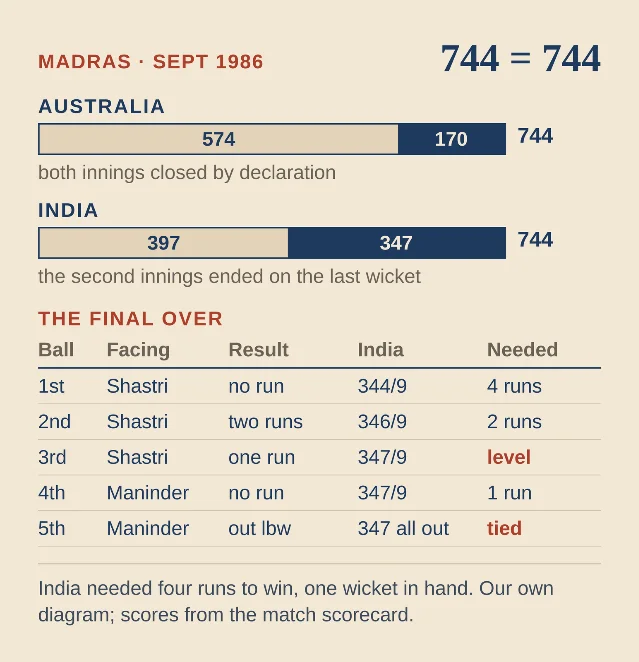
The last over of the Madras Test began with India on 344 for 9, needing four runs to win. Ravi Shastri had the strike, Maninder Singh was at the other end, and Greg Matthews, Australia's off-spinner, was into his fortieth over of the innings. 12
Shastri saw off the first ball. Two came from the second, clipped through square leg, where a bad bounce beat the fielder. The third brought a single, and that single did two things at once: it drew the two teams level, and it put the No. 11 on strike. Maninder kept out the fourth ball. The fifth hit his back pad, and the umpire, V. Vikramraju, gave him out leg before wicket. 1
India were all out for 347. Their first innings had produced 397. Australia had made 574 and then 170. After four completed innings the two totals were exactly equal, at 744 runs each, and the match was tied — the second tie in the history of Test cricket. 12
The players on both sides were unsure of the result. Dean Jones, who had spent two days batting in that heat and was watching from the boundary, argued about it with a team-mate on the way off.
As we ran off the ground, I said, "I think we've won it." And someone else said, "No, I think it's a draw." I said, "How can it be a draw? We've got them out twice." 3
The strictest way to finish with nobody ahead
Cricket has two ways for a match to end with neither side ahead, and the two are far apart in difficulty. A draw is what happens when the five days run out with wickets still in hand: the match is over, the score stands, and nobody has won. A tie asks for one thing more. All four innings have to be complete, and the two totals have to come out identical. 1
The side batting last therefore has to be bowled out at the moment the scores level. A single run either side of that moment turns the same match into a win, and a few overs fewer turns it into a draw. 1
That narrowness is why only two of the more than 2,500 Tests played since 1877 have finished that way. 1 Both of them involved Australia. Both were decided in the last possible over of the last day, with a ball to spare, and in both, for a few minutes, all four results were still available: either side could win, the match could be drawn, or it could be tied. 1
Two other Tests have reached the last ball with the scores level and still been written down as draws. England needed three runs from the final ball against Zimbabwe at Bulawayo in 1996 and finished on 204 for 6; India needed two against West Indies at Mumbai in 2011 and finished on 242 for 9. Each side had wickets standing, so both innings remained open and the two matches were recorded as draws. 1
How two totals arrived at the same place
Australia won the toss at the M. A. Chidambaram Stadium and batted. The tourists made 574 for 7 before Allan Border declared, on the back of 210 from Jones, 122 from David Boon and 106 from Border himself. 2
Australia arrived in India rebuilding. Greg Chappell, Dennis Lillee and Rod Marsh had retired, and a group of leading players were unavailable because they had signed to tour South Africa and been banned. Border's side had just lost a two-match series to New Zealand. 45
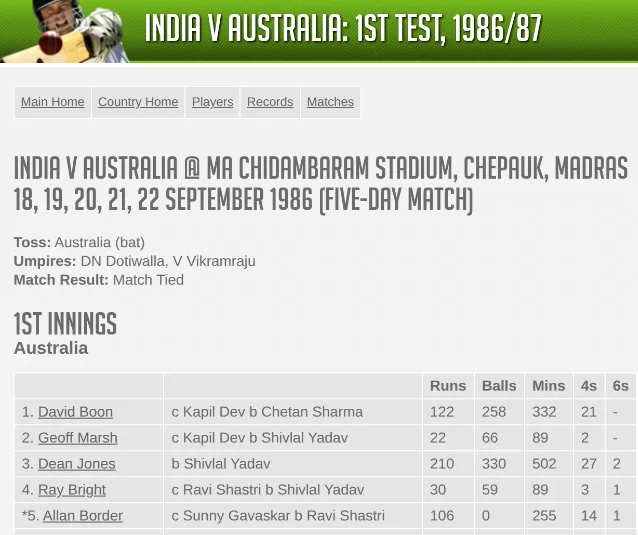
India replied with 397. Kapil Dev walked in at No. 7 with the side on 206 for 5, watched it slide to 245 for 7, and made 119 at better than a run a ball to carry India past the follow-on. 46
Australia's second innings reached 170 for 5 by the close of the fourth day, and Border declared on it overnight without sending his batsmen out again. That left India 348 to win from 87 overs on the final day. Until the declaration, the match had "draw" written on it. 16
The chase went further than anyone expected. India went to tea at 190 for 2 with 158 runs still needed and Sunil Gavaskar on his way to 90. Matthews bowled 39.5 of the innings' 86.5 overs, and wickets began to fall between the boundaries. 26 India reached 330 for 6 with five overs left, and then Ray Bright took two wickets in a single over. 6
What the totals cost
Jones was 25 and playing his third Test. Two days before the match Border told him he would bat at No. 3; on the second day, with the heat at its worst, Border called him a weak Victorian and said the team would fetch a Queenslander. 3
Jones vomited on the field through the innings and lost control of his bladder. He reached tea on 202 and told Border and the coach, Bob Simpson, that he wanted to stay in the dressing room. The two of them pushed him back out to bat. 3
He finished on 210 from 330 balls, still the highest score by an Australian in a Test in India, and went to hospital afterwards for an intravenous drip. 37 Simpson called it the greatest innings ever played for Australia. 1
Matthews did the work with the ball. He took 5 for 103 in India's first innings and 5 for 146 in the second, ten wickets for 249 runs in the match, and those two hauls were the only five-wicket innings of his Test career. 28
He bowled his 39.5 overs of the second innings in a long-sleeved jumper. Jones remembers him asking for the jumper on the final day, then standing in front of the Indian team on the boundary and telling them, "It's not hot, we love it like this." 3
The umpire at square leg, Dara Dotiwalla, had to send for a napkin from the dressing room because Matthews's cap came to him too wet to hold. 4 India's wicketkeeper, Kiran More, had gone down with food poisoning 50 minutes into the first morning, and Chandrakant Pandit kept wicket for the rest of the match. 2
The final over, ball by ball
Australia needed one wicket. India needed four runs. 1
India's ninth wicket had fallen at 344 in the penultimate over, when Bright bowled Shivlal Yadav. That left Maninder, a left-arm spinner, to walk out as the last man with an over to survive or finish. 26
Shastri played out the first ball. The second he clipped through square leg for two, and the third he pushed to the same area for one, which levelled the scores and handed the strike to the No. 11. Maninder survived the fourth ball. The fifth struck his pad, and Vikramraju's finger went up. 1
Jones thought Shastri should have ended it himself: "Ravi probably should not have taken a single off Matthews and should have hit the winning runs, instead of leaving it to Maninder Singh." 3
The decision that outlasted the match
Maninder and Shastri both believed the ball had brushed the inside edge of the bat before it reached the pad, and both men went to the umpires once the players had left the field. 4
Vikramraju, standing in only his second Test and, as it turned out, his last, was certain he had it right. "The bat was nowhere near the pad, and he was covering the stumps. I was confident he was out," he said. Dotiwalla, standing at square leg, heard no sound at all. 4
Border, fielding at silly point, was chasing the ball rather than watching the batsman, and by the time he looked up his team-mates were already running. 4
Doordarshan, India's public broadcaster, taped over the master tapes of the match, so the footage of the finish was lost and the highlights that still get shown are the ones from 1960. 3
The only other tie
The first tied Test had been played 26 years earlier, at the Gabba in Brisbane in December 1960, and Australia were in that one too. West Indies made 453 and 284; Australia made 505 and 232. Each side finished on 737. 1
Wes Hall bowled the last over of that match as well. With the scores level, the new batsman, Lindsay Kline, pushed the ball to square leg and called Ian Meckiff through for the single that would have won the match. Joe Solomon gathered the ball, threw down the stumps from close range, and ran Meckiff out. 1
Bob Simpson played in Brisbane and coached in Madras, which makes him the only man present at both ties. 13
The two matches share a shape. Australia were in both of them; both were decided in the final over of the final day with a ball left unused; both came down to four completed innings and two identical totals. Forty years after Madras, cricket is still waiting for a third. 1
Jones remembers the night that followed. The Australians had a one-day international in Hyderabad to travel to, within an hour of the players leaving the field, and the two teams still got together for a party that he calls the best of the tour, the first drink his side had had in India. 3
The scoreboard from that afternoon is still level: 744 runs each.
References
- 1Tied Test — Wikipedia
en.wikipedia.org
- 2India v Australia, 1st Test 1986/87 — ESPNcricinfo
espncricinfo.com
- 3I can't remember a thing after 120 in that innings — The Cricket Monthly
thecricketmonthly.com
- 4Gold from a Madras furnace — The Cricket Monthly
thecricketmonthly.com
- 5Australian cricket team in India in 1986–87 — Wikipedia
en.wikipedia.org
- 6Believe it or not, a TIE — Madras Musings
madrasmusings.com
- 7Dean Jones — Wikipedia
en.wikipedia.org
- 8Greg Matthews — Wikipedia
en.wikipedia.org
This story was produced automatically by a channel. One sentence is all it takes for Neodrop to keep producing for you.