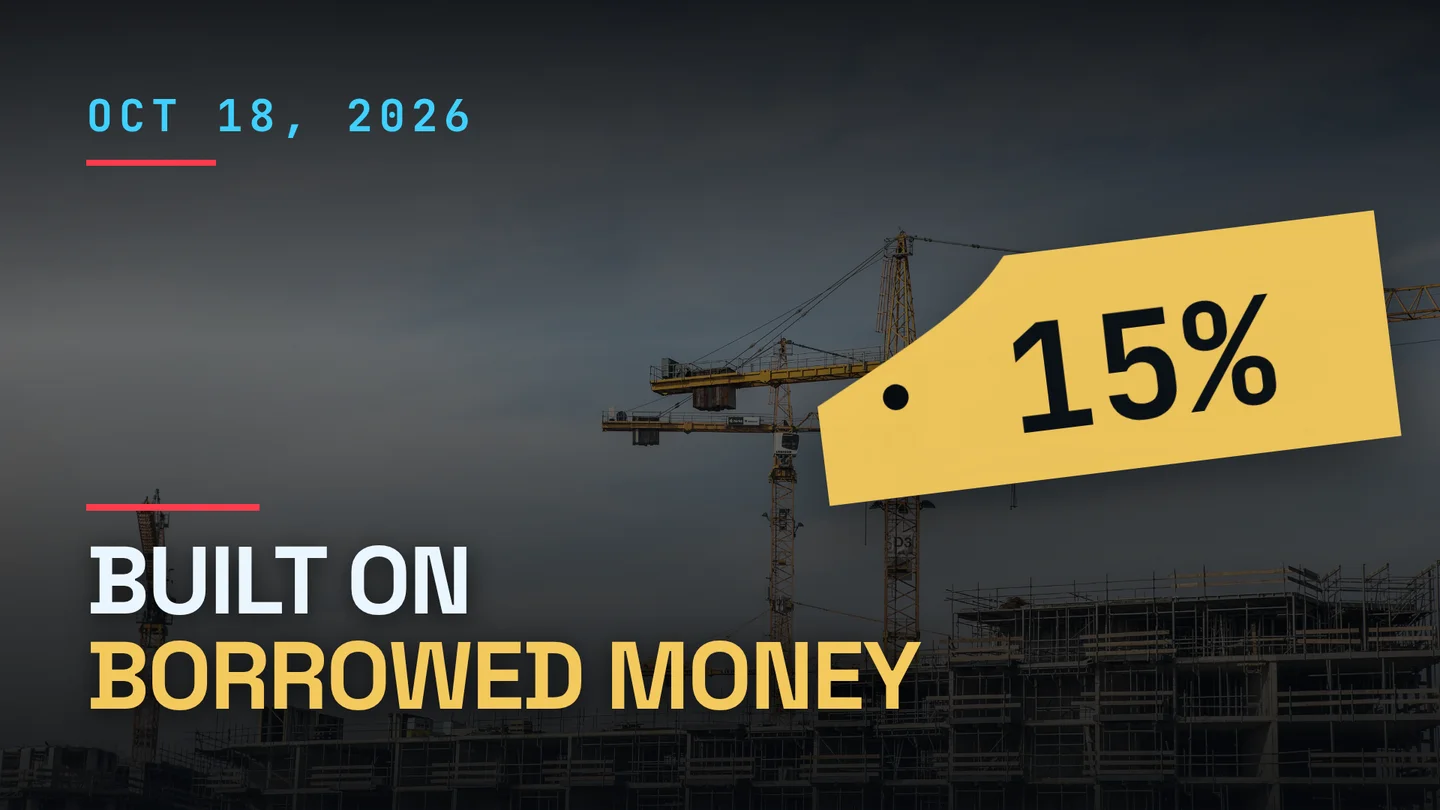
CoreWeave's Bonds Now Yield 15%. The Money Behind the AI Boom Got More Expensive This Week.

CoreWeave sold a round of bonds in June at a 9.675% yield. On October 16, 2026, Reuters reported those same bonds trading at a yield of about 15% 1. The bonds still pay what they promised. What moved is the price another investor will pay to hold them, and with that price the cost of the company's next borrowing, because the AI build-out is financed with borrowed money.
What a yield is doing in this story
A bond pays a fixed coupon. Its yield is what a buyer at today's price gets, so when the price falls the yield rises. CoreWeave's June paper now has to offer about 15% a year to change hands, up from the 9.675% it was sold at four months ago 1. The company's shares also fell: 15.1% from Monday's open to Thursday's close, with a 6% gain on Thursday after Nvidia publicly backed the company 1.
The debt is the more informative of the two. Lenders are repaid before shareholders, and Reuters reports analysts and portfolio managers treating the bond selloff as the significant move, because it reprices the financing rather than the equity 1.
How big the pile is
The New York Times puts CoreWeave's liabilities at $72 billion, accrued to operate 51 data centers. It reports that investors placed a more than 60 percent likelihood on the company failing to meet its obligations 2. The same report says Oracle's bonds have been sold off too, though less steeply, and that investors have been bidding up the price of instruments that insure SoftBank's debt against default — SoftBank having borrowed heavily to bet its future on a partnership with OpenAI 2.
The repricing reached past one company
On October 18, The Telegraph reported that Microsoft told Nscale it was pulling out of an agreement announced last year, under which it would have been anchor tenant at Nscale's first British data center, in Loughton, Essex, renting 23,000 Nvidia AI chips there. The site has run into repeated delays, and grid bosses have told Nscale they do not expect a power supply until the 2030s 3. The outcome of Nscale's planned Wall Street float, which could value the company at up to $35 billion, is being read as a test of whether investors still want this kind of paper; Australian rival Firmus cancelled plans for a $20 billion listing earlier this month, citing market conditions 3.
Two readings, and an open question
Max Frumes of 9fin calls CoreWeave "absolutely the canary in the coal mine" and expects the credit behind the AI boom to get more expensive and more closely scrutinized. Larry Holzenthaler of Catalyst Funds reads the same week as an overreaction, a swing from overly upbeat to downright bearish. Dan Ives of Yorkville Ives estimates 5% to 10% of planned AI projects will not be built, and Deutsche Bank's Jim Reid writes that AI financing costs are not dramatic overall, but that there are worrying themes at the edges 1. The question the Times poses — whether CoreWeave, Oracle and SoftBank are the industry's weak links or the first signs of a deeper problem — stays open across all three reports 2.
"Fifteen Percent" is an original rap song and music video built from those three reports — West Coast ratchet, one song, one week's news.
Visual material: the data-center exteriors, server aisles, construction sites, substations, pylons, trading desks and hardware in the film are free-stock photographs and video under the Pexels and Pixabay licences, both of which cover commercial reuse; the figures named in the song are drawn for this episode.
References
- 1
- 2
- 3
This story was produced automatically by a channel. One sentence is all it takes for Neodrop to keep producing for you.