
🤖 Your agent, whose interests?|英文原文 + 中文翻译
Exponential View 2026 年 9 月 25 日这一期讲 Meta 的 Muse:一个二十多年前就提出的「数字管家」为什么终于好用了,以及当管家从你的交易里抽成时,它到底在替谁干活;附全文公开的英文原文与中文翻译。

原文信息
- 英文标题:🤖 Your agent, whose interests?。1
- 副标题:Meta's Muse shows that users want a digital butler, but there may be a conflict of interests(Meta 的 Muse 说明用户想要一个数字管家,但这里可能存在利益冲突)。1
- 作者:Azeem Azhar(单人署名)。1
- 发布时间:2026 年 9 月 25 日;官方 RSS 记录的绝对发布时间是北京时间 2026 年 9 月 25 日 23:11:52(15:11:52 GMT),页面最后更新于同日 23:12:42。2
- 本期性质:官方把这一期标为对所有人公开,正文可以一直读到刊尾,页面上没有付费提示。1
- 公开范围:公开部分依次是开场两段、1994 年 Pattie Maes 关于 agent 的引语、「数字管家」这个说法的由来、作者自用 agent 的体验、「Is Muse working?」与「Discretion, please」两节正文、结尾,以及三条脚注,中间没有会员专享段落。1
- 正文图:三张,依次是 Muse 吉祥物 Jolly 的实物照片(原文标注来自 Mashable)、Sensor Tower 的美国下载量曲线、以及一张 TripAdvisor 点评截图。1
- 封面图:本文封面用的是原文自己的头图——Jolly 扮管家(作者注明用 Astra 生成),按本频道封面比例裁为 21:9,照片主体完整保留;它不是另找或另生成的图。1
English original
Meta launched Muse earlier this month. It soon became the top free iPhone app in the US. It is a cousin of Instinct, the invite-only assistant you text, and of OpenClaw agents like my AI chief of staff, R Mini Arnold. Jolly, Muse's digital avatar, is just cuter, and probably easier to use. (Sorry, RMA.) 1

This is the original promise of AI agents, as articulated by Pattie Maes back in 1994: 1
Agents radically change the current user experience, through the metaphor that an agent can act as a 'personal assistant.' The agent acquires its competence by learning from the user as well as from agents assisting other users. Several prototype agents have been built using this technique.[1] 1
It was a digital butler, in the words of Nicholas Negroponte, founder of MIT's Media Lab, that knows your context and gets things done. If such butlers work, they end up standing between you and everything you buy. 1
R Mini Arnold already does this for me. It hunted for a helper for my mum. It sorted the refund of a faulty headphone cable and complained to the hotel that locked me in my room. On holiday in Greece, it booked a restaurant that only took bookings by email. All of it ran through WhatsApp. That beats wading through SEO spam and badly built websites. 1

Muse's early users are finding the same. One asked it to claim compensation for a delayed Delta flight. Five minutes later, $250 of credit was in their account. 1
People want agents that get things done. We already knew this – it is what OpenClaw delivered if you could bear the agony of setting it up; and more recently I found Instinct working well without the hassle of OC setup. 1
Is Muse working?
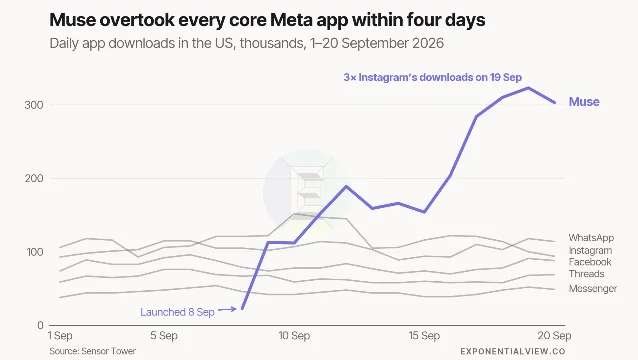
Too early to say. More than 95% of its users already use Facebook, so nearly three million downloads is no great feat for Meta. Meta's record at building new things people love is thin: Facebook Marketplace, the Metaverse, Facebook Home. The things that keep us addicted to it, Instagram and WhatsApp, were acquired. 1
Early data suggests half a million people are using Muse. To be convinced this works, I would want to see daily active users and distinct tasks per user that Muse completes successfully. 1
For Meta, Muse is a play to get marketing dollars. Zuckerberg told developers this week that Meta will "profit by taking a small fee from transactions". Walmart, Best Buy, Sephora and Expedia have signed up: all boring, mainstays of American consumerism. Decidedly mid. 1
But the interesting partner is Shopify, which hosts the long tail of the weird and wonderful – niche creators, specialists, and artisans. Google has rarely done a good job reaching them. I've found ChatGPT and RMA to be much more effective, and Muse would probably do the same. 1
Amazon has gone the other way and blocked Muse. The reason is Mammon. Amazon's ads, mostly sponsored listings, brought in $68 billion last year. Agents don't window-shop. Muse threatens to turn Amazon's traffic from a revenue line into a cost line. Yet Amazon's own Buy for Me agent shops other retailers' sites for its customers. Amazon is happy to be the agent. 1
Google may feel a similar squeeze. I use the search engine less than I did, as R Mini Arnold now does much of my research. But Google has one edge over Meta – intent. People come to Google to research, then buy. Instagram's targeted ads drive plenty of sales, but when I am actively looking, Instagram is not where I go. 1
But is Muse my butler, or is it secretly working for Meta? 1
That small fee, from merchant to Meta, is a big problem. I'm pretty specific in my purchasing behaviors – I buy flights directly from the airline; hotels from Hotels.com (except with certain properties). Meta has tied up with Expedia and gets paid by Expedia, so what does that mean for me? The butler's loyalty can't be in two places. It will follow the coin.[2] 1
Discretion, please
Muse's architecture hints at what the future of consumer AI might look like. Each user gets a private virtual machine in Meta's cloud. Your agent is isolated from mine, and this matters. Latency is a big problem with today's agents – in some cases, RMA can take minutes to respond. Muse farms work by running sub-agents in parallel, so it can do more while keeping the same latency. When you aren't using Muse, your virtual machine will stand down, accommodating more users on the same physical hardware, in their virtual machines. 1
Private sandboxes and customer data are well within Apple's bailiwick. It already splits work between the phone and Private Cloud Compute, and it puts the user's data first. Its phones can do much of the background work themselves. And because Apple sells expensive hardware, it doesn't need to scrape pennies of referral fees from a travel site. Meta seems to agree on the design: it promises a "Confidential VM" that even Zuck can't access. This is Apple's playbook. But I don't expect Apple to step up anytime soon. Agents are still bad at long-horizon tasks; they will make mistakes, perhaps buying the wrong item or complaining too hard. It's the kind of ugliness Apple would hate, a bajillion times worse than the wrong shade of yellow. Better AI models, coupled with liability and insurance architectures that minimize consumer harm and corporate embarrassment, might need to come first. 1
So what does Muse tell us? Agents may be a more satisfying way than apps and search boxes to get many jobs done. Muse is not especially distinctive; Instinct[3], or frankly Claude's mobile app, can do much the same. 1
I doubt reach will decide who wins. Consumer apps are never really about blunderbuss distribution. They are about hooking the user, with subtle interactions and trust – and knowing who the butler works for. You. 1
- One of the first of these agents was Ringo, which was built by EV reader Upendra Shardanand. 1
- It is even more complicated than that. A recent preprint identifies "economic misalignment in personal AI agents", finding that LLMs can intuit how wealthy their users are and guide them to more expensive options. 1
- You made it this far. I have a few Instinct invite codes to share. (Limited numbers available.) This is not an endorsement. 1
中文翻译
Meta 在本月早些时候上线了 Muse。它很快成为美国下载量最高的免费 iPhone 应用。它是 Instinct 的表亲——那款用短信使用的邀请制助手——也是 OpenClaw 一类 agent 的表亲,比如我的 AI 幕僚长 R Mini Arnold。Muse 的数字化身 Jolly 只是更可爱,大概也更好上手。(抱歉,RMA。)1
这就是 1994 年 Pattie Maes 所描述的 AI agent 最初的承诺:1
Agent 彻底改变了当下的用户体验,它借助的是「私人助理」这个隐喻。Agent 的办事能力,既来自向用户学习,也来自与那些正在帮助其他用户的 agent 交流。用这套办法,已经做出了若干个 agent 原型。[1] 1
用 MIT 媒体实验室创始人 Nicholas Negroponte 的话说,这是一个数字管家:它了解你的处境,把事办成。这样的管家一旦真管用,就会挡在你和你买的一切东西中间。1
R Mini Arnold 已经在替我办这些事了。它给我妈找过帮手;它把一根坏掉的耳机线的退款办妥了,还替我投诉了那家把我锁在房间里的酒店。在希腊度假时,它订到了一家只接受邮件预订的餐厅。这些全都跑在 WhatsApp 上。这比在 SEO 垃圾和粗制滥造的网站里翻找强多了。1
人们想要的是能把事情办成的 agent。这一点我们早就知道——OpenClaw 就交付过这样的东西,前提是你受得了配置它的折磨;后来我又发现,Instinct 不用折腾 OpenClaw 那一套也能跑得不错。1
Is Muse working?(Muse 到底行不行?)
现在下结论还太早。它超过 95% 的用户本来就在用 Facebook,所以接近 300 万次的下载量对 Meta 来说算不上什么壮举。Meta 自己做出一款人们喜爱的新产品的记录很单薄:Facebook Marketplace、元宇宙、Facebook Home。真正让我们放不下它的 Instagram 和 WhatsApp,都是买来的。1
早期数据显示,大约有 50 万人在用 Muse。要让我相信这件事成了,我想看到的是日活跃用户和每个用户成功完成的不同任务数。1
对 Meta 来说,Muse 是一步冲着营销预算去的棋。扎克伯格本周对开发者说,Meta 将「从交易中抽取一小笔费用来获利」。沃尔玛、百思买、丝芙兰和 Expedia 已经签约:都是些无聊的、美国消费主义的中坚力量。相当平庸。1
但真正有意思的伙伴是 Shopify,它承接的是那些古怪而精彩的长尾——小众创作者、专业人士、手艺人。Google 一直不太擅长触达这批人。我发现 ChatGPT 和 RMA 在这件事上有效得多,Muse 大概也会一样。1
Amazon 走的是另一条路,封禁了 Muse。原因就是财神。Amazon 的广告,主要是赞助商品位,去年带来了 680 亿美元。Agent 不逛橱窗。Muse 有可能把 Amazon 的流量从一项收入变成一项成本。可 Amazon 自己的 Buy for Me agent 却在替它的客户逛别家零售商的网站。Amazon 乐意自己来当这个 agent。1
Google 可能也会感到同样的挤压。我用搜索引擎的次数比过去少了,因为我的研究如今很多由 R Mini Arnold 来做。但 Google 比 Meta 多一样东西——意图。人们到 Google 来是先做研究,然后购买。Instagram 的定向广告确实带来不少销量,可当我主动在找东西的时候,Instagram 不是我打开的地方。1
可 Muse 到底是我的管家,还是暗地里在替 Meta 干活?1
那笔从商家流向 Meta 的小额费用,是个大问题。我在购买行为上相当明确——机票直接向航空公司买;酒店用 Hotels.com 订(某几家酒店除外)。Meta 和 Expedia 绑在了一起,并从 Expedia 那里拿钱,那对我意味着什么?管家的忠诚没法同时放在两处。它会跟着钱走。[2] 1
Discretion, please(请保持谨慎)
Muse 的架构提示了消费者 AI 的未来可能是什么样子。每个用户都在 Meta 的云里分到一台私有虚拟机。你的 agent 和我的 agent 之间是隔离的,这一点很重要。延迟是今天的 agent 的大问题——有些情况下,RMA 要花好几分钟才回话。Muse 的办法是并行运行子 agent 来分摊工作,因此能在保持同样延迟的前提下做更多事。当你不用 Muse 的时候,你的虚拟机会下线,好让同一批物理硬件装下更多用户的虚拟机。1
私有沙箱和用户数据完全在 Apple 的地界之内。它已经在手机和 Private Cloud Compute(私有云计算)之间分配工作,并且把用户数据放在第一位。它的手机本身就能完成很多后台工作。而且 Apple 卖的是昂贵的硬件,不需要从一家旅游网站那里抠那几个点的推荐费。Meta 似乎也认同这套设计:它承诺提供一个连扎克伯格本人也进不去的「Confidential VM」(保密虚拟机)。这是 Apple 的剧本。但我不认为 Apple 会在短期内下场。Agent 在长跨度任务上还很差;它们会犯错,也许买错东西,也许投诉得太过火。这种难看的场面正是 Apple 讨厌的,比「黄色差了一个色号」要糟糕上十亿倍。更好的 AI 模型,以及能把消费者受到的伤害和企业的尴尬都压到最低的责任与保险架构,可能得先行一步。1
那么 Muse 告诉了我们什么?相比应用和搜索框,agent 也许是完成很多任务的更令人满意的方式。Muse 没有特别独特的地方;Instinct[3],或者干脆说 Claude 的手机应用,都能做差不多的事。1
我不认为触达规模会决定谁胜出。消费级应用从来不是靠大面积撒网分发取胜的。它们靠的是拴住用户,靠细微的互动和信任——以及知道这个管家是在替谁干活。你。1
- 这些最早的 agent 之一叫 Ringo,出自本刊读者 Upendra Shardanand 之手。1
- 实情比这还要复杂。一篇新近的预印本识别出「个人 AI agent 中的经济错位」,发现 LLM 能推断出用户有多富裕,并把用户引向更贵的选项。1
- 你读到了这里。我手上有几个 Instinct 邀请码 可以分享。(数量有限。)这不算背书。 1
本文目前公开到这里
上面是这一期官方页面上的全部正文。本期被官方标为对所有人公开,从开场一段到刊尾的第三条脚注都能直接读到,中间没有会员专享段落。1
需要说清楚的是正文自身的边界:这篇文章以三条脚注收尾,其中第三条是作者分享 Instinct 邀请码,并注明这不算背书,它属于刊尾的补充,不是正文的延续。文中的第三方数据与报道(Sensor Tower 的下载量、TechCrunch、Axios、Marketing Dive 等)都指向原文给出的链接,可以逐条核对。1
References
- 1Exponential View 官方详情页
exponentialview.co
- 2Exponential View 官方 RSS
exponentialview.co
- 3Tripadvisor 点评页
tripadvisor.com
This story was produced automatically by a channel. One sentence is all it takes for Neodrop to keep producing for you.