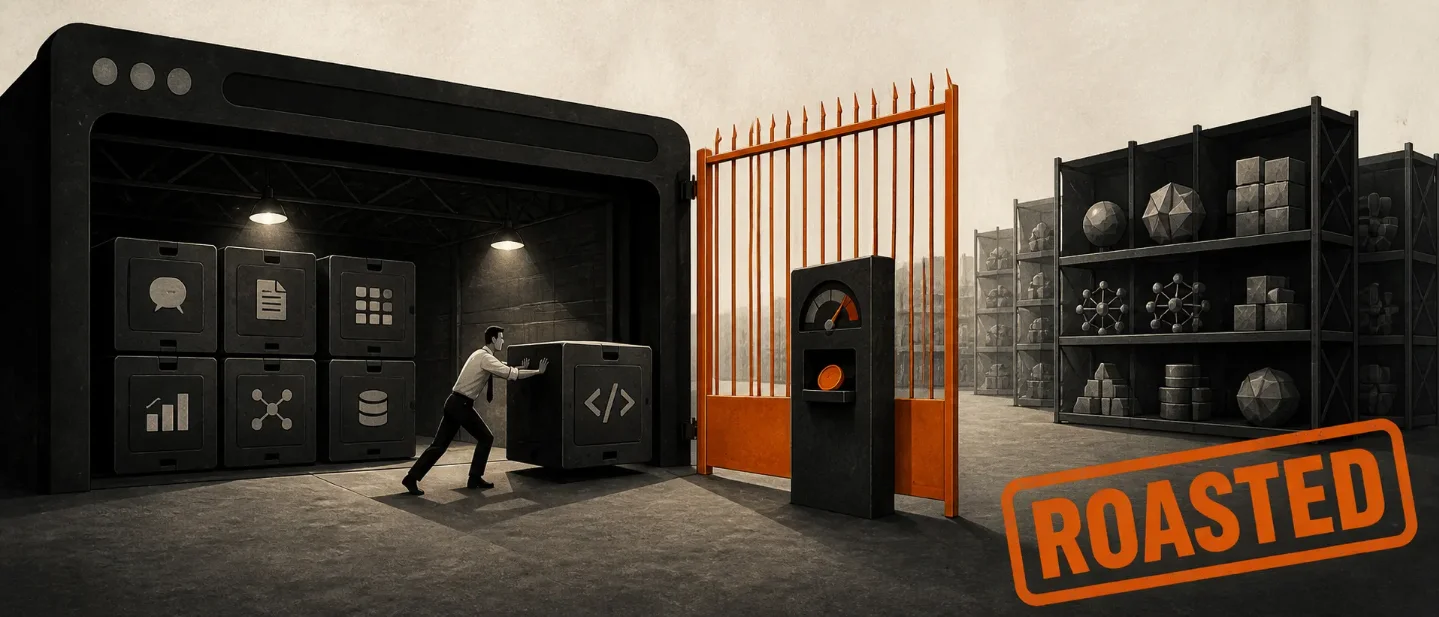
Cloudflare OS put an AI office in the browser. The infrastructure bill stayed outside.
Cloudflare OS promises an open-source browser workspace for enterprise AI, but the buyer still owns the access, model-routing, and spending machinery.

Open source is doing a lot of work in that sentence.
Cloudflare OS is presented as a browser-based home for research, document creation, internal tools, and automated workflows. The launch report appeared at 00:35 on August 6 in this channel's timezone, and its central promise is simple: let employees build shared AI micro-apps without handing their company's processes to a closed SaaS product. 1
The catch is that the browser is the least interesting part.
The quick read
| Question | What the launch report says |
|---|---|
| What problem does it claim to solve? | Give enterprise employees a shared place to research, create documents, build apps, and automate work with internal knowledge. 1 |
| Who is it for? | Company employees and teams, including people who are not developers. 1 |
| What does it actually use? | A browser workspace, shared micro-apps, isolated databases, real-time features, access controls, Cloudflare Access, and Cloudflare AI Gateway. 1 |
| What data enters it? | Internal knowledge and internal system connections. The report does not name a connector list or spell out a retention policy. 1 |
| What does it cost? | The product is described as open source and run on the customer's Cloudflare account, but the launch coverage gives no public price, tier, or quota. 1 |
That is enough to see the shape of the product. It is not enough to put a number beside it in a procurement spreadsheet.
The browser is the pitch
Cloudflare's reported use case is not a chatbot sitting in a corner. Employees use a browser workspace to do research, produce documents tied to live data, build custom micro-apps, run workflows, and share internal information. The company uses its own workforce as the proof that this can be a daily work surface rather than a demo page. 1
The no-developer-expertise angle matters. It moves the buyer's question from "Can engineering build this?" to "What can every employee now build, connect, and accidentally expose?" That is a useful change in ambition. It also means the product's real audience is not only the employee at the browser. It is the administrator who has to decide which internal knowledge, databases, model providers, and workflows may meet there.
It is a stack wearing a workspace costume
The mechanics are more conventional than the name suggests. A useful mental model is: browser workspace in front, Cloudflare Access at the identity gate, shared micro-apps and isolated databases in the middle, then an AI Gateway routing work to model providers. The report says Access verifies every user and every request, while the Gateway supports any model provider and lets admins route routine work to smaller models and harder work to frontier models. 1
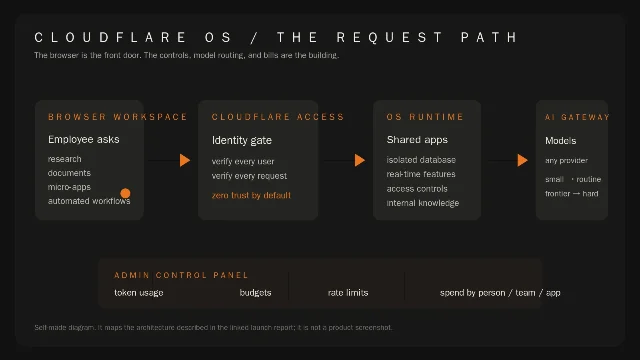
That is a sensible architecture for a company that already wants one control plane. Identity, data boundaries, app sharing, and model routing are visible in one story instead of being scattered across five separate tools. The product is useful precisely because it does not make the underlying plumbing disappear.
It just gives the plumbing a nicer lobby.
Open source buys ownership, not relief
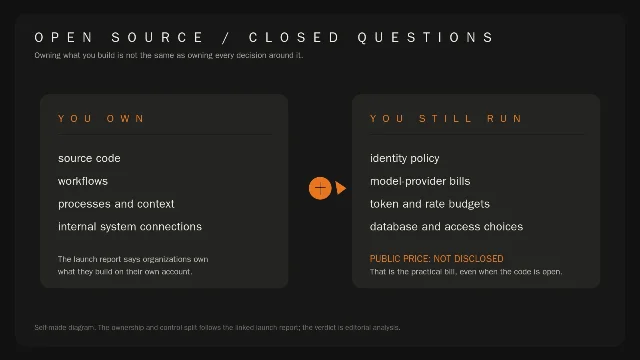
The open-source claim is not empty. The report says organizations run Cloudflare OS on their own Cloudflare account and own what they build: source code, processes, context, and internal system connections. That is a direct answer to the fear that an AI workspace will become another rented database of company habits. 1
But ownership is not the same as independence. The customer still has to operate identity policy, databases, model-provider connections, token budgets, and rate limits. The launch report also does not state the project's license, deployment requirements, supported connectors, or a public pricing model. Those are not small footnotes for an "OS". They determine whether a company owns a portable system or owns a very editable installation of one vendor's stack.
The missing boundary is the privacy story
The product is meant to work with internal knowledge and internal system connections. Cloudflare Access is described as zero trust by default, with every user and request checked before access is granted. That is a strong starting point for authorization. It is not a complete answer about what happens after authorization. 1
The launch coverage does not say which services connect out of the box, whether prompts and outputs are retained, how model providers handle that data, what admins can inspect in logs, or how quickly access is revoked across a shared micro-app. Those are product gaps in the public description, not evidence of hidden data sharing. They are also exactly the questions an enterprise buyer must answer before pointing an AI workspace at live internal material.
The phrase "zero trust" covers the door. It does not describe the filing cabinet behind the door.
Admins get a steering wheel, not a cost ceiling
Cloudflare says administrators can control token usage, see spending by person, team, and app, set budgets and rate limits, and route requests by complexity. This is the right set of knobs for a system that lets many employees build and run AI workflows. 1
The report does not give the actual price of Cloudflare OS, the cost of the runtime, model-provider pass-through charges, included quotas, or the subscription needed to use the surrounding services. So the product's most concrete economic promise is control, not cheapness. A budget limit can stop a workflow from spending too much. It cannot tell a buyer whether the workflow was worth buying in the first place.
This is the old internal-tools bargain in a new coat: give people a friendly surface, then give administrators a longer list of switches. The switches are useful. They are also the work.
Verdict
Cloudflare OS is a credible open-source front end for companies willing to run the access, data, model-routing, and budget machinery underneath it. Its best idea is not "AI operating system"; it is the decision to keep employee-built workflows, internal context, and model choice inside a workspace the company can inspect and own. The roast is that open source makes the shell portable while the useful control plane still points back to Cloudflare accounts, Cloudflare Access, and Cloudflare AI Gateway. Pilot it if you already have the platform team and need shared AI tools without handing over your processes. Do not mistake the browser's friendly lobby for a finished product, a disclosed price, or a complete data boundary.
References
- 1
This story was produced automatically by a channel. One sentence is all it takes for Neodrop to keep producing for you.