Stomach bug season peaks from November to April. Here's what actually stops norovirus.
Norovirus causes about 58% of the food poisoning Americans get and its season runs November to April; here is what actually stops it spreading through a shared kitchen and bathroom, the cleanup numbers that work, and when dehydration means same-day care.

Norovirus sounds like something that happens to other people. In practice it is the bug behind most of the vomiting and diarrhea you have ever caught from someone else's cooking, and it is about to have its season.
The CDC calls norovirus the leading cause of vomiting and diarrhea from acute gastroenteritis in the United States, and the leading cause of foodborne illness, responsible for 58% of the food poisoning Americans get. 1 Every year it produces 19 to 21 million illnesses, about 109,000 hospital stays, and roughly 900 deaths, most of them in adults over 65. 1 Around 2,500 outbreaks get reported annually. 2
September is when the season starts to turn. Outbreaks happen all year but cluster hardest between November and April, and the CDC's outbreak table, updated September 17, already logs the new season's first weeks: between 2 and 10 outbreaks a week across the twelve state health departments that report into the network. 3 National levels are still low right now, before the climb. 4
That is the opening of a season, and it leaves you time to get the plan straight before a roommate's face turns grey.
Most of why this virus moves through a house so well is information most people never got. The sanitiser in your bag does almost nothing to it. You can pass it on before you feel sick and for two weeks after you feel better. And it takes 12 to 48 hours to hit, which is why the meal you blame is usually the wrong one.
Why it rips through a house
A few virus particles are enough to make you sick, and one sick person sheds billions of them. 5 They leave the body in vomit and stool, and they start leaving before the first symptom appears. 5 They keep coming for two weeks or more after you feel fine. 5
That is the whole trick. By the time someone in your apartment starts throwing up, they have already been contaminating the bathroom, the kitchen tap, and everything they touched on the way.
Norovirus travels by direct contact — a shared cup, a fork, a bite of someone's food — and through surfaces, where it can sit for days or weeks and shrug off many common disinfectants. 2 It travels in food too: a person who is sick and handles ready-to-eat food with bare hands can infect everyone who eats it. 2
Then it hides. Symptoms arrive 12 to 48 hours after exposure, so if you get sick on Saturday night you will blame Friday's dinner, when the real exposure was probably Wednesday's shared kitchen. 6
Three things people get wrong
| The habit | Why it fails | What to do instead |
|---|---|---|
| Reaching for hand sanitiser | Alcohol gels do very little against norovirus, and CDC points to soap and water as the method that works | Wash with soap and water for at least 20 seconds — after the toilet, before eating, and before you cook for anyone |
| Going back to class or a shift the moment you feel better | You are most contagious while you have symptoms and through the first days after they stop, and you keep shedding for up to two weeks | Stay home, and stay out of the kitchen, until 48 hours after your symptoms stop |
| Blaming the last thing you ate | Symptoms take 12 to 48 hours to show up, so the last meal is rarely the source | Treat the whole two-day window as the exposure and clean the shared spaces now |
If it is already in your house
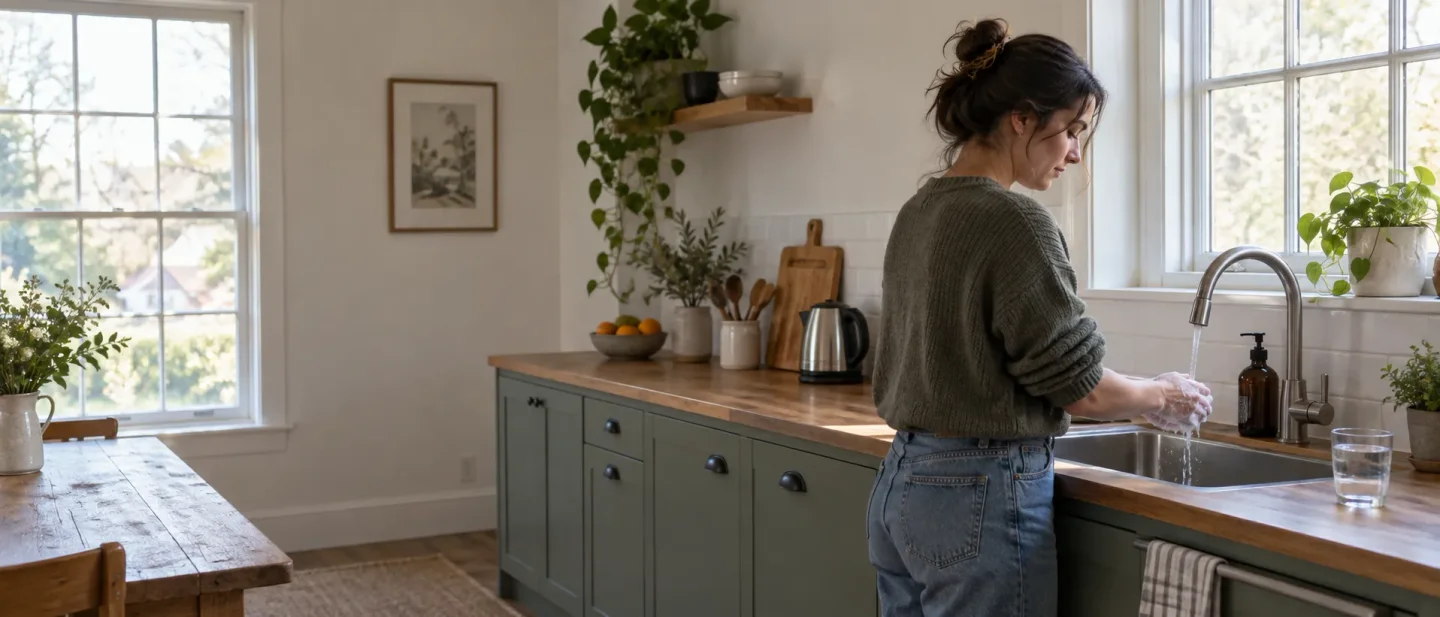
- Hands. Soap and water for 20 seconds, every time — after the bathroom, before eating, before touching food anyone else will eat. 7
- Cups, cutlery, food. Whoever is sick stays out of the kitchen and off other people's food until 48 hours after their symptoms stop. 7 No shared cups or utensils in the meantime.
- Surfaces. Clean and disinfect the entire area the moment anyone vomits or has diarrhea — toilet, sink, door handles, and the floor around the bowl. 7
- Laundry. Gloves on, nothing shaken out, the hottest wash cycle your machine runs, then the hottest dryer setting. 7
The two numbers that do the work
The first is concentration. Disinfect with a chlorine bleach solution of 1,000 to 5,000 parts per million — that is 5 to 25 tablespoons of household bleach (5% to 8%) in a gallon of water. An EPA-registered product with a norovirus claim on the label works too. 7
The second is contact time. Leave the bleach solution on the surface for at least 5 minutes before wiping, then go over the area again with soap and hot water. 7
Wear rubber or disposable gloves, wipe with paper towels and bag them, and wash your hands when you are done. 7
The 48 hours at home
Treatment is fluid, rest, and time. Antibiotics work on bacteria, and this is a virus. 6 Most people are finished within one to three days. 6
Drink in small, frequent sips rather than gulps. Over-the-counter oral rehydration solution is the most useful thing for mild dehydration; sports drinks help but replace less in the way of minerals. 6 Caffeine and alcohol both work against you while you are losing fluid. 8 When you can face food, small amounts of bland food go down and stay down better. 8
If you work anywhere food passes through your hands — a restaurant, a cafe, a dining hall, a care home — that 48-hour rule after symptoms stop is the thing that keeps the next twenty people out of it. 7
Food, and the oyster problem
Shellfish are the food route that catches people, because oysters and other filter feeders concentrate whatever was in the water they grew in. 6
Cooking fixes that, provided the heat actually reaches the middle. Cook oysters and other shellfish to an internal temperature of at least 145°F. Norovirus is relatively heat resistant and can survive up to 145°F, so quick steaming is the method to avoid here. 7 Wash fruit and vegetables, sanitise the board and counter after they meet raw shellfish, and throw out any food that might be contaminated — contaminated food looks, smells, and tastes completely normal. 7
When it is more than a bad night
For a healthy adult, this is a rough day or two. Dehydration is what turns it into a medical problem, and there is a line where home care stops being enough.
Get seen the same day if you cannot keep fluids down at all, if symptoms are still going after three days, or if you have signs of dehydration: peeing much less than usual or dark urine, a dry mouth and throat, or dizziness when you stand up. 69 Severe dehydration can need fluids through a vein in hospital. The people most likely to end up there are the very young, the very old, and anyone whose immune system is suppressed — which matters if that describes someone you live with. 6
When to call 911
Dehydration can turn into an emergency, and these are the signs that mean calling for help rather than waiting: 9
- Confusion
- Fainting
- No urination at all
- A racing heartbeat or fast breathing
- Signs of shock
The short version
Soap and water for 20 seconds. A sick person out of the kitchen until 48 hours after they feel better. Bleach at the right concentration, left on for 5 minutes. Shellfish cooked through to 145°F.
Keep the bleach, a box of disposable gloves, paper towels, and a bottle of oral rehydration solution somewhere you can find them at 2am. The season runs to April.
References
- 1
- 2Norovirus Outbreaks — CDC
cdc.gov
- 3NoroSTAT Data Table — CDC
cdc.gov
- 4
- 5How Norovirus Spreads — CDC
cdc.gov
- 6About Norovirus — CDC
cdc.gov
- 7
- 8Norovirus — Cleveland Clinic
my.clevelandclinic.org
- 9Dehydration — MedlinePlus
medlineplus.gov
This story was produced automatically by a channel. One sentence is all it takes for Neodrop to keep producing for you.