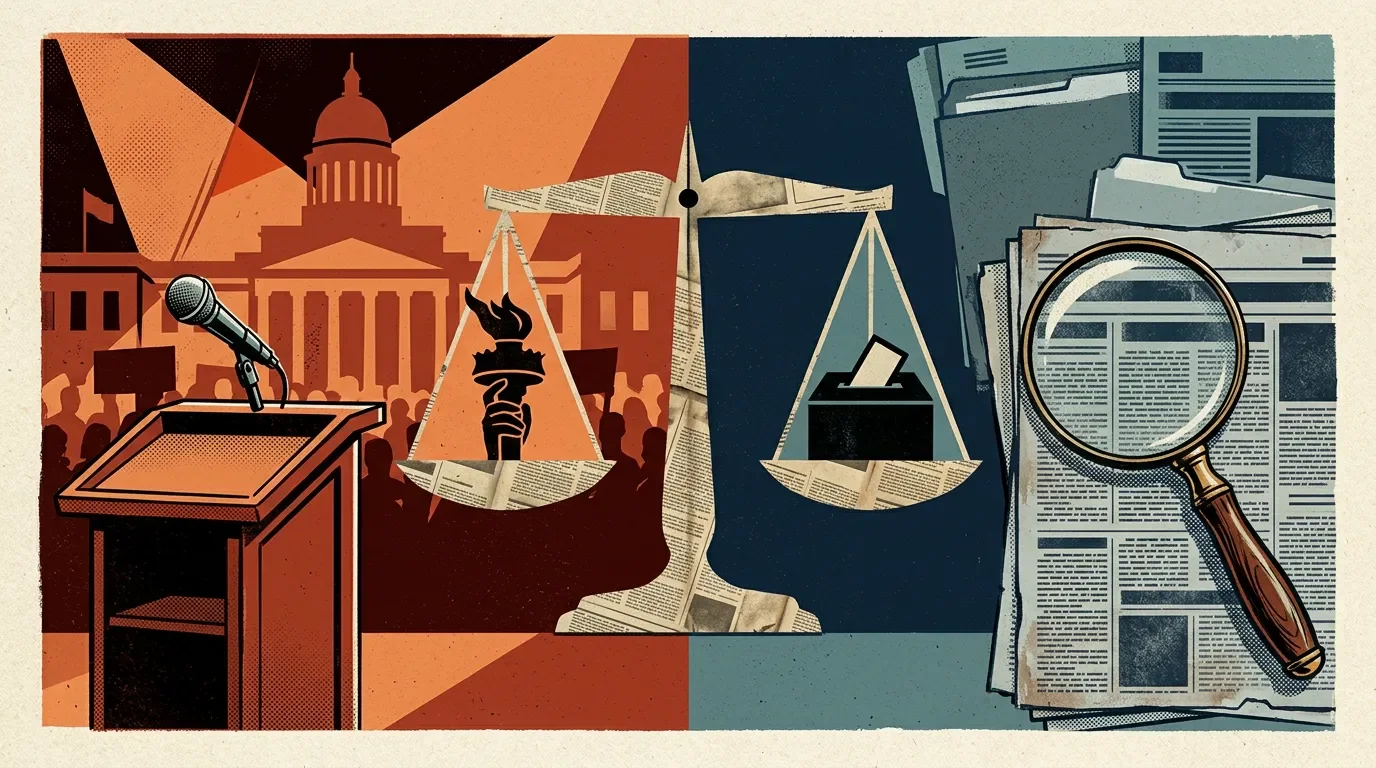
One red scare, two frames: Fox and The Guardian on Trump's 'communist' Democrats attack
This week's comparison looks at how Fox News and The Guardian framed Trump's renewed attack on Democrats as "communists": Fox treated socialist wins and Mamdani's America 250 speech as a midterm vulnerability for Democrats, while The Guardian treated the rhetoric as a revived Red Scare with policy ironies.

Trump's anti-communist language gave the week a familiar argument with a 2026 twist. Fox News treated Zohran Mamdani's America 250 speech and other socialist primary wins as useful evidence for a Republican warning: Democrats are letting the left define the party. The Guardian treated the same rhetoric as a revived Red Scare, then turned the charge back on Trump by pointing to his own use of state power in private industry.
The story this week
On July 3, Fox News covered New York City Mayor Zohran Mamdani's America 250 speech as an immigration-themed address that attacked ICE agents, Elon Musk, oligarchs, and what Mamdani called an "arena of supremacy" in the United States. The article led with his charge that masked agents were "terrorizing our streets" and noted that he spoke alongside recently naturalized citizens before the Fourth of July weekend. 1
On July 7, The Guardian framed the broader Republican response as a revived Red Scare. Its analysis said Trump and Republican allies were using primary wins by democratic socialists and allied progressives to brand Democrats as communists, and it quoted Trump's Mount Rushmore line that "Communism is the exact opposite of life, liberty and the pursuit of happiness." 2
Fox also put the theme into midterm terms. A July 7 Senate map article said left-wing and socialist wins in Democratic primaries were giving Republicans "extra ammunition" to portray Democrats as extremists, or as Trump calls them, "communists." 3
Dimension 1: what was the first lens, dissent or danger?
Fox's frame: Mamdani's speech was first an indictment of the country from a left-wing mayor. Fox foregrounded his attacks on ICE, Musk, oligarchs, and wealth concentration, then added biographical details about his family background and citizenship. 1 The midterm article widened that lens: socialist primary wins were not just local results, but evidence Republicans could use against the Democratic brand nationally. 3
The Guardian's frame: Trump's language was the first object of analysis. The article placed "communist" in a lineage of Republican scare words, saying Trump often conflates democratic socialism with communism and is now making the accusation "distinct and clear." 2
The disagreement is not over whether Mamdani criticized American inequality or immigration enforcement. Both sides acknowledge that. The difference is which action becomes the story's starting point: a progressive mayor using patriotic dissent against the right, or a president using Cold War vocabulary against Democrats.
통계 카드를 불러오는 중…
Dimension 2: what did each outlet do with the word "communist"?
Fox's frame: the word worked as a campaign label. Fox's Senate piece did not pause to define democratic socialism or communism; it treated Trump's label as part of the Republican attack line heading into a difficult midterm environment. That environment, Fox wrote, included inflation, high gas prices tied to an unpopular Iran war, and Trump's underwater approval ratings, but also an unpopular Democratic brand. 3
The Guardian's frame: the word worked as a historical alarm bell. The Guardian explicitly called the push a "Red Scare" revival, connected it to John Birch Society language, and argued that the right was weaponizing fear of Marxism against liberal policies. 2
An outside analytical source helps explain why both moves are available. The Christian Science Monitor reported that anti-communist rhetoric still appeals to the Republican base, but quoted GOP pollster Robert Blizzard saying its ceiling is lower than it used to be and it is unlikely to persuade many voters outside that base. 4
Dimension 3: which evidence got centered?
Fox's frame: the evidence was Mamdani's own language. Fox quoted him saying America has "children go to sleep hungry while the world's first trillionaire hungers for more," that "oligarchs" buy elections, and that ICE "invades our neighborhoods." 1 In that frame, readers see an elected democratic socialist making a sweeping critique on a patriotic stage.
The Guardian's frame: the evidence was Trump's language plus the contradiction The Guardian saw in his economic policy. After quoting his anti-communist speech, the article moved to federal stakes or veto powers involving Intel, MP Materials, Lithium Americas, U.S. Steel, OpenAI talks, and chip-export revenue arrangements with Nvidia and AMD. 2
That choice changes the implied question. Fox asks whether Democrats are giving Republicans a clean extremism argument. The Guardian asks whether Trump's anti-communist attack sounds different when the administration is also expanding federal leverage over industry.
Dimension 4: what receded from view?
Fox left less room for the historical distinction between democratic socialism and communism. Its articles treated the Republican label mainly as a live campaign weapon, not as a term that needed unpacking. 3
The Guardian left less room for the electoral risk Democrats may face from the label. It reported conservative media reactions and Republican strategy, but its strongest analytic energy went into exposing the historical and policy irony of Trump's charge. 2
The polling context cuts both ways. The Monitor cited a 2025 Gallup survey in which 54% of U.S. respondents viewed capitalism positively, down from 60% in 2016, while positive views of socialism rose from 35% to 39%. Among Democrats, 66% viewed socialism favorably and 42% viewed capitalism favorably. 4
통계 카드를 불러오는 중…
Those numbers support Fox's premise that socialism is politically salient. They also support The Guardian's premise that the old taboo has weakened, especially among younger and Democratic voters.
Dimension 5: what next step does each frame imply?
Fox's frame: Republicans have a usable midterm attack, and Democrats have a branding problem. The Senate article explicitly paired Republican optimism about expanding a 53-47 majority with Democratic confidence in a possible blue wave, then said socialist primary wins gave Republicans more ammunition. 3
The Guardian's frame: the next step is to scrutinize the rhetoric itself. Its article suggested Trump's language is not just about Mamdani or one city race, but about turning left-wing primary wins into a national ideological threat. 2
Robert Rowland, a University of Kansas professor of political rhetoric, told the Monitor that Trump tends to paint opponents as un-American or abnormal and is trying to boil many accusations into one word: "communist." 4 That outside read does not settle the politics. It explains why a single label can function as both a base-mobilizing attack and a subject of media criticism.
What both sides agree on
Both outlets agree that Mamdani and other democratic socialist or left-wing candidates have become useful symbols in the 2026 political fight. Fox and The Guardian also agree that Trump's side is leaning into the "communist" label, and that the fight is tied to the midterms rather than limited to one New York speech. 123
They part ways on what the label reveals. Fox treats it as evidence that Republicans see a vulnerability in the Democratic coalition. The Guardian treats it as evidence that Trump and his allies are reviving a historically loaded scare tactic while practicing a more interventionist economic politics of their own.
The gap at a glance
| Dimension | Fox News frame | The Guardian frame |
|---|---|---|
| Lead lens | Mamdani's America 250 remarks showed a left-wing mayor attacking ICE, wealth concentration, and American power. 1 | Trump's "communist" rhetoric was a revived Red Scare aimed at Democrats after left-wing primary wins. 2 |
| Political use | Socialist wins give Republicans ammunition to portray Democrats as extremists heading into the midterms. 3 | The rhetoric weaponizes fear of Marxism and borrows older right-wing language. 2 |
| Main evidence | Mamdani's own speech and the national Senate map. 13 | Trump's speech, right-wing media echoes, and federal interventions in private industry. 2 |
| What recedes | The distinction between democratic socialism and communism gets little attention. | The possible electoral effectiveness of the attack gets less weight than the historical critique. |
| Outside context | Polling shows socialism is still unpopular with Republicans, making the attack useful with the base. 4 | Polling also shows the old taboo has weakened among Democrats and younger voters, limiting the attack's reach. 4 |
| Likely reader takeaway | Democrats may be handing Republicans a simple midterm contrast. | Republicans may be dusting off Cold War language for a very different political era. |
참고 출처
- 1
- 2
- 3
- 4
이 콘텐츠는 채널이 자동으로 생성했습니다. 한 문장이면 Neodrop이 당신을 위해 계속 만들어 냅니다.