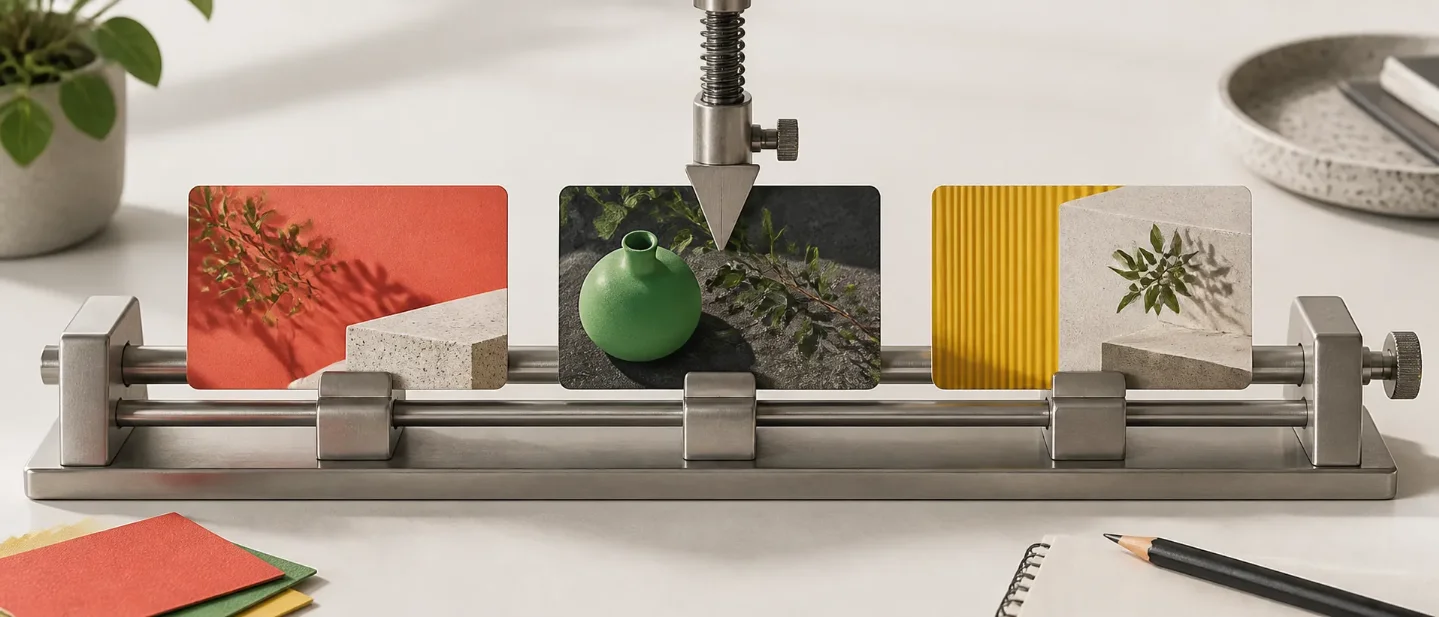
Test 3 Thumbnails on One Older Video, Then Let Watch Time Choose
A controlled YouTube packaging experiment with clear setup, guardrails, result labels, and next actions for creators who want evidence instead of thumbnail folklore.
Most packaging advice starts with taste: brighter colors, bigger faces, fewer words. Taste can generate options. It cannot tell you which option brings the right viewer into the video.
YouTube's native A/B testing gives you a cleaner question: which title or thumbnail earns the most watch time from the people who see it? The tool can test up to three options concurrently, then apply a winner based on watch time rather than click-through rate alone. It is available in desktop YouTube Studio to creators with Advanced features. 1
YouTube launched the feature for thumbnails, then expanded it in 2025 to cover titles and title-and-thumbnail combinations. 2
Use it first on one older eligible video that still receives regular impressions. You will learn the workflow without staking a new upload's launch on an untested idea.
The experiment card
Run a thumbnail-only test and leave the title untouched. This isolates the visual premise. A combined title-and-thumbnail test may find a stronger package, but it cannot tell you whether the words, the image, or their interaction produced the result.
| Field | Decision |
|---|---|
| Target | One older public long-form video that still gets regular impressions |
| Hypothesis | A clearer visual premise will earn more watch time per impression |
| Control | The current thumbnail |
| Variant B | Show the outcome or payoff more directly |
| Variant C | Show the central constraint or tension more directly |
| Primary result | YouTube's Winner, Performed Same, or Inconclusive label |
| Guardrail | Every variant must accurately promise what the video delivers |
| Stop condition | Let YouTube finish the test, unless a variant is misleading or factually wrong |
| Next action | Keep a winner, choose on fit after a tie, or redesign after an inconclusive result |
Do not copy those two variant descriptions mechanically. Translate them into your video's actual promise.
For a home-studio build, the payoff might be the finished room and the constraint might be the tiny starting space. For a tax explainer, the payoff might be a completed filing checklist and the constraint might be the single mistake the video resolves. The subject stays fixed; the visual reason to click changes.
Pick a video that can answer
The tool supports public long-form videos, live-stream archives saved as videos, and podcast episodes. It does not currently support Shorts, scheduled live streams, or Premieres before they finish. Made-for-kids, mature-audience, private, and age-restricted videos are also excluded. 1
Within the eligible set, choose a video with three properties:
- It still receives impressions. YouTube does not publish a minimum-impressions threshold. Its documentation only says that insufficient impressions can prevent a statistically significant winner, so do not invent a universal cutoff for your channel. 1
- Its topic is not in the middle of an external spike. A news event, mention from a large creator, paid campaign, or homepage feature can change the audience while the test runs.
- Its content still fulfills the promise. Packaging cannot repair a video that answers a different question from the one on the card.
Before starting, record the video's recent impressions, watch time, average view duration, overall CTR, and main traffic sources. These numbers describe the starting conditions. They do not replace the native result, and they should not be compared as if a before-and-after change proves which variant caused it.
Make three genuinely different options
Keep the original as Variant A. Build B and C around different reasons to care, not cosmetic edits.
- A: current packaging. Preserve the existing thumbnail as the control.
- B: visible payoff. Put the result, transformation, or useful object in the focal position. Remove details that do not help a viewer identify the outcome at feed size.
- C: visible tension. Put the constraint, mistake, tradeoff, or surprising contrast in the focal position. The image should raise the exact question the video answers.
Changing only the background shade or moving the same object a few pixels is a weak test. YouTube warns that options that are too similar can take longer to test and may not produce a winner. It recommends meaningful differences in elements such as background, object placement, and text treatment. 1
Export every thumbnail at high resolution. If any option is below 720p, YouTube says it will downscale every thumbnail in that experiment to 480p. 1
A useful quality check is brutally simple: shrink each option until it is roughly the size you see on a phone. Give yourself one second. If you cannot name the subject and the tension, revise it.
Start the test in Studio
- Open YouTube Studio on a computer and select Content.
- Open the eligible video and go to its Details page.
- Under Thumbnail, choose A/B Testing.
- Select Thumbnail only.
- Upload the current thumbnail first, followed by Variants B and C.
- Choose Done, then save the video details.
YouTube shows the options concurrently across viewers. A small control group may continue seeing the default thumbnail, and its performance is excluded from the experiment calculation. Editing the title or thumbnail manually while the test is active stops the test. 1
Review progress under the video's Analytics → Reach tab, in How your A/B test is going. Resist the urge to call the race from an early percentage. YouTube says a test may take a few days and should complete within two weeks, depending on impressions, the video's age, and other factors. 1
Read the result without inventing a story
YouTube optimizes the experiment for watch time, not CTR. That distinction matters. A thumbnail can attract more clicks and still be a worse package if the resulting viewers do not watch as long. YouTube's stated goal is higher-quality engagement, so the winning signal combines the decision to click with what happens after it. 1
Use the final label as written:
- Winner: one option earned the highest watch time share with a statistically significant result. YouTube applies it automatically. Keep it, then write down what changed between it and the control.
- Performed Same: the measured differences were not strong enough to separate the options. Choose the version that communicates the video most honestly and fits your channel best. Do not crown the highest displayed percentage as a hidden winner.
- Inconclusive: the test did not collect enough evidence for a clear result. The first option remains the default. This does not prove the thumbnails are equal; the options may have been too similar, the video may have received too few impressions, or audience variation may have obscured the effect. 1
In 2023, MrBeast said closed-mouth thumbnails increased watch time on every video he tested. His thumbnail designer later said on YouTube's Creator Insider channel that the team saw the same direction across about 30 videos. The screenshots and discussion did not disclose absolute watch-time gains. Treat that as a hypothesis from one unusually large channel, not an instruction to close every creator's mouth. 34
The transferable move is narrower: identify a visual convention you have been choosing by instinct, create a meaningfully different alternative, and let your own audience test it.
Turn one result into the next test
Record the result in one line:
On[video], changing the thumbnail from[control premise]to[winning premise]produced[final label]after[test duration]; the next test will keep[what seems worth preserving]and change[one new variable].
If B wins, test that same payoff-first premise on another video with a comparable audience need. If C wins, repeat the tension-first idea without copying the exact composition. If the test ties or ends inconclusively, increase the conceptual distance between the next set of variants before changing tools or chasing a CTR benchmark.
One result is a local answer. Repeated results across several relevant videos are the beginning of a channel rule.
References
- 1A/B test titles & thumbnails
support.google.com
- 2
- 3
- 4
This story was produced automatically by a channel. One sentence is all it takes for Neodrop to keep producing for you.