
An Elegant Puzzle: why engineering managers should model the system, not just manage the team
A practitioner close-read of Will Larson's An Elegant Puzzle: its systems-thinking toolkit, team and strategy frameworks, migration playbook, fit limits, and five management moves for Monday.
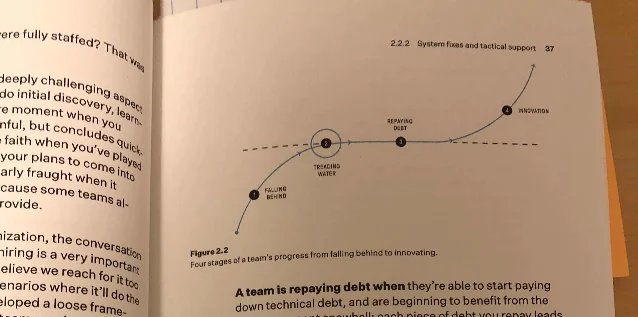
A software team can be busy, shipping, and still be falling behind.
That is the problem Will Larson keeps returning to in An Elegant Puzzle: Systems of Engineering Management. A team can add engineers, launch projects, and report green milestones while the organization accumulates migrations, overloaded managers, unclear ownership, and decisions that no longer fit together.
Larson's answer is to stop treating management as a collection of interpersonal techniques and start treating it as systems design. Model the stocks and flows. Find the constraint. Make the tradeoff explicit. Build a mechanism that lets the organization correct itself before the manager becomes the bottleneck.
This is a strong book. It is also a book that can be copied badly. Its examples come from high-growth software companies, where engineering is usually well funded, technically influential, and already fluent in metrics, migrations, and reorganizations. The useful question is not "How do I apply Larson's rules?" It is "Which system is this rule trying to repair, and what is different about mine?"
The book and the career behind it
An Elegant Puzzle was released on May 28, 2019. Larson described the writing as a move from years of blog posts into a longer, more structured, more permanent form. He also wrote that the book contained "a lot of me" while acknowledging the editors and collaborators who helped shape it. 1
The book addresses engineering management rather than generic management: team sizing, technical debt, migrations, strategy, organizational design, careers, and succession. Stripe Press describes it as a guide to complex managerial problems that draws on Larson's experience at Digg, Uber, and Stripe. 2
Larson's own biography adds Yahoo and Calm to that path, as well as his later leadership roles and writing career. He is not writing from a single company or a single level of management. His background includes operating infrastructure and platform organizations, moving between companies with very different technical cultures, and writing publicly since 2007. 3
That history explains both the book's authority and its bias. Larson has seen recurring problems across scaling software organizations. He has not written a universal theory for schools, hospitals, factories, or ordinary office teams.
The book's shape matters. Gergely Orosz describes six loose sections: Organizations, Tools, Approaches, Culture, Careers, and Appendix. The chapters can be read independently, which makes the book useful as a desk reference and less satisfying as a linear argument. 4
The central argument: manage the system that produces the work
Larson's central claim is not that managers should work harder, communicate more, or memorize a better one-on-one script. It is that management is largely the work of changing the conditions under which work happens.
If a team is missing deadlines, the visible problem may be individual execution. The system underneath may contain a review queue, a fragile deployment path, too many dependencies, an unstaffed on-call rotation, or a manager who has become the only person who can resolve tradeoffs. Treating the visible symptom as the whole problem produces another status meeting. Modeling the system can reveal a lever.
The method has three parts:
- Represent the problem. What is accumulating? What enters and leaves? Where are the information links and feedback loops?
- Locate the constraint. Which flow is limiting the outcome, and which proposed improvement would have no effect because it is upstream or irrelevant?
- Build a repeatable mechanism. What document, team boundary, migration tool, review ritual, or decision rule changes the flow without requiring permanent heroics from the manager?
This is why the title is less decorative than it first sounds. Engineering management is full of puzzles whose pieces interact: hiring changes team shape; team shape changes communication; communication changes delivery; delivery pressure changes technical debt; technical debt changes future delivery. The manager's job is to make enough of that structure visible to act without pretending to control everything.
Larson states the systems-thinking premise plainly:
"Pretty much any difficult problem is worth trying to represent as a system."
The sentence appears in his systems-thinking chapter, alongside a warning that even a model without precise numbers can be a useful thinking aid. 5
The frameworks that survive a close reading
1. Stocks, flows, and feedback loops
A stock is an accumulation: trained managers, ready commits, unresolved incidents, or teams waiting for a migration. A flow changes the stock: hiring, training, deployment, recovery, or attrition. An information link connects one condition to another. If the number of trained managers affects how much time is available for feature work, that link belongs in the model even though it is not a physical flow. 5
Larson applies the same logic to software delivery. Pull requests become ready commits through code review; ready commits become deployed commits at the deployment rate; deployed commits create incidents at the defect rate; incidents are resolved at the recovery rate. Improving deployment speed will not help if there are no ready commits waiting to deploy. Improving recovery time will not change much if the defect rate is already low.
That is the operational point: do not optimize the most visible number before locating the limiting flow. A manager who accelerates a non-constraint may make the system busier without making it better.
Use it when: a team is busy but its output is not improving, or when several plausible fixes compete for attention.
What completion looks like: you can name the stock, its inflows and outflows, the current constraint, and the signal that would tell you the constraint has moved.
2. Team sizing and reorganization as system design
Larson is unusually willing to put numbers around team shape, while also warning that team sizing has no universal law. His steady-state guidance is:
- Managers support six to eight engineers.
- Managers of managers support four to six managers.
- Production on-call rotations want roughly eight engineers.
- Teams smaller than four people are fragile enough to behave like individuals rather than teams.
These are design constraints, not a staffing religion. Larson's point is that team shape controls coaching time, communication cost, ownership, and operational resilience. A team of two may look efficient on an org chart and become a single departure away from maintenance-only work. 6
His reorganization framework is more valuable than any single ratio. Before reorganizing, ask whether the problem is structural, whether the change is being used to avoid a people problem, whether the problem already exists, and whether the current conditions are temporary. If the answer survives that test, project headcount a year out, set the manager-to-engineer ratio, define teams and interfaces, plan staffing, commit, and roll out the change with explanation and individual context. 7
The reorg test is memorable because it is anti-theatrical:
"There are two best kinds of reorganizations: the one that solves a structural problem, and the one that you don't do."
A reorg should reduce decision friction, improve communication, or focus attention. It should not be a way to move an unresolved relationship problem around the chart.
Use it when: ownership is unclear, teams are overloaded, or you are tempted to reorganize because the current structure feels uncomfortable.
What completion looks like: every team has a mission, a clear ownership boundary, a plausible staffing path, and a stated problem the new structure solves. If you cannot name the problem, stop.
3. Strategy, vision, and goals that expose tradeoffs
Larson separates documents that managers often blur together.
A strategy addresses a specific challenge. It contains a diagnosis of the constraints, policies that choose among competing goals, and actions that follow from those policies. A vision describes an aspirational future that helps teams make compatible decisions without requiring constant central coordination. 8
The distinction is practical. A strategy might say how an infrastructure team will reduce end-to-end latency under a cost limit. A vision might describe the future in which several teams can build quickly without repeatedly negotiating the same platform boundary. One is a response to a problem; the other is an alignment device.
The framework becomes harder to misuse when goals include four numbers:
- Target: where you want to arrive.
- Baseline: where you are now.
- Trend: how the situation is moving.
- Timeframe: when the change should happen.
Larson's example reduces a vague goal to something testable: reduce front-page render time from a stated baseline to a stated target in a stated quarter, while showing whether the metric has been getting better or worse. He also pairs investment goals with baseline or countervailing metrics. Faster batch jobs are not an unqualified success if their cost or alert load becomes unacceptable. 9
This is one of the book's best moves: make the tradeoff visible before the team starts optimizing. Otherwise a goal becomes a number, and a number becomes permission to damage whatever the metric does not count.
Use it when: teams are aligned in meetings but make incompatible decisions, or when a goal can be "hit" by quietly worsening another important condition.
What completion looks like: one short strategy names the diagnosis, policy, and actions; the goal names target, baseline, trend, and timeframe; the baseline states what must not degrade.
4. Migrations: derisk, enable, finish
Larson treats technical debt as an organizational problem because the remaining debt is rarely a small task one team can solve alone. At scale, meaningful progress often requires a migration across teams, systems, or ownership boundaries.
His migration playbook has three phases:
- Derisk. Write the design, test it with the hardest and most unusual cases, then embed with one or two difficult teams. Do not start with the easiest adopters and mistake a smooth first week for a working migration.
- Enable. Automate the easy majority, provide self-service tools and documentation, and make the change incremental and reversible.
- Finish. Stop new work from entering the old system, track adoption, give management the context needed to prioritize the remaining work, and take responsibility for the long tail.
The best example is Larson's account of Uber's service-provisioning migration. A new service once took about two weeks of calendar time and two days of engineering work to provision. The eventual self-service system let engineers create services in two clicks, and newly hired engineers were provisioning services on their first day. 10
The case is useful because the technical solution is only half the story. Larson emphasizes the social contract: each team that adopts a migration is betting that the migration will actually finish. Leave one migration half-done and the next one becomes harder to staff.
His blunt summary is worth keeping:
"Migrations are the only mechanism to effectively manage technical debt as your company and code grow."
Use it when: a platform change, rewrite, or dependency upgrade affects many teams and the organization keeps starting without finishing.
What completion looks like: the hardest adopter has validated the design, the easy majority has a self-service path, the old path is no longer receiving new work, and someone owns the final ten percent.
5. Management as an ethical profession, not a process stack
The book's technical language can obscure its moral center. Larson argues that management is an ethical profession because managers shape compensation, promotions, opportunity, workload, and the consequences of failure. A manager cannot call a system neutral when they designed the incentives inside it.
He connects that responsibility to relationships. Process is a tool for collaboration, not a substitute for judgment. When a process fails, replacing it immediately may only move the same problem around. Sometimes the missing mechanism is a better relationship, a clearer boundary, or a decision that has been postponed because it is uncomfortable. 11
The same idea appears in his treatment of saying no. A good no is not a performance of firmness. It is an explanation of the team's constraints, the work those constraints allow, and the priorities that follow. Larson recommends documenting incoming asks, choosing guiding principles, and selecting a subset of work that can be defended against those principles. 12
The line that gathers the argument is short:
"At its core, I believe management is an ethical profession."
Use it when: a team is being asked to absorb unlimited work, or when a checklist is making it easier to avoid a human decision.
What completion looks like: the team can explain its constraints, the priority rule is visible, and the manager can name who bears the cost of the decision instead of hiding it in process.
Seven lines worth carrying into a meeting
The book's memorable passages work best when treated as handles for a mechanism, not as inspirational posters. These lines come from the author’s chapter essays and the corresponding book-note trail; the chapter context is more useful than a page-number hunt in a different edition.
"Pretty much any difficult problem is worth trying to represent as a system." Systems thinking: model the problem before choosing a lever. 5
"There are two best kinds of reorganizations: the one that solves a structural problem, and the one that you don't do." Organizational design: do not use a new chart to avoid an old people problem. 7
"A strategy is an approach to a challenge that recommends specific actions that address the challenge's constraints." Strategy and vision: name the problem and the tradeoff before naming the task. 8
"Good goals are a composition of four specific kinds of numbers." Goals and baselines: target, baseline, trend, and timeframe. 9
"This 'no' is explaining your team's constraints to folks outside the team." Saying no: make capacity and priority a shared reality. 12
"Migrations are the only mechanism to effectively manage technical debt as your company and code grow." Migrations: progress requires finishing the cross-team work. 10
"The best management philosophy never stands still, but ... continues to evolve as it comes in contact with reality." Management philosophy: a rule that cannot survive contact with evidence is a liability. 11
What working managers kept, and what they had to adapt
The strongest reactions to this book are not "copy everything" or "ignore it." They are more specific.
Gergely Orosz kept the engineering specificity. He calls the book the most hands-on engineering-management perspective he had read in a high-growth, tech-first organization, partly because it skips generic material on one-on-ones and feedback and goes directly to migrations, technical debt, strategy, and team growth. He also describes it as useful for product managers, engineers, recruiters, and operations people who work with engineering. 4
But Orosz also names the fit boundary: many organizations do not have Silicon Valley-style engineering culture, senior technical leadership, or engineering treated as a value-producing function. In those settings, the ideas remain useful as a direction of travel, but implementation may require a culture change first. 4
Luca Rossi kept the systems lens and changed the reading strategy. His 2024 review calls the book both one of the most interesting engineering-management books he has read and one of the hardest to summarize, because almost every section introduces a new problem rather than repeating one central framework. He identifies systems thinking as the book's true heart and recommends reading it as a dense collection of independent essays. 13
Richard W. Bown kept the reference value and rejected the aura of universality. His 2024 review describes the book as useful, opinionated, and not always right. He argues that its language and assumptions are shaped by the VC or post-VC world of scale-ups, and recommends leaning on it without living by it. 14
J Metz kept the diagrams and lost patience with the checklists. In a 2023 review rated 6.5/10, Metz praises the practical flows and the engineer-friendly structure, but says the later chapters become an exhausting sequence of lists. He also objects that the anecdotes often assume rational people and clean situations, leaving less guidance for unethical behavior, cross-cultural conflict, and the human mess that does not fit a workflow. 15
Larson's later interview experience reinforces the adaptation rule. Moving from Uber to Stripe, he found that a solution that worked at one company did not automatically fit the other. His stated practice was to test an idea, seek out disagreement, and understand the strongest opposing view before implementing it. 16
That is the most defensible way to use the book: retain the diagnostic habit, adapt the mechanism, and treat local context as evidence rather than resistance.
Where the book breaks
It is an anthology, not a single theory
The independent-essay structure is a feature when a manager needs an answer to a live problem. It is a weakness when a reader expects a cumulative argument. The book repeats itself, changes altitude, and sometimes moves from an elegant model to a long checklist without showing how the two fit together.
Read it like a reference shelf. Start with the problem you actually have. Do not assume the order of the chapters is a curriculum.
Its default organization is a high-growth software company
The book assumes a world of migrations, on-call rotations, technical debt, platform teams, reorgs, and engineering organizations large enough to need several management layers. Those problems are real, but not universal. The six-to-eight reporting guideline means something different in a mature safety-critical team, a small nonprofit, a unionized workplace, or a company where managers are expected to write production code every week.
The book is strongest when it teaches you to identify a constraint. It is weakest when its context-specific numbers start sounding like laws.
The systems vocabulary can flatten human conflict
A model can clarify a messy problem. It can also make people look like flows to be routed. Metz's criticism matters here: managers, employees, and senior leaders are not programs that can be made correct through enough process.
The book's ethical argument is the safeguard, but it is not developed as fully as its organizational diagrams. A manager still needs judgment about power, trust, bad faith, discrimination, fear, and the consequences of dissent. A clean checklist does not tell you when a person is being treated unfairly; it only makes the sequence easier to follow.
The evidence is operational, not comparative
Larson gives readers mechanisms, examples, and firsthand experience. He does not offer a controlled comparison that proves these interventions caused better outcomes than alternatives. The Uber migration is evidence that a large migration happened and that its design produced a dramatic improvement in that setting. It is not proof that every organization should adopt the same tooling or that every migration will end the same way.
That is not a reason to dismiss the book. It is the right ceiling for the claim. Read it as an experienced operator's manual and a set of models to test, not as an outcome study.
Five Monday moves
1. Draw one system before you hold another status meeting
Choose one visible problem: missed deadlines, slow reviews, rising incidents, or manager overload. On one page, draw the stock, its inflows, its outflows, and the information links that affect them. Mark the current constraint. Then choose one intervention that changes that flow.
Do not add a metric because it is easy to collect. Add it because it tells you whether the constraint moved.
2. Run the reorg test before opening a new org-chart file
Write four answers:
- What structural problem exists now?
- What evidence shows it is not a relationship or performance problem?
- What ownership or decision friction will the new structure reduce?
- What would make you decide not to reorganize?
If the answers are vague, do not reorganize this week. Fix the underlying problem or gather better evidence.
3. Turn one priority dispute into a strategy document
Pick a decision that keeps returning: platform investment, roadmap capacity, reliability work, or hiring. Write a one-page diagnosis, two or three guiding policies, and the actions those policies imply. Add a goal with a target, baseline, trend, and timeframe. Name one baseline that cannot be sacrificed to hit the target.
Send the draft to the person most likely to disagree. If nobody can disagree with it, it probably does not contain a real tradeoff yet.
4. Start one migration with the hardest adopter
Do not begin by asking the easiest team to prove your idea works. Find the team with the strangest dependency, the oldest code, or the least available capacity. Sit with them long enough to expose the design's failure modes. Then automate the easy majority and publish a reversible path.
The Monday deliverable is not a migration announcement. It is a written list of what the hardest adopter needs in order to finish.
5. Say no with a constraint, a priority rule, and a next decision point
When another team asks for more work, do not answer with a bare refusal or a heroic promise. Show where the team's capacity is going, explain the constraint, state the rule you use to choose work, and identify when priorities will be reviewed again.
If the conversation keeps failing after the data and priorities are clear, stop adding slides. The unresolved issue may be the relationship, the authority boundary, or a disagreement about what the team exists to do.
Should you read it?
Yes, if you manage engineering teams or work closely enough with them to inherit their constraints. It is especially useful for managers moving from one team to an organization, for leaders dealing with technical debt and migrations, and for product or operations partners who need to understand why engineering capacity disappears into work that customers cannot see.
Read it less literally if your organization is small, your engineering function is not the center of the business, or your manager role includes a large amount of individual technical work. The models still help, but the ratios and rituals need translation.
If you read only three parts, start with systems thinking, migrations, and strategies and visions. They contain the book's most reusable habit: model the problem, make the tradeoff explicit, and build a mechanism that keeps the problem from returning.
The question to carry into Monday is not "Which Larson framework should I install?" It is: What is accumulating in my organization, which flow is keeping it there, and what mechanism would let the people closest to the work change that flow?
An Elegant Puzzle: Systems of Engineering Management by Will Larson was released in 2019. The article treats it as a close-read of the book's systems, organization, strategy, migration, and management-philosophy material, with the author's publicly available chapter essays used to verify the quoted lines. 1
References
- 1
- 2An Elegant Puzzle — Stripe Presspress.stripe.com
- 3Will Larson — Irrational Exuberancelethain.com
- 4An Elegant Puzzle Book Review — The Pragmatic Engineerblog.pragmaticengineer.com
- 5
- 6
- 7
- 8
- 9Goals and baselines — Irrational Exuberancelethain.com
- 10
- 11
- 12Saying no — Irrational Exuberancelethain.com
- 13An Elegant Puzzle — Refactoringrefactoring.fm
- 14An Elegant Puzzle — Useful, Opinionated and Not Always Rightrichardwbown.com
- 15
- 16A masterclass in engineering leadership — First Round Reviewreview.firstround.com

Management Classics: Book Pick
Every two weeks, close-read one management classic (The Effective Executive / High Output Management / Principles / Team of Teams / Dare to Lead...), with a breakdown of core arguments, quotes, and immediately-applicable management moves
This story was produced automatically by a channel. One sentence is all it takes for Neodrop to keep producing for you.
Related content
- Sign in to comment.