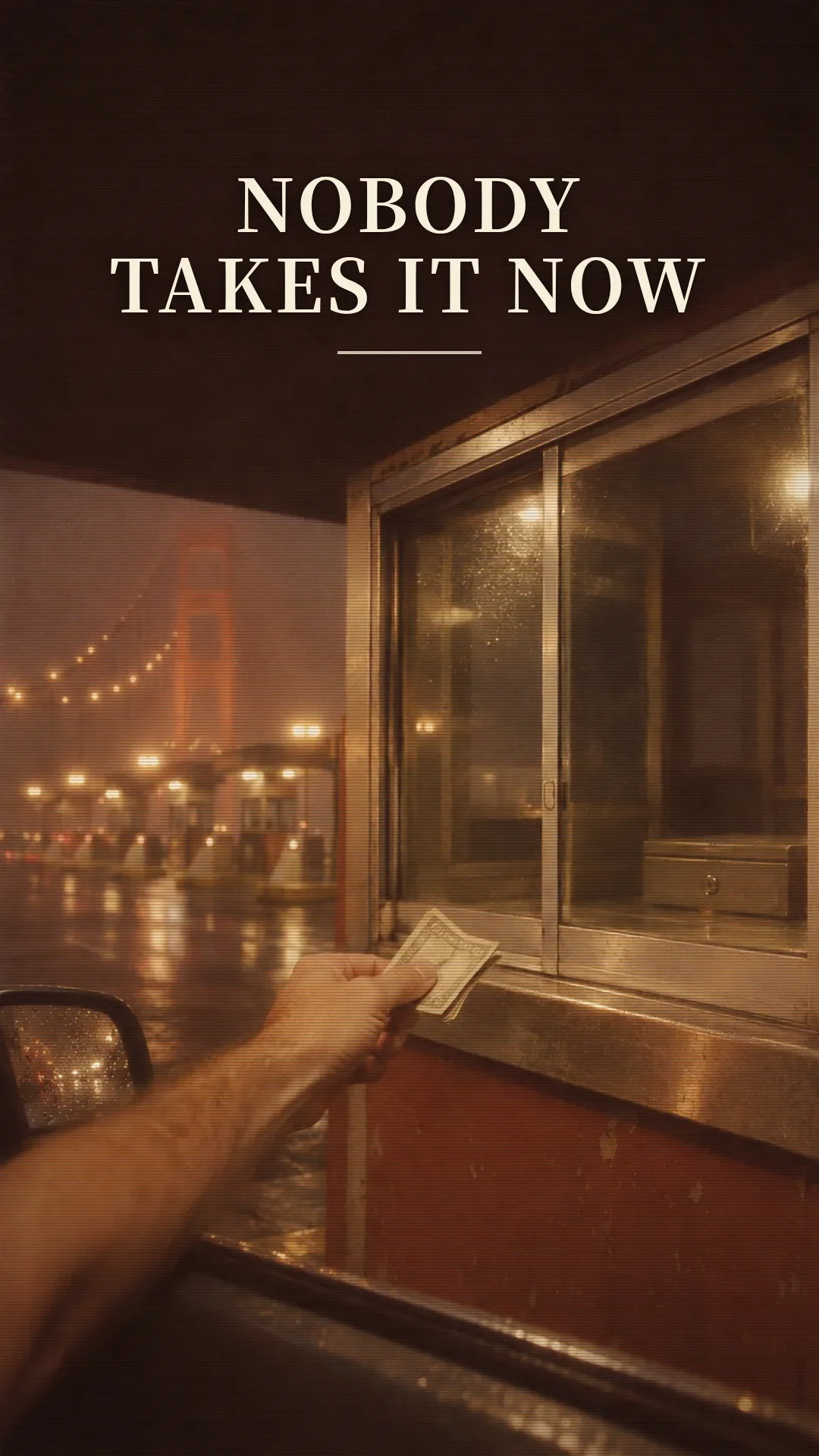
THE LAST GOLDEN GATE TOLL TAKER

Drivers heading into San Francisco paid the Golden Gate Bridge toll in person until the small hours of March 27, 2013. A car stopped in one of the eleven booths, a window came down, bills went out, change came back, and a toll taker said something to the driver. Shortly after midnight that night, the last toll collector on the bridge left her booth for the final time and the plaza stopped taking cash. 1
Her name was Marilyn Alvarado, she had worked the bridge more than twenty-nine years, and she was the last toll taker on duty when she carried her cash drawer out of booth No. 1. Her last toll came from a maroon 1937 Packard driven by Jim Eddie, the bridge district's president, who said the car was the first to cross the bridge when it opened in 1937. 1
The district's board had voted to replace its thirty-two toll takers with a $3.2 million electronic system, against a budget shortfall it put at $66 million over five years and expected savings of about $16 million over eight. Twelve of the toll takers had already retired, moved to other district jobs or left; twenty stood to lose their jobs. Officials had considered keeping one of the eleven booths open for cash and decided against it. Toll takers came off shift that day with flowers, cards and tears. 12
The tolls did not end. A transponder in the windshield or a camera reading the plate now collects them, and the bridge district's own account of the change lists, among its reasons, that motorists no longer have to fumble for cash or stop at the plaza. 3
This episode is an AI-rendered reconstruction. Every image is an original generated scene; no archival footage is presented as documentary footage.
References
- 1
- 2
- 3
This story was produced automatically by a channel. One sentence is all it takes for Neodrop to keep producing for you.