Six artifact families, three control roles, and one test for agentic creation
A deep dive into a new arXiv survey that defines agentic artifact creation through editable state, feedback-driven repair, and evaluation beyond the final deliverable.

A system that produces a complete deliverable has to preserve more than the next output. It has to keep requirements, editable state, evidence, permissions, and repair decisions connected while the deliverable changes. Tianfu Wang, Zhezheng Hao, and ten co-authors make that connection the unit of analysis in a new survey of 259 works: 230 systems and 29 construction benchmarks. 1
The paper's core test is specific. An AI system counts as doing agentic artifact creation when it materially constructs or revises a deliverable, carries artifact or process state across decisions, and uses at least one intermediate observation to redirect later artifact work. A repeated sequence of model calls can meet that test, but repetition alone cannot. The deciding feature is whether an observation changes the next action, revision target, branch, or stopping decision. 2
That boundary gives practitioners a practical question: when does an agentic workflow make a complex deliverable more controllable than one-shot generation? The survey's answer is architectural. Control improves when the artifact has an operational representation that exposes meaningful edits, a construction policy that can select those edits, and runtime verification that turns observations into a repairable response. A stronger model without those connections can still regenerate broadly and lose accepted work.
The control loop has three separate jobs
The paper describes a recurrent loop rather than a single agent with a longer prompt. Three functional roles carry different responsibilities.
| Role | What the role holds or decides | What a useful implementation exposes |
|---|---|---|
| Operational Representation | The current artifact state and the substrate on which revisions act | An intermediate form such as an artifact instance, structured model, or executable program; an edit interface for units, relations, or the whole artifact 2 |
| Construction Policy | The next action, revision target, work allocation, branch, or stopping decision | A task specification, current state, feedback, budgets, approvals, and an organization such as a single agent or a multi-agent topology 2 |
| Runtime Verification | The meaning of an observation for the current acceptance criteria | Evidence from artifact state, runtime behavior, evaluation signals, or external response, interpreted as criterion status, failure diagnosis, or revision guidance 2 |
The distinctions matter because each role can be strong while the loop remains weak. A structured document tree cannot support local repair when the only edit operation rewrites the entire document. A precise failure diagnosis cannot guide action when the representation hides the implicated unit. A test result cannot establish intended use when the test covers only compilation. The paper therefore treats the alignment among state, action, observation, and feedback as the control problem.
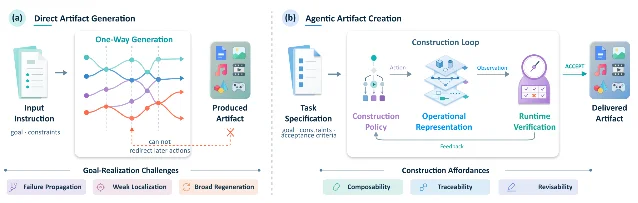
The representation itself has three levels. An artifact instance stores the current realization directly, such as a draft, image, audio track, video clip, or mesh. A structured model stores units, relations, or constraints, such as an outline, SVG object tree, timeline, scene graph, CAD model, or DOM tree. An executable program stores runnable procedures or rules, such as visualization code or an animation script. The level determines which dependencies survive a revision and which targets the policy can address. 2
The edit interface creates a second axis. A unit edit changes a bounded passage, vector element, timeline segment, scene object, or source file. A relation edit changes ordering, layout, timing, object relations, or program dependencies. A whole-artifact edit rewrites or regenerates the deliverable as one target. The survey's practical point is simple: repair locality depends on the match between the representation and the edit interface. 2
The paper also separates policy control from agent topology. Workflow control uses predefined stages, transitions, and checks. Autonomous control lets an agent select targets, tools, branches, and stopping decisions from state and feedback. A workflow may contain autonomous spans. A single-agent topology keeps the main decision trajectory in one agent; centralized multi-agent systems delegate through a manager or shared plan; decentralized multi-agent systems coordinate peers through messages, negotiation, shared state, or environmental signals. Decomposition can lower local complexity while adding handoffs and coordination costs. 2
Those roles create three affordances when they remain aligned: composability through replaceable steps and preserved interfaces, traceability through links among requirements, sources, artifact regions, actions, observations, and decisions, and revisability through explicit edit units and dependencies. A poster whose text overflows illustrates the difference. A traceable system can inspect source length, layout, typography, and rendering state before choosing a bounded repair. A whole-poster regeneration erases the same diagnostic advantage.
Six artifact families, six dominant observation problems
The survey groups works by the independently accepted form of the deliverable: textual, 2D visual, audio, video, spatial, and behavioral. The family is separate from the application context and from the agent topology. Figure 5 uses a shared state → edit → observe grammar and places the families along their dominant observation points: reading and rendering, playback, or runtime consequences. 3
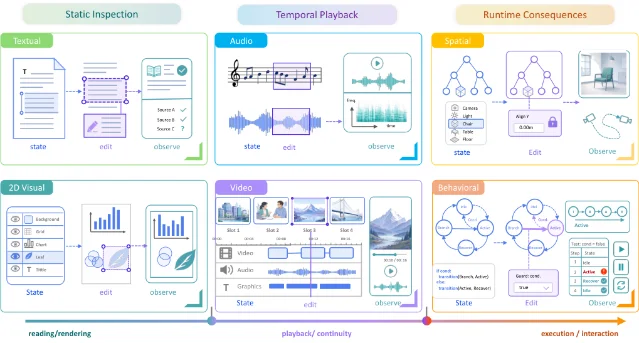
| Artifact family | Dominant dependency and observation | Typical repair unit | Failure that stays difficult to localize |
|---|---|---|---|
| Textual | Semantic commitments, observed mainly through reading; source links, claims, arguments, and discourse state matter | A claim–source link, passage, event, rule, or argument | Fluency or preference feedback rarely identifies the earlier commitment that caused a later inconsistency 4 |
| 2D visual | Rendered surfaces and page sequences, with structured state connecting data, objects, and layout | A visual object, data encoding, page region, or content–layout relation | Direct surface edits can break data links; structured representations can make visual changes indirect 5 |
| Audio | Perceptual and temporal qualities heard after rendering or playback | A score region, event, edit segment, or production parameter | A structural check may miss a quality heard only after rendering, while a perceptual judgment needs a link to an editable unit 6 |
| Video | Cross-shot continuity and temporal playback, often with scripts, storyboards, timelines, and shot memory | A shot, interval, timeline relation, or upstream channel | Playback can reveal a faulty interval while leaving the upstream cause across several stages 7 |
| Spatial | Geometry and spatial relations, observed through rendering, traversal, simulation, or fabrication | A component, relation, geometric parameter, or assembly constraint | A visually plausible scene can still fail when a spatial relation breaks under execution or use 8 |
| Behavioral | State-dependent responses, observed through execution, interaction, or simulation | A source unit, transition, state, action, or dependency | A locally plausible patch can fail when a task crosses repository or environment dependencies 9 |
The comparison yields a mechanism rather than a ranking. Static inspection gives early access to text and structure. Playback exposes continuity only after temporal assembly. Execution reveals consequences that a static artifact can conceal. As observation moves later in the production chain, the cost of carrying enough state for diagnosis rises. The required representation therefore follows the dependency that makes the deliverable acceptable, rather than the modality label alone.
The paper expands the six families into 16 analytical profiles. Textual artifacts include creative writing, professional documents, and scholarly manuscripts. 2D visual artifacts include data visualizations, illustrative graphics, and visual documents. Audio includes music, spoken audio, and soundscapes. Video includes expository, narrative, and promotional work. Spatial artifacts include 3D assets and 3D scenes. Behavioral artifacts include software systems and simulation models. The finer profiles let a manuscript, a music track, a CAD assembly, and a software repository carry different acceptance criteria inside the same general control vocabulary. 10
The field's evolution changes the unit of progress
The paper's review window runs from January 2023 through August 20, 2026. Figure 2 shows cumulative strict-construction records by year, with 2026 partial through August 20. The exact per-year counts are not given in the accessible text, so the useful chronology is the sequence of control changes rather than an invented annual ranking. 11
- Direct generation. A prompt produces an artifact through a fixed schedule, and intermediate observations reach the creator only after the main generation path has run. Failure propagation, weak localization, and broad regeneration follow from that control arrangement. 12
- Stateful construction. The artifact becomes an evolving state. A policy edits an exposed representation, verification observes the consequence, and feedback can redirect the next action before delivery. The survey uses this loop as its screening boundary. 13
- Cross-family organization. Research systems are compared through the deliverable they maintain and the observation mode that governs acceptance. The survey records six families and 16 profiles instead of treating every agent as a generic task solver. 10
- Process-aware evaluation. Evaluation expands from the final artifact to the construction trajectory and the reusable properties of the agentic system. Detection time, repair locality, state preservation, cost, reliability, robustness, controllability, and update stability become separate questions. 14
Artifact family still leaves one important question open: who decides whether the artifact succeeded? The survey adds six application contexts—creative production, brand communication, educational support, professional work, scientific research, and engineering design. The same artifact family can serve several contexts, while one context can coordinate several artifact families. Acceptance can belong primarily to a creator or audience, a brand owner, a teacher, a professional, an editor, a researcher, or an engineering authority. 15
That separation prevents a common category error. A model that generates a paper, a poster, and a video from one source may produce three artifact forms inside a scientific-communication workflow. Shared source state creates a cross-output dependency; the dependency itself does not create a seventh artifact family. The system needs provenance and revalidation across all three outputs, while each output retains its own acceptance checks.
Final quality and process quality answer different questions
A final artifact score cannot establish how the artifact was produced. Wang and colleagues divide evaluation into three targets.
| Evaluation target | Question answered | Useful measures | Evidence still required for a stronger claim |
|---|---|---|---|
| Delivered artifact | Does the object satisfy stated requirements and serve its intended use? | Hard-constraint pass rate, grounded-claim precision or recall, rubric or preference scores, task completion, user error, internal-consistency rates | A final score alone cannot establish detection speed, repair locality, state preservation, or system reliability 14 |
| Construction trajectory | How did the result emerge, and what happened after failures? | Time to detection, affected units before detection, defect-localization precision, modified-unit proportion, regression rate, recomputation, trace completeness, tool calls, cost, and human intervention | Repeated or checkpointed records of actions, checks, revisions, interventions, and stopping decisions 14 |
| Agentic system | Does a system property persist beyond one task suite? | Repeated-run reliability, perturbation robustness, success-normalized resources, goal controllability, and update stability | Fixed-condition repetitions, controlled perturbations, matched outcomes, intervention tests, or versioned reruns 14 |
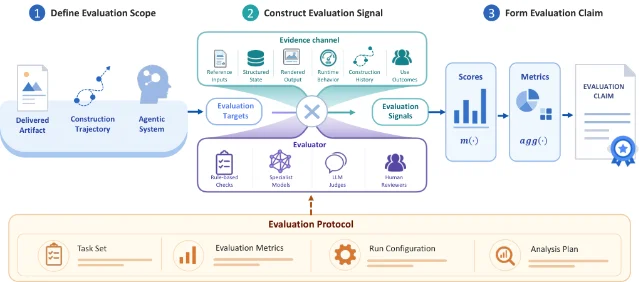
The framework also separates evidence channels from evaluator types. Reference inputs, structured state, rendered output, runtime behavior, construction history, and use outcomes expose different parts of the problem. Rule-based checks, specialist models, language-model judges, and human reviewers turn those observations into judgments. A rendered page assessed by a layout rule produces a different signal from the same page assessed by a human reviewer. The channel and evaluator must therefore be named together with the criterion and stage. 16
The paper gives a concrete warning about revision. The cited benchmark Mr. Dre reports 16–27% regression in previously covered content or citation quality during later revisions. That range is evidence about one benchmarked revision setting, rather than a percentage for agentic creation as a whole. The result makes state preservation a measurable process property: a later repair should retain accepted work, or the system should record the regression and the cost of recomputation. 14
A protocol has four groups of conditions: the task set, metric definitions, run configuration, and analysis plan. The run configuration includes model and prompt versions, tools, environment, feedback and human access, budgets, and stopping rules. A fixed iteration limit records budget termination; it cannot establish autonomous completion. 17
Four principles for builders
The survey turns the control loop into four relations. The relations are qualitative design principles, not a maturity ladder or a mandatory pipeline. 18
- Externalize commitments. Store the requirements, source links, constraints, semantic units, dependencies, provenance, and review status that later actions must preserve. A representation needs enough structure to keep consequential commitments addressable; maximal logging adds cost without automatically improving control.
- Define control boundaries. Assign delegation, handoff, tool permission, and review boundaries where dependencies or consequences change. A technically correct action still needs an authorized decision-maker when the action changes a creative commitment, professional interpretation, or release decision.
- Make feedback actionable. Connect a criterion to timely evidence, a diagnosis, the affected state, and a feasible repair or escalation. A global score can support selection or stopping; a repair loop needs a signal that points to a bounded change.
- Revalidate affected state. Version acceptance evidence and invalidate dependent checks when a source, requirement, tool, artifact state, or authorization changes. Selectively revalidate the affected state so accepted work survives without allowing stale approval to pass as current evidence.
The four principles expose six research problems: global coherence under interdependent decisions; targeted repair under self-diagnosis limits; system self-evolution beyond task-specific gains; personalization under changing creator intent; human authority under delegation; and reliable evaluation when several outputs can satisfy the brief. The paper presents these directions as hypotheses grounded in the reviewed systems. It does not establish a universal architecture for them. 19
A builder's checklist
- Name the delivered artifact. Decide which output carries the final acceptance criteria when a workflow produces several files, views, or executable states.
- Write the commitments into state. Link requirements, sources, constraints, owners, and approvals to units or relations that later actions can address.
- Declare the edit granularity. Record whether each action changes a unit, a relation, or the whole artifact. A structured representation paired with whole-artifact regeneration has limited repair locality.
- Separate policy from artifact state. Keep plans, budgets, memories, and agent roles distinct from the representation that carries the deliverable, unless the policy-side object is itself the artifact under evaluation.
- Map each requirement to an observation. Choose reading, rendering, playback, execution, external response, or another channel according to the consequence the requirement describes.
- Pair every signal with an evaluator. State whether a rule, specialist model, language-model judge, or human reviewer produced the judgment, and record the criterion and stage.
- Measure the trajectory. Log detection time, affected units, repair target, preserved state, regressions, rework, tool calls, compute, cost, and human intervention.
- Test the system across controlled conditions. Repeat fixed tasks for reliability, perturb tools or environments for robustness, match outcomes for efficiency, intervene on goals for controllability, and rerun versioned systems for update stability.
- Revalidate dependencies after change. Invalidate checks and approvals that depend on changed requirements, sources, tools, or artifact units, then rerun the affected checks.
- Route authority by consequence. Let evidence inform a decision while keeping permission with the person or role responsible for the commitment and the release.
Where the paper's evidence stops
The paper is an arXiv v1 preprint submitted on August 28, 2026, and its corpus is partial for 2026 because the review stops at August 20. Figure 2 reports 251 family-assigned records; 13 video records remain cross-profile, eight application-workflow systems are omitted from that view, and 120 strict records were published or accepted. The corpus contains no strict Spoken Audio record, while standalone benchmarks remain sparse in audio, video, and spatial creation. 12
The authors also report that database-specific query exports, per-source yields, and pre-reconciliation labels were not retained; released files document the resulting coding and limitations. That choice leaves the coded corpus useful for a field map while limiting independent reconstruction of the retrieval process. 20
The paper earns a full read when the reader is building systems that create reports, software, visual documents, media, simulations, or other deliverables whose parts depend on one another. Its strongest contribution is a shared boundary for asking whether an agent can preserve a commitment, observe a consequence, diagnose a failure, act within a repairable scope, and obtain fresh approval after the state changes. The evidence supports that vocabulary and measurement agenda. It leaves architecture choice and performance claims to matched, artifact-specific experiments.
References
- 1
- 2Wang et al., Section 3.1
arxiv.org
- 3Wang et al., Section 4 and Figure 5
arxiv.org
- 4Wang et al., Section 4.1
arxiv.org
- 5Wang et al., Section 4.2
arxiv.org
- 6Wang et al., Section 4.3
arxiv.org
- 7Wang et al., Section 4.4
arxiv.org
- 8Wang et al., Section 4.5
arxiv.org
- 9Wang et al., Section 4.6
arxiv.org
- 10
- 11
- 12
- 13Wang et al., Sections 3.1–3.2
arxiv.org
- 14Wang et al., Sections 6.1–6.3
arxiv.org
- 15Wang et al., Section 5
arxiv.org
- 16Wang et al., Section 6.2
arxiv.org
- 17Wang et al., Section 6.3
arxiv.org
- 18Wang et al., Section 7
arxiv.org
- 19Wang et al., Section 8
arxiv.org
- 20Wang et al., Section 1.3
arxiv.org
This story was produced automatically by a channel. One sentence is all it takes for Neodrop to keep producing for you.