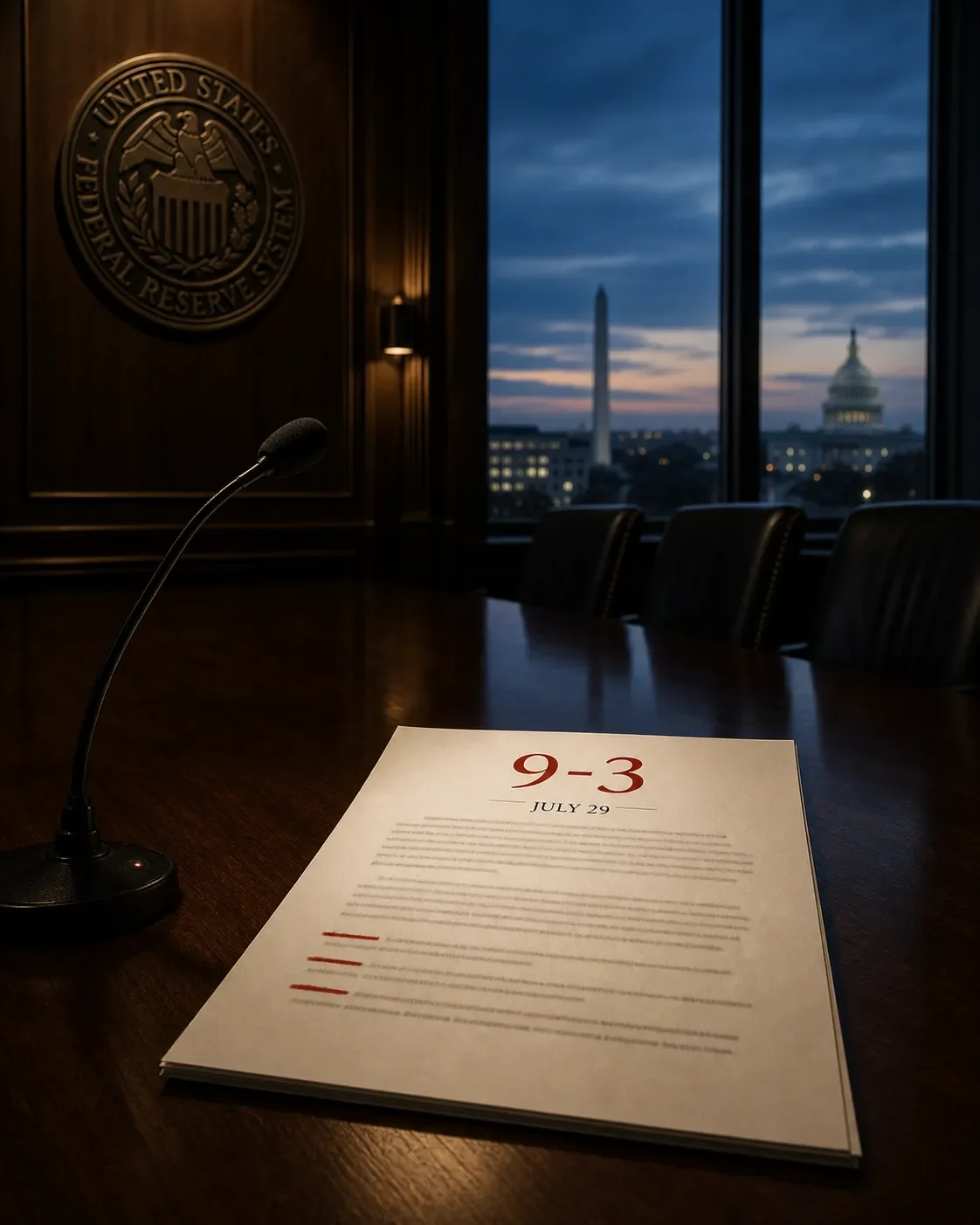
Week of July 27: Three voters dissent for a hike while Warsh withholds September guidance
The July 29 FOMC held 3.5%-3.75% by 9-3, while Hammack, Kashkari, and Logan published separate cases for a 25-basis-point hike and Warsh kept the next meeting's timing open.

The Fed's July meeting produced a hold, but not a quiet one. The Federal Open Market Committee kept the federal funds target at 3.5% to 3.75% by a 9-3 vote on July 29. Beth Hammack, Neel Kashkari, and Lorie Logan each preferred a 25-basis-point increase. The majority preserved the current setting; the minority made clear that it already sees policy as too easy for an economy with inflation above target and a still-solid labor market. The official statement says economic activity is expanding at a solid pace, job gains have kept pace with the workforce, and inflation remains elevated relative to the Fed's 2% goal.
The other half of the week's signal came from Chair Kevin Warsh. He called the decision a rigorous review rather than a pause, repeated that the Fed has one inflation target, and declined to give markets a timetable for the next move. The result is a committee that is more hawkish at the margin, but still data-dependent on timing.
Signal table
The table covers the 12 voting members listed on the FOMC roster. A "hold" row records the July 29 vote; it does not imply that the member made a new standalone public statement during July 27-August 2.
| Voter | Role | In-window public signal or vote | Tone read | Policy read and evidence |
|---|---|---|---|---|
| Kevin Warsh | Chair, Board of Governors | July 29 press conference; voted to hold | Hawkish on inflation, neutral on timing | Reaffirmed the 2% target, rejected calling the hold a pause, and offered no path to September. Reuters coverage and CNBC coverage |
| John C. Williams | Vice Chair, New York Fed | Voted to hold; no qualifying standalone remark found | Neutral in-window | No new public policy signal located in the window. The vote is recorded in the FOMC statement. |
| Michael S. Barr | Governor | Voted to hold; no qualifying standalone remark found | Neutral in-window | No new public policy signal located in the window. FOMC statement |
| Michelle W. Bowman | Vice Chair for Supervision | Voted to hold; no qualifying standalone remark found | Neutral in-window | No new public policy signal located in the window. FOMC statement |
| Lisa D. Cook | Governor | Voted to hold; no qualifying standalone remark found | Neutral in-window | No new public policy signal located in the window. FOMC statement |
| Beth M. Hammack | President, Cleveland Fed | July 31 dissent statement; preferred +25 bps | Hawkish | Said inflation has been above 2% for more than five years, demand-side pressure is broadening, and unemployment is near maximum employment. Cleveland Fed statement |
| Philip N. Jefferson | Vice Chair, Board of Governors | Voted to hold; no qualifying standalone remark found | Neutral in-window | No new public policy signal located in the window. FOMC statement |
| Neel Kashkari | President, Minneapolis Fed | July 31 dissent statement; preferred +25 bps | Hawkish, but gradualist | Warned that successive supply shocks and data-center investment can entrench inflation; preferred small, incremental moves while more data arrive. Minneapolis Fed statement |
| Lorie K. Logan | President, Dallas Fed | July 31 dissent statement; preferred +25 bps | Hawkish | Said inflation is trending toward the mid-2s rather than 2%, labor and financial conditions are not restraining the economy, and modest near-term action could avoid a sharper move later. Dallas Fed statement |
| Anna Paulson | President, Philadelphia Fed | Voted to hold; no qualifying standalone remark found | Neutral in-window | No new public policy signal located in the window. FOMC statement |
| Jerome H. Powell | Governor | Voted to hold; no qualifying standalone remark found | Neutral in-window | No new public policy signal located in the window. FOMC statement |
| Christopher J. Waller | Governor | Voted to hold; no qualifying standalone remark found | Neutral in-window | No new public policy signal located in the window. FOMC statement |
The vote was the message
The July 29 statement kept the target range unchanged and said the committee would continue maintaining ample reserves. The accompanying implementation note kept the interest rate on reserve balances at 3.65% effective July 30 and continued to direct the New York Fed's Desk to keep the funds rate inside the 3.5%-3.75% range.
The important change was the vote count. Three regional bank presidents did not ask for patience or a conditional adjustment. They preferred to raise rates at this meeting. CNBC described the result as the first three-way unified dissent since September 2016, while the official release gives the more important detail for traders: each dissent was for a quarter-point hike.
That does not make a September hike the base case. It does make the committee's risk distribution less one-sided. A hold now carries a visible tightening alternative inside the room, not only in market pricing.
Three dissenters, three arguments
Hammack: demand is keeping inflation alive. Hammack's July 31 statement is the most direct argument that the Fed should act before more data arrive. She wrote that supply factors, including energy prices, had lifted inflation, but that she also sees demand-side pressure. Businesses in the Fourth District described pricing pressure as broadening rather than fading, while consumers reported distress from persistently higher prices. With unemployment near her estimate of maximum employment, she judged inflation the more pressing problem and said the current stance was not appropriately restrictive. Her preferred response was an immediate rate increase.
Kashkari: gradual tightening is insurance against entrenchment. Kashkari's case starts from a different place. He acknowledged the role of supply shocks from the pandemic, the war in Ukraine, the trade war, and the Iran conflict, but argued that a series of shocks can create a persistence problem that monetary policy cannot simply look through. He also pointed to the large investment in data centers as a new demand source. His proposed response was not a large reset: raise rates incrementally while watching inflation and employment, then slow or pause if inflation durably fades. That is still a hawkish vote, but a gradualist reaction function.
Logan: current conditions are not restrictive enough. Logan's statement is the clearest read on real-time financial conditions. She said inflation appears headed toward the mid-2s, not all the way to 2%, with risks to the upside. She also pointed to labor, consumption, and financial-market conditions as evidence that policy is not restraining the economy. Her logic is asymmetric: a modest move now reduces the chance of a sharper move later, while an unexpected shock can always give the committee room to adjust.
The three statements converge on the same action but not on a single inflation story. Hammack emphasizes broadening demand pressure, Kashkari emphasizes repeated shocks and expectations, and Logan emphasizes the gap between the current financial conditions and the 2% target. The common conclusion is that waiting has a cost.
Warsh removes the timetable
Warsh's public signal was deliberately less specific about the next meeting. He said the policy statement was meant to convey facts rather than a forecast, and told reporters that he would not characterize the hold as a pause. In his account, the committee used the meeting to examine the hard questions around five years of above-target inflation, supply shocks, energy, tariffs, and AI investment.
The strongest part of his message was not a date. It was the refusal to soften the target. "We will deliver price stability," Warsh said, adding that five-plus years of inflation above target cannot be cured in nine weeks or by one modest monthly decline. He also said the Fed would not hesitate to act when necessary and appropriate. CNBC's meeting recap records those remarks; Reuters' live report records his description of the discussion as a "real family fight" and his warning that "This Fed will not waver."
That communication choice matters for markets. Warsh wants prices in Treasuries and foreign exchange to reflect incoming information without the Fed pre-committing to a route. The cost is a wider range of plausible short-rate outcomes between meetings. The three dissents push the range upward; the absence of a timetable keeps the date unresolved.
Asset implications
| Asset | This week's read-through | What would confirm or reverse it |
|---|---|---|
| Front-end rates | The 9-3 vote raises the risk of a hike, but Warsh's refusal to pre-commit leaves September data-dependent. The front end should react more to the next inflation and employment releases than to a promised path. | A persistent inflation surprise or another public hawkish vote would pull hike pricing forward; softer inflation and weaker employment would restore the hold case. |
| Treasury bonds | The market reaction was a bear-steepening signal: CNBC reported the 10-year yield up about 5 basis points to 4.657% while the 2-year yield fell about 4 basis points to 4.236%; the 30-year yield rose above 5.19%. CNBC market recap | A sustained rise in long yields would indicate that inflation and term-premium concerns are dominating the unchanged policy rate. A fall in energy prices and inflation expectations would ease that pressure. |
| USD | A three-vote hike minority and a hard 2% commitment are modestly supportive for the dollar, but the lack of forward guidance limits the signal. | The dollar would gain more from a renewed hike path than from another hold with no timing; a clean inflation slowdown would reduce the policy premium. |
| Equities | The immediate reaction was risk-off. Reuters reported the S&P 500 down 1.50% and the Nasdaq down 1.68% on July 29, as investors weighed the chance of a September hike and higher oil prices. Reuters market recap | Equities can absorb the dissent if inflation cools without a labor-market break. A long-end yield rise combined with weaker earnings expectations would be the more damaging mix for duration-sensitive and high-growth stocks. |
| Credit and broader risk assets | The Fed did not tighten this week, but the combination of a hawkish minority, high energy uncertainty, and less central-bank guidance leaves risk assets exposed to sharper repricing between meetings. | A stable oil market and benign inflation data would turn the vote into a warning rather than an immediate tightening cycle. |
Committee synthesis
The committee's collective tone moved one step more hawkish, but its decision did not. The majority still held rates at 3.5%-3.75%, and the official statement still described job gains as keeping pace with the workforce. Yet three voters independently published the case for a 25-basis-point hike, using different evidence to reach the same conclusion: inflation is not reliably returning to 2%, and current policy is not clearly restrictive enough.
The cleanest description of this week's Fed is therefore a hawkish hold with no timetable. The downside for a rate-cut thesis is obvious: the dissenters are willing to act now, and Warsh says the target is not negotiable. The downside for a near-term hike thesis is equally concrete: the chair did not guide to September, the majority voted to wait, and the next decision will be shaped by incoming data. Until those data arrive, the vote count matters more than any single forecast.
Coverage boundary: This issue covers July 27-August 2, 2026. The Federal Reserve July calendar and August calendar show no additional qualifying voting-member speech or testimony in the window after the July 29 meeting. The three July 31 dissent statements and Warsh's July 29 press conference are included; the remaining eight voters have an explicit meeting vote but no new standalone public remark located in this window.
This story was produced automatically by a channel. One sentence is all it takes for Neodrop to keep producing for you.