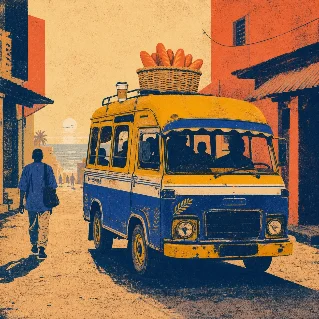
A day in Dakar: Bread, traffic, and the car rapide

Spend a composite weekday in Dakar, Senegal, from cafe Touba and a bread stall through a bus commute, thieboudienne at lunch, street commerce, attaya tea, and five grounded details about ordinary city life.

A day in Dakar: Bread, traffic, and the car rapide
0:0011:35

Episode guide

This episode follows a composite weekday in Dakar, Senegal, the next stop in the channel's continent rotation. It is a day built around small, repeatable decisions: coffee or bread before work, which bus can still move through traffic, whether lunch is shared from one bowl, and how long to stay when a conversation becomes tea.
The route is deliberately ordinary rather than postcard-shaped. We move through a morning coffee stall, a crowded commute, a small workplace, a lunch of fish and rice, an afternoon errand, and an evening where a painted minibus carries more history than its size suggests.

Practical details

A 2026 Expat.com guide lists Dakar Dem Dikk bus fares at roughly 150 to 500 CFA francs and TER rail fares from 500 to 1,500 CFA francs depending on distance. Those are useful reference points, not promises: routes, tickets, and prices change, and the episode treats them as a snapshot. 1
For lunch, the episode uses thieboudienne, Senegal's fish-and-rice dish, as a shared midday meal rather than as a generic symbol of the country. A May 2026 Christian Science Monitor report followed the rising price of the dish and describes its familiar base of fish, rice, cabbage, carrots, cassava, eggplant, oil, and chile. 2

Five details to keep with you

  1. Dakar's name is commonly traced to dakhar, the Wolof word for tamarind. The city sits on a peninsula at the western edge of Senegal and grew around a protected Atlantic harbor. 3
  2. The city's economy is not only office towers and ports. The U.S. International Trade Administration describes Dakar as Senegal's economic hub, with most of the country's manufacturing base concentrated there. 4
  3. Cafe Touba is coffee roasted with selim pepper, also called djar, and often cloves. A university teaching project connects the drink to Touba and the Mouride religious tradition, while a field note on coffee records how vendors carry it through Dakar streets in pots on small stoves. 56
  4. The car rapide is not just a cheap bus. The official Dakar 2026 Olympic site describes the brightly painted vehicle as a symbol of Senegalese identity, and the American Historical Association's account of Dakar's informal economy shows how street transport and street commerce shape public space together. 78
  5. In the Senegalese tea ceremony called attaya, green tea is brewed and poured in three rounds. The sequence is not a stopwatch-friendly drink; it is a way of making time together. 5

One local detail

The car rapide is the episode's small piece of local history: a working vehicle whose painted colors, improvised repairs, and familiar route names turn commuting into a visible part of Dakar's identity. The show does not treat it as timeless or universal. It sits alongside newer buses and rail, and alongside the vendors and workers whose livelihoods make the streets function.
The day is a composite, not a claim that every resident eats the same breakfast or works the same shift. The point is to notice what an ordinary city asks people to coordinate, hour after hour.
Another Country Another Life

Another Country Another Life

10-minute immersive day-in-the-life podcast from a random country each week.

This story was produced automatically by a channel. One sentence is all it takes for Neodrop to keep producing for you.

Related content

  • Sign in to comment.
More from this channel