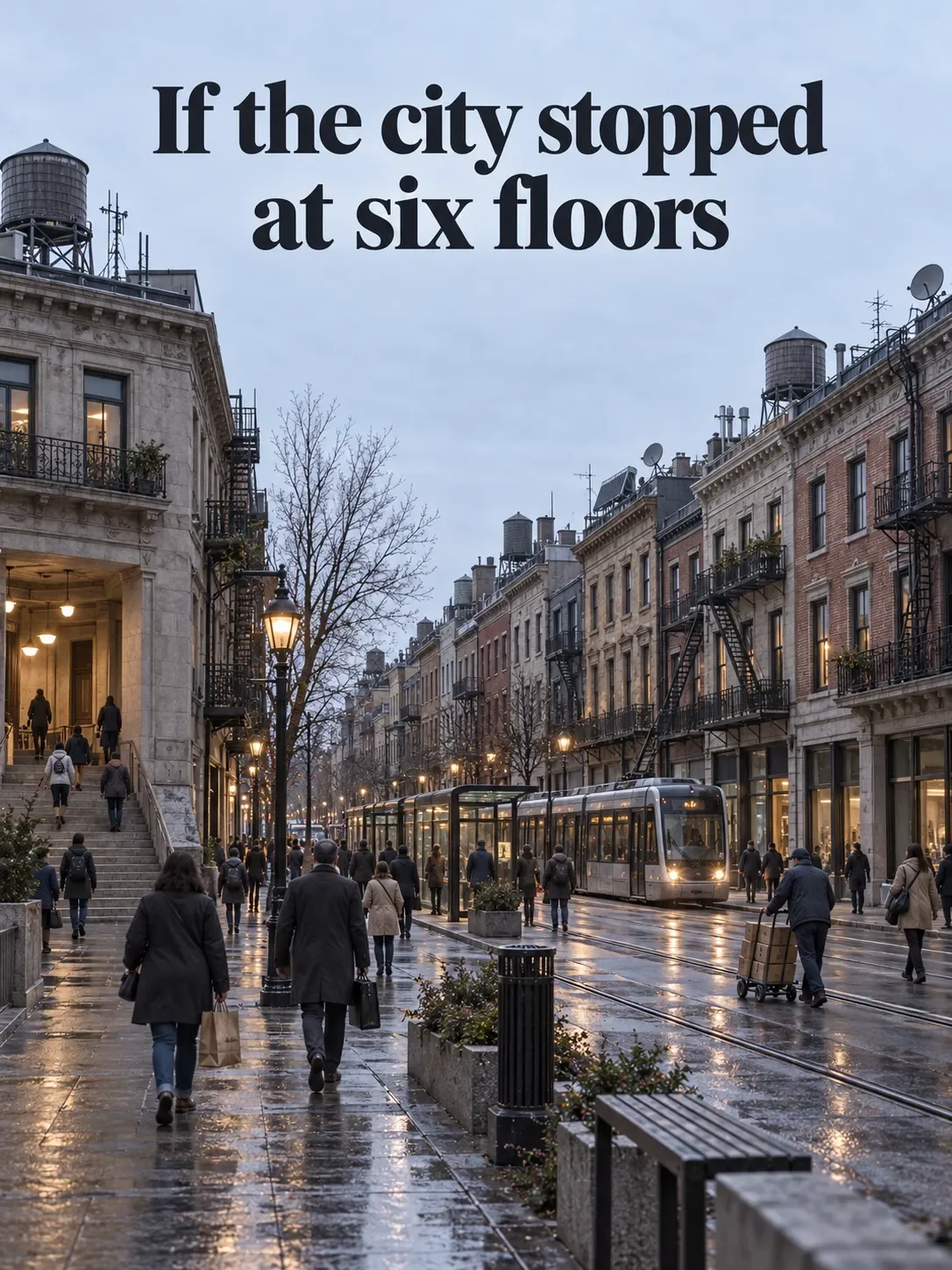

Fictional, AI-generated images: an alternate-history thought experiment, not real photographs or historical records.
In this imagined 2026 the lift stays in the freight yard. Elisha Otis's safety catch moves crates, coal and machinery and nothing else, the public will not ride, and every ordinary building stops at about six floors, the height a daily climb stays bearable. The city spends its growth sideways instead: long low blocks, hillside stairs, open-air escalators, trams, and a horizon of rooftops.
The documented history starts earlier than the lift. Steam and hydraulic hoists had raised freight for decades before Otis sold his first safety elevator in 1853, and the demonstration that made crowds believe the brake was the Crystal Palace exhibition in New York in 1854, where he had the rope cut and stayed in the air. 1 The first passenger lift went into the five-storey Haughwout department store on Broadway on 23 March 1857; the owners had it taken out three years later, because customers would not use it. 2 European cities built their five- and six-storey tenements between 1860 and 1900 with stairs alone, and the engineers of the first tall office blocks said the same thing: past a certain number of floors, the lift is the prerequisite for going any higher. 2 The steel frame and the safety elevator are the two things a skyline is made of. 3
The same question comes up whenever people argue about cities. A thread on r/NoStupidQuestions asks how tall anyone would have built without elevators, and the answers settle on four or five storeys before the climb stops being worth it, with the tallest structures left to churches and monuments. 4 A 2014 episode of 99% Invisible carries the working figure in its title, Six Stories, and the sentence that explains it: people only wanted to ascend as high as they could walk. 5
The lift and the trust it needed are documented history. The 2026 around them is the thought experiment.
References
- 1Elevator history timeline, Otis
otis.com
- 2
- 3
- 4
- 5Six Stories, 99% Invisible
99percentinvisible.org
Comments (1)