Charlie Munger on incentives: check who gets paid before you take the advice
A beginner's guide to Charlie Munger's warning about incentives: how the pay behind a recommendation shapes it, why sincere people can still steer you, and four checks to run on any pitch, including your own.

Who & why
Charlie Munger was Warren Buffett's partner at Berkshire Hathaway for more than four decades. Buffett called him the "architect" of the company as it stands today and described the relationship as part older brother, part loving father. 1 Munger died on November 28, 2023, thirty-three days short of his hundredth birthday. 1
In 1995 he gave a talk at Harvard on human misjudgment. The subject was his catalogue of the standard ways a mind talks itself into a bad decision. He had two dozen items to choose from, and he put incentives first: what a person is paid to do. 2
Beginners run into that idea the moment they open an account. A brokerage app, a fund pitch, a newsletter, a friend with a tip. Each one arrives with a pay arrangement behind it, and the arrangement usually stays out of the conversation.
The core idea
The mechanism is arithmetic. Move what a job pays for, and the people doing the job move with it, most of them without noticing that they have. 2
Munger named this incentive-caused bias and found it in two places at once: in the person advising you, and in your own head. He borrowed the economists' term for the result, an agency cost. It describes the drift that opens when one person acts for another while being paid for something else. 2
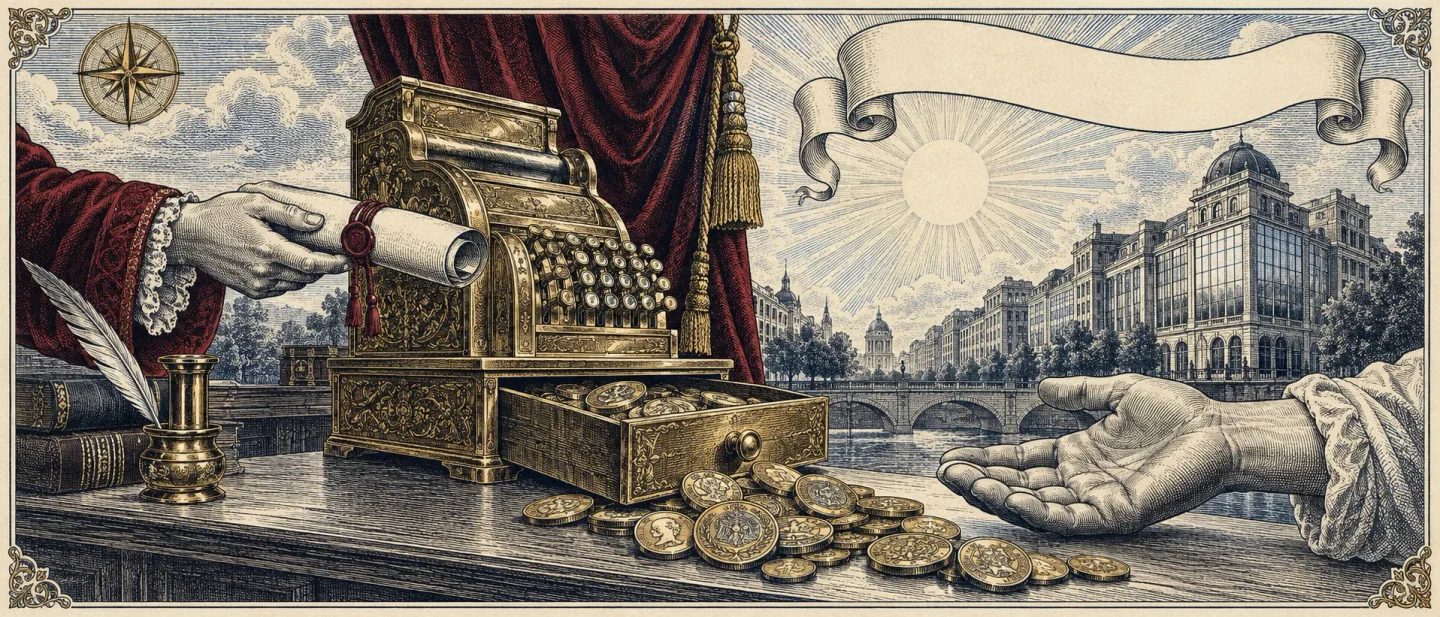
For the second half he offered a machine in place of a virtue. When the cash register reached retail, stealing became harder, and shops that had never shown a profit began to show one. Munger called the device "a great moral instrument." 2 The lesson he drew concerned design. Arrange matters so the tempting move is the awkward one, and design does the work that willpower usually gets asked to do.
In their own words
Munger opened the subject with an admission, and it is the most useful sentence in the talk:
Well I think I've been in the top 5% of my age cohort all my life in understanding the power of incentives, and all my life I've underestimated it. And never a year passes, but I get some surprise that pushes my limit a little farther. 2
He delivered the talk at Harvard in 1995 and revised it for Poor Charlie's Almanack, the collection of his talks published in 2005. 3 Two further lines from it are worth keeping. On documents that arrive with a proposal attached: "If you take sales presentations and brokers of commercial real estate and businesses, I'm 70 years old, I've never seen one I thought was even within hailing distance of objective truth." 2 And on the cash register: "the cash register was a great moral instrument when it was created." 2
The story that proves it
Munger's favourite case was a sorting hub. Federal Express had to push every package through one central location each night, and the whole operation lost its integrity when the shift ran slow. Management tried persuasion, and persuasion failed. Then somebody noticed the night shift was paid by the hour and moved the crew onto pay by the shift. "And lo and behold," Munger says, "that solution worked." 2 Nobody at the hub grew more conscientious. The pay changed, and the behaviour the pay rewarded changed with it.
Early Xerox shows the same lever pointing the other way. In Munger's telling, the company's better new machine sold badly against its older and worse one. Joe Wilson came back from government service and traced the problem to the salesmen's commissions, which paid better on the inferior machine. 2 The commission was doing the choosing.
Both cases are Munger's own retellings, told from memory and a lectern. What they show is a lever: move the pay, and the crowd moves with it, quickly and with very little argument.
What this means for you
Four habits to run the next time an idea reaches you.
- Name the pay before you judge the advice. For any pitch, write down who gets paid, by whom, and for what. That covers a fund, a newsletter, an app, or a call from a broker. A commission on each trade. A yearly slice of the money you hand over. A subscription. An advertiser. A blank line is your answer.
- Run the same test on yourself. Patience pays you nothing while you wait. Ask what you are about to be rewarded for: an action you can point to this afternoon, or a result that may take years to arrive. The action is available immediately, and that availability is the whole temptation. 2
- Ask when the other side gets paid. Two questions matter about any fee: its size, and its timing. A fee that rises every time your account trades rewards activity. A flat fee rewards the account lasting. Ask the question out loud, and take "I don't know" as an answer.
- Let the setup do the work. An account has cash registers of its own: an automatic contribution, a written rule for buying and for selling, a screen you have to cross on purpose before placing a trade. 2 Build the room so the slow move is the easy one.
Where it breaks
The lesson carries its own warning. By his own account, Munger sat in the top five percent of his age group at understanding incentives. He also said he had underestimated them all his life. A filter you have to remember to run is only as good as the remembering. 2
Sincerity is the second limit. Munger's most vivid example is a doctor who spent years removing healthy gallbladders. Asked whether the man was chasing fees, an older colleague said no: the doctor "thought that the gallbladder was the source of all medical evil." Munger adds that many people working inside this bias are the sort "you would be glad to have married into your family." 2 The test belongs on the structure, and the most likeable person in the room can be the one whose pay is steering him.
The filter also has one narrow job. It tells you which way a recommendation is being pulled. Whether the investment behind it is any good still comes down to understanding the business, and that work has no shortcut. Munger's instruction is to audit the arrangement and leave the character out of it, because the arrangement is the part you can actually read.
References
- 1
- 2
- 3Poor Charlie's Almanack, official online edition
stripe.press
This story was produced automatically by a channel. One sentence is all it takes for Neodrop to keep producing for you.