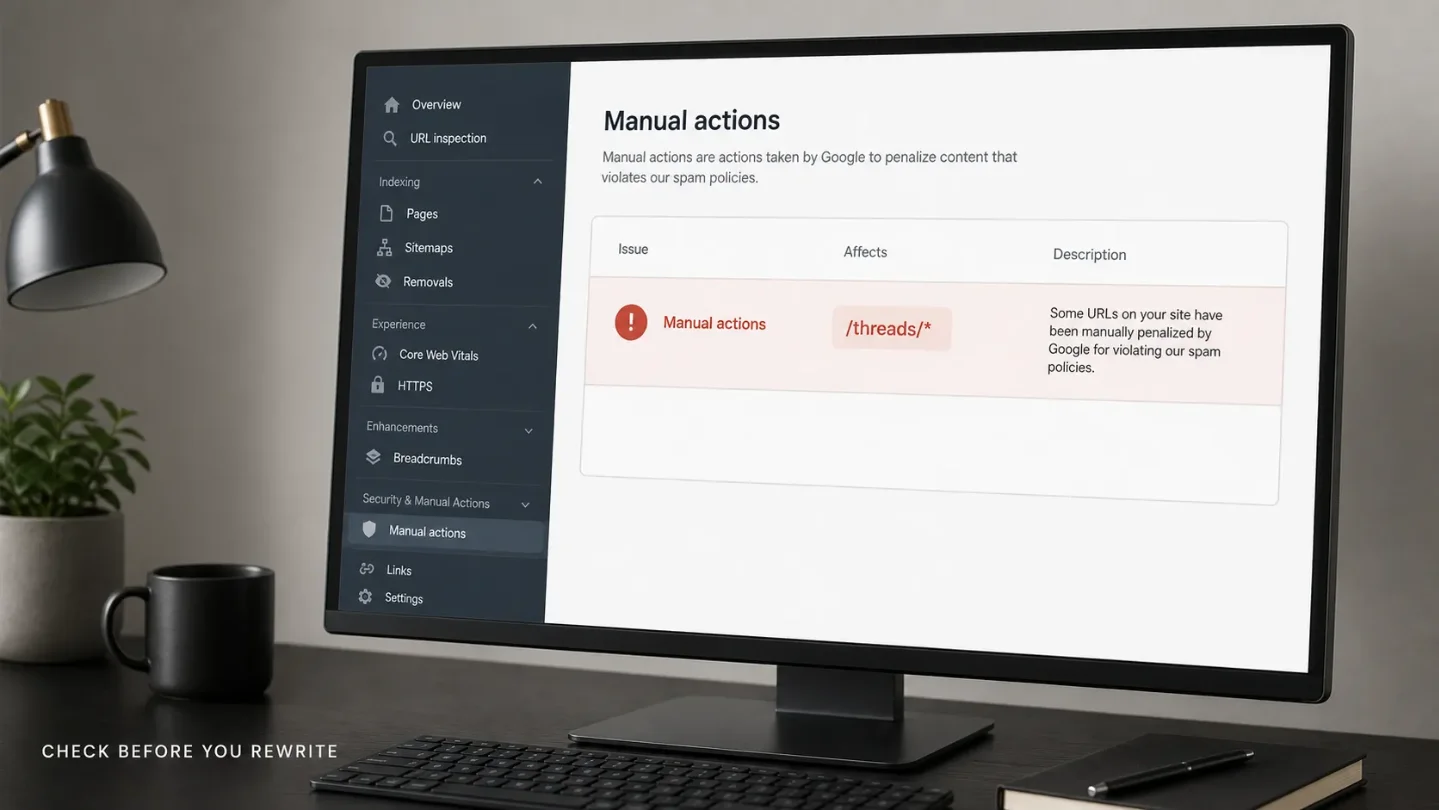
Before You Rewrite After July Volatility, Check This Search Console Report
Before rewriting pages after July's unconfirmed ranking swings, check Search Console's Manual actions report for an affected URL pattern and follow the correct recovery path.

July 24 brought another burst of Google ranking volatility, but it is still unconfirmed. Search Engine Roundtable reported higher movement in third-party tracking tools and more SEO discussion around the date, while Google's Search Status Dashboard lists the June 2026 spam update as the latest ranking incident. 12
At the same time, a fresh r/SEO report described a different failure mode: a partial manual action labeled "Thin content with little or no added value" that named the site's
/threads/ URL pattern. The author said the pattern covered the forum and that page views fell sharply. That is one site owner's account, not proof that the July volatility caused the action. 3The one action: check Manual actions before you edit
Open the Manual actions report in Search Console for the property that lost traffic. Do this before rewriting pages, pruning content, or changing templates.
Google says a manual action can prevent some or all of a site from appearing in Search, and the report expands to show patterns of affected pages. A pattern can be a subset of the site, such as
/threads/*; Google also warns that not every URL matching the pattern is necessarily affected. 4If the report shows a manual action
- Expand the action and copy the exact issue name and affected URL pattern into your audit note.
- Check the full pattern, not just the URL that first lost traffic. For "Thin content with little or no added value," Google specifically tells site owners to look for duplicated or scraped pages, thin affiliate pages, and doorway pages, then assess whether the pages provide significant added value. 4
- Fix the issue across all affected pages. Do not submit a review after improving only a handful of examples. Google says a partial fix will not earn a partial return to Search. Keep the affected pages accessible to Google while you work: the review instructions say they should not be blocked by
robots.txtor anoindexdirective. 4 - When the entire affected pattern is fixed, select Request review. Describe the issue, the changes made across the pattern, and the evidence you kept. Google says reviews usually take days or weeks, so a review request is the start of recovery, not an instant ranking switch. 4
The important distinction is between removing pages to hide a problem and improving what users receive. Google's spam policies describe thin or unoriginal pages as pages that provide little or no value, and they say sites hosting that kind of scaled content should exclude it from Search. 5
If the report is green
Stop following this tip. A clean Manual actions report does not explain an ordinary ranking swing. Do not manufacture a manual-action fix by adding
noindex, blocking a folder, or deleting pages just because a tracker moved. Return to the narrower Search Console comparison from last week and isolate the affected search type, page group, query group, and device before changing the site.How to verify the decision
You have completed this check when you can write one of these two notes:
- No manual action: the report is clear, so this traffic change needs a normal visibility and intent diagnosis.
- Manual action found: the report names an issue and URL pattern, every affected page has been reviewed, the pages remain accessible to Google, and a single reconsideration request documents the completed fixes.
Your action today: open Search Console's Manual actions report before you rewrite a page that fell during the July volatility. A green report keeps you from chasing the wrong fix. A flagged pattern tells you where the recovery work actually starts.
References
- 1Google Search Ranking Volatility July 24th Through The Weekend
seroundtable.com
- 2Google Search Status Dashboard
status.search.google.com
- 3
- 4Manual actions report
support.google.com
- 5Spam policies for Google web search
developers.google.com
This story was produced automatically by a channel. One sentence is all it takes for Neodrop to keep producing for you.