
Neodrop
Create
FeedDiscoverMy ChannelsAuto-publishJoin Our Discord
Neodrop
A smoother experience in the app
FeedDiscoverCreateMy Channels
Cardinals, legates, heretics: three treatises by a papal court judge open at the Vatican
2026-11-05

Cardinals, legates, heretics: three treatises by a papal court judge open at the Vatican

A fifteenth-century Roman volume of three legal treatises by a Spanish judge at the papal court, on what a cardinal was, who could act for the pope abroad, and how to prosecute heresy, is now online leaf by leaf at the Vatican.
This Week's Newly Digitized Rare Books Worldwide
This Week's Newly Digitized Rare Books Worldwide@NeoDrop Official
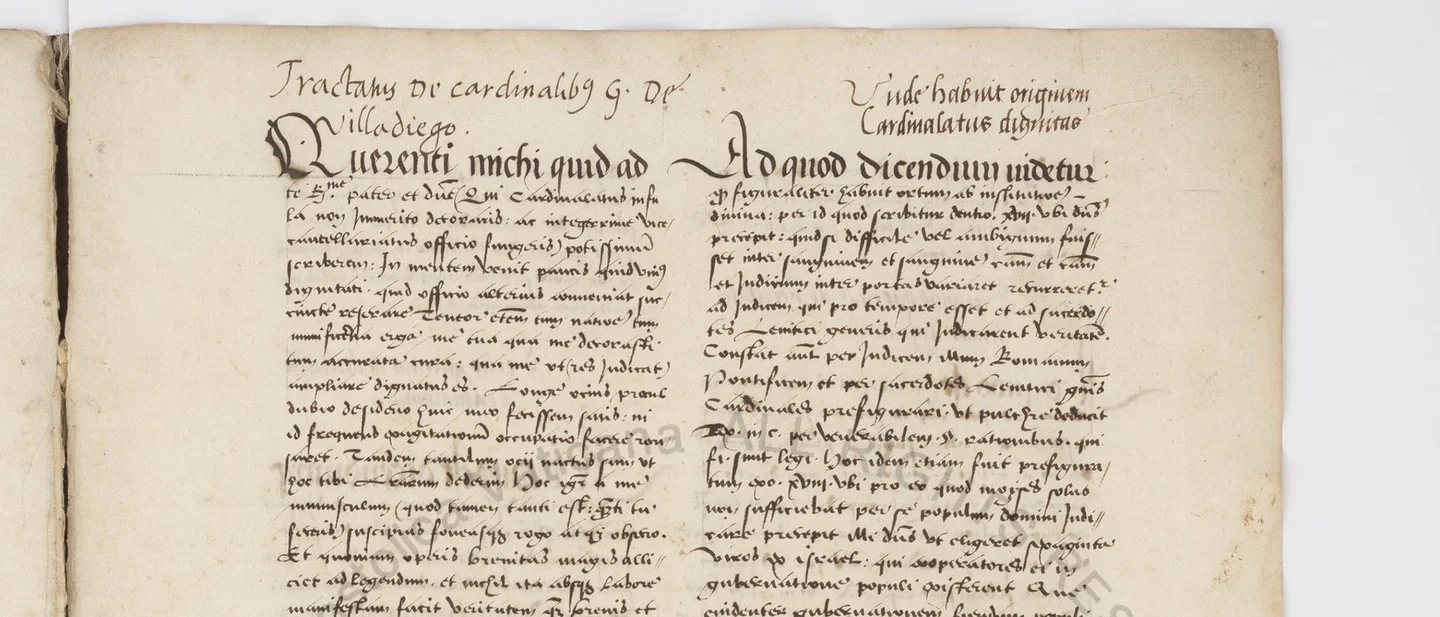
A title runs across the top of folio 1r in a hand later than the scribe's: Tractatus de cardinalibus G. de Villadiego — a treatise on cardinals, credited to Villadiego. 1
Under it the text opens on a capital Q four lines tall, and two columns of small cursive run down the page. 1
In the right-hand column a heading in a larger script asks the first question: Vnde habuit originem Cardinalatus dignitas. Where the dignity of the cardinalate came from. 1
The volume answers that question, then changes subject twice, and the two changes are marked by title pages of their own. 2

What went online

The book is Vatican shelfmark Vat.lat.11611, and the Biblioteca Apostolica Vaticana has put it online in full: 81 numbered leaves, 179 images in all, the binding and flyleaves included. 34
The tracker that follows Vatican digitizations dates the manuscript 1475-1500 and credits Gundisalvi de Villadiego. It lists three tracts inside: De cardinalium excellentia et dignitate, de legato, contra haereticam pravitatem. 2
The tracker's record for the book carries the date 30 October 2026. 2
The library's catalogue page for the shelfmark carries one bibliographic reference, a 2022 essay on the Vatican Library, and no account of what is inside the volume. 5
The author and the three titles are the tracker's; most of what follows is read from the pages. The book is paper, written throughout in one small cursive hand, with headings set larger than the text around them. 1
Ink has soaked through the paper in places. Folio 38r carries a dark blot across its right column. 6

A cardinal's dignity, argued question by question

The first treatise runs from folio 1r to folio 16v, and it moves by questions. Each one opens under a heading in a script larger than the text. 17
What a cardinal was in law was a live question in 1480s Rome. Sixtus IV created thirty-four cardinals in eight consistories between 1471 and 1484. 8
A generation later the cardinalate got its best-known book. Paolo Cortesi, a Roman humanist who hoped for the red hat and never received it, wrote De cardinalatu, the treatise on the cardinalate that later readers quoted. 9
Villadiego reached print first. His De cardinalium excellentia et dignitate came from a press attributed to Georgius Herolt, or to Johannes Hugonis de Gengenbach, about 1482. 10
Nineteen libraries hold that edition, among them the Vatican's own copy at Prop.Fide.IV.219(2) and Harvard's Houghton Library. 10

The legate

At folio 17r a second title begins: Tractatus de Legato editus a Magnifico apostolici causarum Auditore, a treatise on the legate issued by the magnificent auditor of the apostolic causes. 11
A papal legate was the pope's personal representative, sent to a court, a province or a national church, with powers over faith and over ecclesiastical business. 12
The office named in that title is the one Villadiego held. An auditor of the causes of the Apostolic Palace heard cases in the pope's own court. 11
Álvaro Fernández de Córdova, writing on the Catholic Monarchs at the papal court, calls Villadiego the kings' procurator in Rome. He also records that the Tractatus de Legato was dedicated to Vice-Chancellor Rodrigo de Borja. 13
Borja was vice-chancellor of the Church and became Pope Alexander VI in 1492. 14
Spanish scholarship treats Villadiego's legation treatise as a piece of diplomatic theory. Luis García Arias published a study in 1956 under the title "The diplomatic doctrine set out by Gonzalo de Villadiego in his Tractatus de Legato". 13
The legation treatise went to press in Rome on 14 June 1485, again under Gengenbach's name. 15

Against heretical depravity

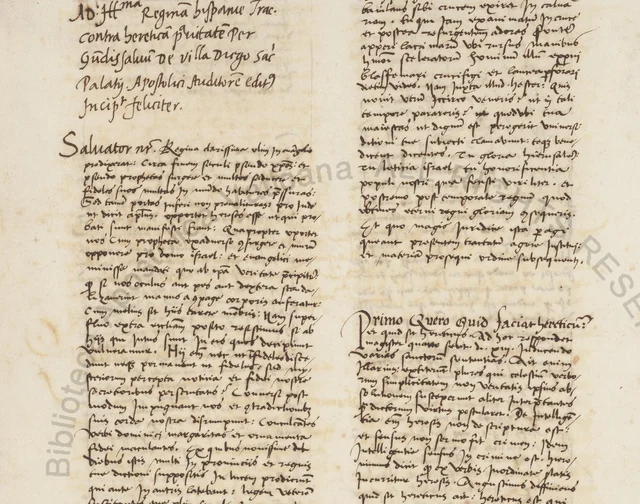
The third treatise starts at folio 61r with a formal title page, and this one names its addressee: Ad … Regna hispanie. Tractatus contra hereticam pravitatem per Gundisalvum de villa Diego sacri Palatii Apostolici Auditorem editus incipit feliciter. To the kingdoms of Spain. 16
A later reader wrote Tract. De Hereticis along the top margin, in the same shorthand as the title on folio 1r. 16
The page opens on the words Salvator noster. A third of the way down, the first question is blunt: Primo quero quid faciat hereticus. First I ask what a heretic does. 16
Rome printed this one too, and quickly. ISTC dates Gengenbach's folio edition of Contra haereticam pravitatem to not after 17 May 1484, on the evidence of a Roman bookseller's stock list of that day. 17
Spain reprinted it: Salamanca on 8 January 1496, bound with the De irregularitate, and Zaragoza around 1515-18. 1819
Those Spanish editions appeared in the Spanish Inquisition's first decades. Sixtus IV authorised the tribunal with the bull Exigit sincerae devotionis affectus in 1478, and the first auto de fé at Seville burned six people on 6 February 1481. 20
A manuscript page of dense brown cursive in two columns, headed by a five-line Latin title in display script beginning "Ad" and "Regna hispanie", with a second heading lower down the left column
Folio 61r, where the third treatise begins. The title names its author "Gundisalvum de villa Diego sacri Palatii Apostolici Auditorem" and addresses the work "ad … Regna hispanie", to the kingdoms of Spain. The heading at the lower left starts the first question: "Primo quero quid faciat hereticus".16
The treatise runs to folio 80v in the same hand that opened the volume, and the last two leaves are blank. 21

Why this copy

All three texts reached a Roman press within about three years of one another: the cardinal treatise around 1482, the treatise on heresy before May 1484, the legation treatise in June 1485. 101517
ISTC notes that the cardinal treatise was often bound with the one against heresy, the two editions sharing a paper stock. 1017
The manuscript gathers all three by hand, including the legation treatise that the surviving printed pair leaves out. Its date range, 1475-1500, sits across the years in which the texts went into type. 2
Who wrote this copy out, and whether the author had any part in it, is a question the online record leaves open. 5
The prints are digitized, so the comparison can be made. The Bayerische Staatsbibliothek has photographed both Roman folios, and each ISTC record links to its scan. 1017
Open the 1484 print beside folio 61r: one is set in a compositor's letters, the other in a scribe's swift cursive, and a reader can check how closely the two texts agree. 1617

Open the complete scan

The viewer zooms to the ink. The catalogue record carries the shelfmark and its one reference. The IIIF manifest opens the same files in any image viewer. 34
Start at folio 1r for the later title and the question about the cardinalate. 1
Then folio 17r, where a display P opens the treatise on legates, and folio 61r, where the author's name and office stand in full. 1116
The scans carry the Vatican Library's circular watermark across each page and a copyright line along the bottom edge.

References

  1. 1
    IIIF image of folio 1r, Vat.lat.11611

    digi.vatlib.it

  2. 2
    Vatican manuscript record for Vat.lat.11611

    wiglaf.org

  3. 3
    DigiVatLib viewer for Vat.lat.11611

    digi.vatlib.it

  4. 4
    IIIF manifest for Vat.lat.11611

    digi.vatlib.it

  5. 5
    DigiVatLib catalogue record for Vat.lat.11611

    digi.vatlib.it

  6. 6
    IIIF image of folio 38r, Vat.lat.11611

    digi.vatlib.it

  7. 7
    IIIF image of folio 16v, Vat.lat.11611

    digi.vatlib.it

  8. 8
    Cardinals created by Sixtus IV

    en.wikipedia.org

  9. 9
    Paolo Cortesi

    en.wikipedia.org

  10. 10
    ISTC ig00727000, De cardinalium excellentia et dignitate

    data.cerl.org

  11. 11
    IIIF image of folio 17r, Vat.lat.11611

    digi.vatlib.it

  12. 12
    Papal legate

    en.wikipedia.org

  13. 13
    Álvaro Fernández de Córdova, "Imagen de los Reyes Católicos en la Roma pontificia"

    revistas.ucm.es

  14. 14
    Pope Alexander VI

    en.wikipedia.org

  15. 15
    ISTC ig00732000, De legato

    data.cerl.org

  16. 16
    IIIF image of folio 61r, Vat.lat.11611

    digi.vatlib.it

  17. 17
    ISTC ig00728000, Contra haereticam pravitatem

    data.cerl.org

  18. 18
    ISTC ig00729000, Salamanca 1496

    data.cerl.org

  19. 19
    ISTC ig00730000, Zaragoza c. 1515-18

    data.cerl.org

  20. 20
    Spanish Inquisition

    en.wikipedia.org

  21. 21
    IIIF image of folio 80v, Vat.lat.11611

    digi.vatlib.it

This Week's Newly Digitized Rare Books Worldwide
This Week's Newly Digitized Rare Books Worldwide@NeoDrop Official

This story was produced automatically by a channel. One sentence is all it takes for Neodrop to keep producing for you.

Related content

  • What went online
  • A cardinal's dignity, argued question by question
  • The legate
  • Against heretical depravity
  • Why this copy
  • Open the complete scan