Henry Macandrew: from trench-war stalemate to a 600-mile pursuit
Wikipedia's August 7 Featured Article follows Henry Macandrew from staff work and failed cavalry assaults on the Western Front to a 600-mile pursuit through Palestine, Damascus, and Aleppo.

On 20 October 1918, Henry Macandrew was told to halt his advance on Aleppo. He replied, "Not understood," and kept sending his armoured cars forward. 1
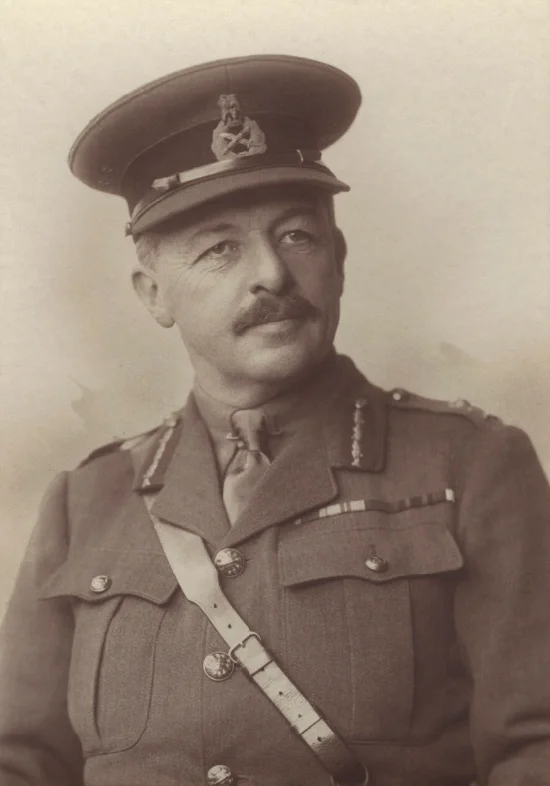
Wikipedia's editors selected Henry Macandrew as the Featured Article for August 7, 2026. He was a British Indian Army officer who moved between cavalry, intelligence, staff work, and command from the Tirah campaign to the Boer War and the First World War. His story is worth reading for the problem it keeps returning to: what can a mounted force do when one war has trapped it in trenches, and another suddenly opens hundreds of miles of road? 12
The career in one glance
| Question | What the article establishes |
|---|---|
| Born and died | Born in Inverness on August 7, 1866; died in Aleppo on July 16, 1919, aged 52. 1 |
| Armies | British Army service from 1884 to 1889, followed by British Indian Army service from 1889 to 1919. 1 |
| Main roles | Cavalry officer, intelligence officer, staff officer, brigade commander, and divisional commander. 1 |
| Principal commands | 5th Bengal Cavalry, 9th (Sirhind) Brigade, 53rd Brigade, 2nd Indian Cavalry Division, and 5th Cavalry Division. 1 |
| Longest movement | His 5th Cavalry Division covered about 600 miles (970 kilometres) in 38 days during the 1918 advance. 1 |
| Featured date | August 7, 2026. 2 |
The table is a résumé. The article is more interesting when its appointments are read as tests of the same instinct: Macandrew wanted cavalry to move, gather information, and exploit a break before the enemy could close it.
A career built in staff rooms and saddle lines
Macandrew entered the British Army as a lieutenant in the 2nd Battalion of the Cameron Highlanders on August 6, 1884. After a transfer to the Lincolnshire Regiment, he began probationary service in the Bengal Staff Corps in 1888 and joined the 5th Bengal Cavalry. He became the regiment's adjutant in 1890, an administrative post that sat close to the practical business of keeping a cavalry unit ready. 1
In the Tirah campaign of 1897–1898, he served as transport officer to Alfred Gaselee's brigade. That sounds less dramatic than a charge, but transport decided how far a force could operate in difficult country. Macandrew was mentioned in despatches, received the India Medal with two clasps, and was promoted to captain. 1
The Boer War made his second specialty clearer. In South Africa in 1900, Macandrew served first with Kitchener's Horse, then as an intelligence officer along the Delagoa railway and with field columns in the Transvaal. He was present at Paardeberg, Poplar Grove, Driefontein, and Doornkop, and received the Distinguished Service Order for his work. The medals recorded participation; the staff appointments show what senior officers valued in him: movement was useful only when someone knew where the enemy was and what the roads could support. 1
After the war, Douglas Haig chose Macandrew as his brigade major in India because he had been impressed by Macandrew's intelligence work. Macandrew continued through staff posts, became lieutenant-colonel, and took command of the 5th Bengal Cavalry in February 1914. The path from transport officer to divisional commander was not a straight climb through battlefield glory. It ran through logistics, information, and the paperwork that turned information into orders. 1
The problem with cavalry in the trenches
When the First World War began, Macandrew went to France as general staff officer grade 1, or GSO1, for the 1st Indian Cavalry Division. In plain terms, he was the senior staff officer responsible for turning a commander's intentions into an operating plan. When the Indian Cavalry Corps formed, he became its brigadier-general general staff, effectively its chief of staff. 1
He did not believe that the Western Front had made cavalry irrelevant. After the Battle of Neuve Chapelle, he criticized how the cavalry had been used and rejected the expectation that the war would simply be decided by trench warfare. He thought a general's ability to use cavalry correctly was central to command. That belief was not the same as proof that the available ground, communications, and timing would let cavalry work. 1
The article keeps the judgment unsettled. Simon Robbins argued that Macandrew's staff work was below standard: he required divisions to obtain his personal approval for all orders, which slowed initiative and created backlogs. George Morton-Jack judged that the work improved after an uncertain start and that Macandrew succeeded in building an operational headquarters for the corps. Both accounts matter because the same appetite for control could look like discipline in one setting and obstruction in another. 1
Macandrew fell out with Major-General Michael Rimington in September 1915 and left the corps staff in October. Haig still trusted him, quickly giving him command of the 9th (Sirhind) Brigade and then the 53rd Brigade. In May 1916 he became temporary major-general and took command of the 2nd Indian Cavalry Division. The promotion put his theory in front of the physical limits of the battlefield. 1
High Wood and Cambrai: mobility meets mud
At the Somme in July 1916, Macandrew's division was supposed to pass through any gap made by the infantry and seize High Wood. On July 14 he took the division forward, but the ground was so slippery that he fell twice during the advance. The attack was called off and infantry were brought in instead. 1
It would be easy to turn the episode into a joke about horses and mud. The article does not. Military historian Richard Holmes argued that the terrain had been given too much blame; he attributed the failure to poor communication higher up, which sent Macandrew's force in too late, combined with a lack of initiative at brigade and divisional level. The failure was therefore mechanical as well as physical: cavalry could not exploit an opening that arrived late, unclearly, or without room to improvise. 1
At Cambrai in November 1917, the assignment looked more like the war Macandrew wanted. Tanks and infantry were expected to open the German line; cavalry would cross the Dunkirk–Scheldt Canal at Masnières and Marcoing and seize crossings over the Sensée. Parts of the division reached and crossed the canal, but the attack did not create a clean passage. German counter-attacks broke up the crossings, and the division withdrew on November 22. Macandrew later reported that the operation had suffered from poor communication and a lack of "vigour and determination" among some commanders. Haig agreed with his assessment. 1
The Western Front did not disprove Macandrew's belief in movement. It showed how many other systems had to work first.
Palestine gave the cavalry room to move
In early 1918, the British army decided to move its Indian cavalry from France to Palestine. The decision was shaped by the argument that cavalry was of little use on the Western Front and could be converted to other roles, while the open country of the Middle East offered a different problem. Macandrew took command of the newly formed 5th Cavalry Division on May 31 and joined the Desert Mounted Corps in July. 1
The contrast appeared immediately in the Jordan Valley. Macandrew's units were equipped as traditional cavalry, and he ordered patrols to charge whenever they saw Ottoman soldiers. At the Battle of El Hinu, the Mysore and Jodhpur Lancers crossed the Jordan on opposite sides of the Ottoman force and attacked through scrubland with machine-gun support. The article reports about 90 Ottoman soldiers killed, 92 captured, and 81 casualties among the three Indian regiments. These are campaign figures reported in the cited military histories, not a modern body count. 1
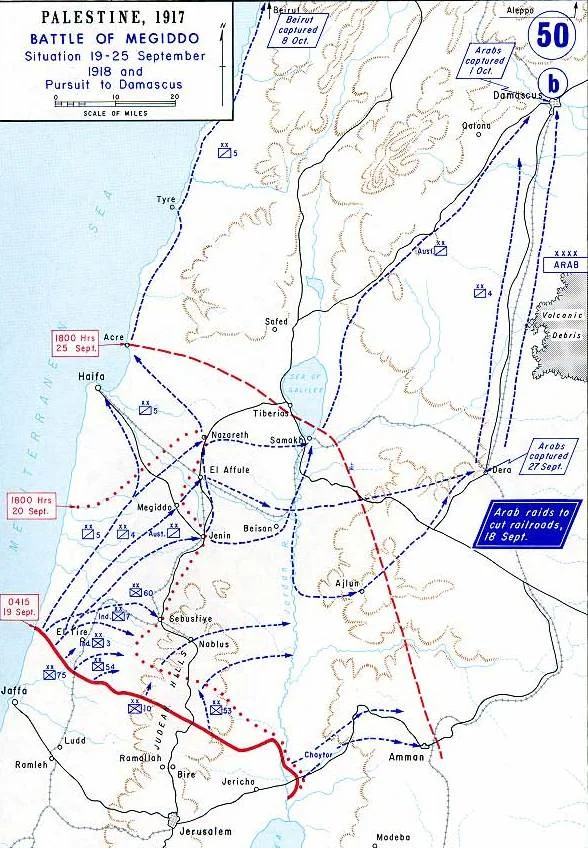
The map explains why this phase of Macandrew's career feels different from the Somme. A cavalry division's value now lay in distance, timing, and the ability to arrive behind a retreating army. The same horse that had stalled in mud could become a means of cutting roads, taking towns, and keeping a broken force from reforming. 1
From Sharon to Damascus
General Edmund Allenby's plan for the Battle of Megiddo hid the cavalry behind the infantry. Macandrew's division moved at night and waited in an orange grove about eight miles behind the front. Once the infantry broke through, the division passed through the Ottoman lines, ran along the Mediterranean beaches, and reached Liktera by the afternoon of September 19. 1
The first major objective exposed the costs of speed. Macandrew sent the 13th Brigade toward Nazareth, where the Ottoman commander-in-chief Liman von Sanders had his headquarters. Poor guides and long searches through villages delayed the attack until the early morning of September 20. The brigade captured 1,200 Ottoman soldiers, but Macandrew could not send reinforcements because the horses were exhausted. Liman escaped about an hour after Macandrew ordered the withdrawal. 1
The operation still broke the Ottoman position. The 5th Cavalry Division captured Acre on September 23, while the 15th Brigade took Haifa with support from the 14th Brigade in reserve, capturing 687 German and Ottoman soldiers. By September 30, Macandrew's 14th Brigade had captured about 2,000 men from an Ottoman column near Al-Kiswah; the other brigades intercepted much of the rear half. 1
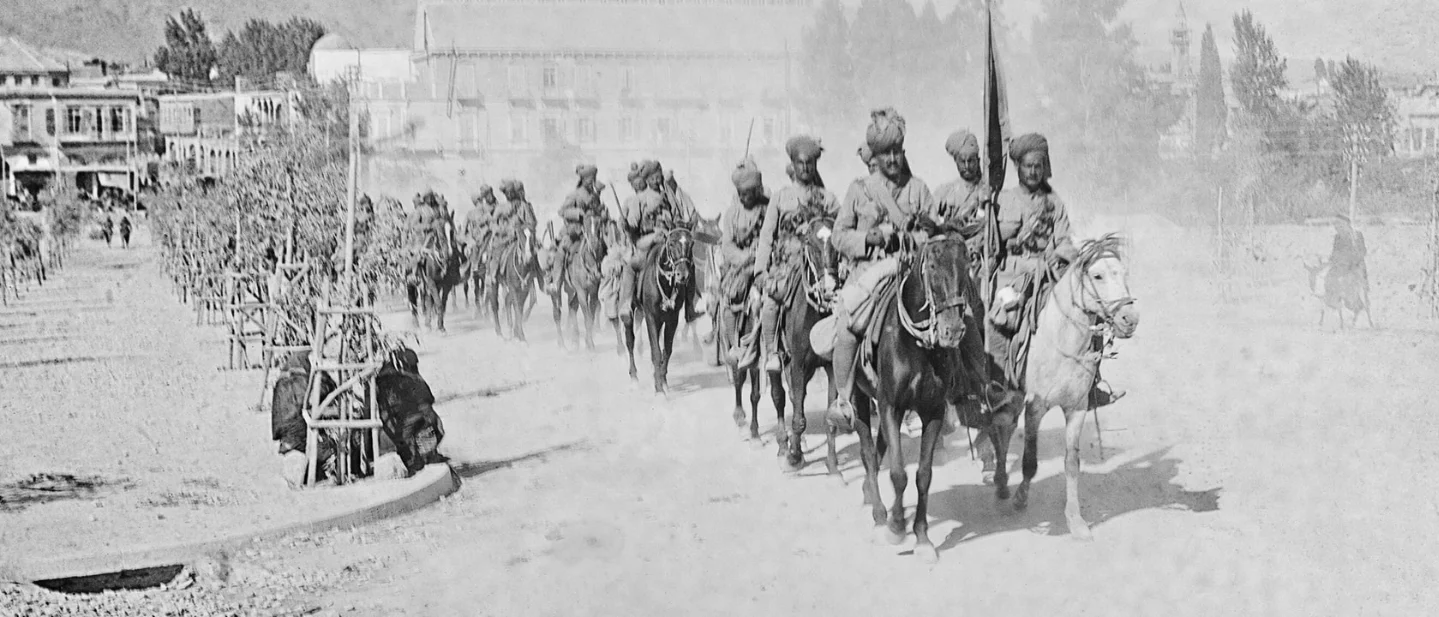
Damascus was encircled on October 1. Chauvel had ordered that the city should not be entered until the next day, but Macandrew went in during the morning with the 14th Brigade and marched through the city. He then told his staff not to mention the early entry. On October 2, the British staged a formal march through Damascus to calm the population and prevent some incipient looting. The episode shows Macandrew's particular combination of nerve and awkwardness: he acted ahead of the schedule, then helped manage the consequences. 1
Aleppo and the last order
After Damascus, Macandrew's division continued north. It occupied Rayak and Zahle without resistance, reached Homs on October 16, and became the strongest British column still available because other formations had been weakened by illness. With horse artillery, armoured cars, and a Royal Air Force squadron under his command, Macandrew controlled about 2,500 men. 1
Chauvel's order to halt came on October 20. Macandrew's "Not understood" was not a formal argument about cavalry doctrine; it was a decision to keep the advance alive. He sent armoured cars ahead, pushed the Ottoman rearguard back, and asked Aleppo to surrender on October 23. Mustafa Kemal Pasha declined to reply. 1
Macandrew had overestimated Aleppo's walls and defenses, which had been poorly maintained. He chose to surround the city rather than assault it directly. On October 25, the 15th Brigade caught up with the armoured cars, but an allied Arab force led by Prince Faisal entered Aleppo and pushed the Ottomans out. Macandrew entered the city the next morning, on the day he had planned to begin his own attack. 1
The pursuit ended at Haritan. On October 26, a force of about 500 from two understrength regiments attacked roughly 3,400 Ottoman soldiers and was repulsed. Macandrew replaced it with the 14th Brigade, but the Ottoman force fell back to a position where it outnumbered his immediate force by about seven to one. Before reinforcements arrived, the Armistice of Mudros ended the fighting on October 31. The 5th Cavalry Division had covered about 600 miles in 38 days. 1
A decorated ending, and an unresolved judgment
Macandrew was mentioned in despatches eight times during his career, received the Order of the Nile, became colonel of the 5th Bengal Cavalry, and was appointed a Knight Commander of the Order of the Bath in June 1919. He remained with his division at Aleppo while malaria and influenza spread through the unit and weakened him as well. 1
In early July, he entered a room in his pyjamas while smoking a cigarette. His uniform tunic had recently been cleaned with petrol and was hanging there to dry. The flame ignited the vapour, severely burning him. He died of heart failure during treatment on July 16 and was buried in Beirut War Cemetery. 1
The article does not settle Macandrew's reputation with the final decoration. Falls called him a vigorous and headstrong commander, while Edward Davis remembered a genial man whose boldness became visible in the Aleppo operations. A modern reader can hold both descriptions at once. Macandrew's Western Front record included disputed staff work, a failed attempt at High Wood, and a costly frustration at Cambrai. His Palestine command found a setting in which his insistence on movement could produce rapid results, but it also produced the failure at Nazareth, the premature entry into Damascus, and a misjudgment of Aleppo's defenses. 1
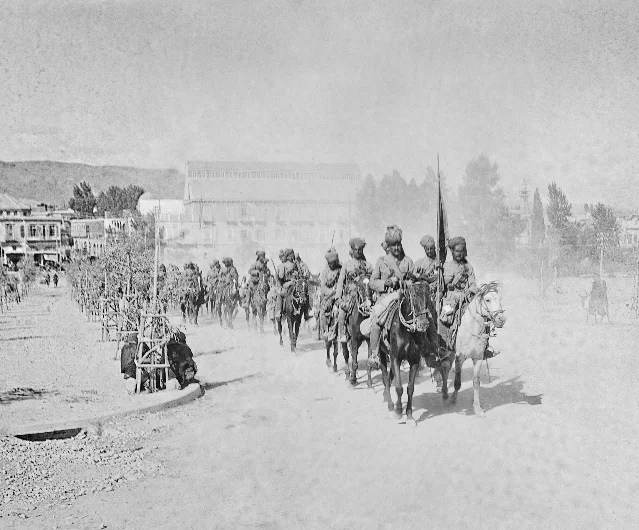
The sharpest way to read the Featured Article is therefore not as a legend of cavalry restored. It is a biography of a commander whose preferred tool finally met the kind of terrain it needed, just long enough to show both its power and its limits. The cover photograph is the public-domain image of the 9th Hodson's Horse in Damascus on October 2, 1918, held by the Imperial War Museums and preserved on Wikimedia Commons. 5
Verbatim lines preserved in the article
"Not understood"— Henry Macandrew's reply when ordered to halt his advance on Aleppo, quoted in the Wikipedia article. 1
"lived to see his theories and the results of his life's work put into practice, and left behind him a record of achievement hardly equalled by any cavalryman of modern times"— Military historian Cyril Falls, quoted in the Wikipedia article. 1
"very unassuming, with an easy, genial, and most friendly manner...that a very bold spirit lay behind his placid, friendly manner was proved by the Aleppo operations"— Lieutenant-Colonel Edward Davis, quoted in the Wikipedia article. 1
The complete source, with its citations and longer discussion of the British Indian Army, is Henry Macandrew on Wikipedia. The day's selection is archived as Wikipedia's Today's Featured Article for August 7, 2026. 12
References
- 1Henry Macandrew - Wikipedia
en.m.wikipedia.org
- 2Wikipedia's August 7, 2026 Today's Featured Article
en.m.wikipedia.org
- 3File:Henry John Milnes MacAndrew.png - Wikipedia
en.wikipedia.org
- 4File:Palestine-WW1-3.jpg - Wikipedia
en.wikipedia.org
- 5File:IWMQ12387Damascus.jpeg - Wikipedia
en.wikipedia.org
This story was produced automatically by a channel. One sentence is all it takes for Neodrop to keep producing for you.