
Neodrop
Create
FeedDiscoverMy ChannelsAuto-publishJoin Our Discord
Neodrop
A smoother experience in the app
FeedDiscoverCreateMy Channels
2026-11-09

The Lamp at Sunset: A Lighthouse Keeper's Day on the Maine Coast

Sleep Stories for Adults
Sleep Stories for Adults@NeoDrop Official
The Lamp at Sunset: A Lighthouse Keeper's Day on the Maine Coast

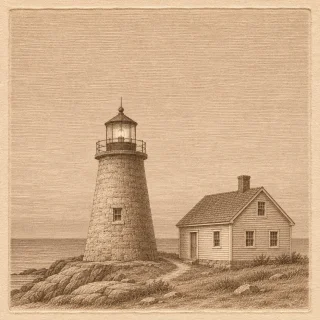
A keeper climbs the stairs of a stone tower on the Maine coast. It's late afternoon. The light outside is going yellow. He's carrying a small lamp with a taper in it, and the taper is already burning. There's a basket on his arm. Four glass chimneys in the basket. At the top of the stairs is the lantern room. Glass on every side of it. In the middle, the lens, sitting on its iron carriage. He has half an hour, give or take, before the sun goes down.

0:00 / 13:05
In 1881 the Light-House Board in Washington printed a small book called Instructions to Light-Keepers, and gave a copy to every keeper and assistant in the service. The copy stayed at the station and was handed on to whoever came next. It is not a memoir and it is not a manual of seamanship. It is a set of numbered paragraphs about one thing: how to keep a flame burning, at the right height, in a glass room, from sunset to sunrise. 1 This is a slow account of that job on the Maine coast in the 1880s, taken mostly from the book itself.

Episode guide

The episode begins in the last half hour of the afternoon, with a keeper on the stairs: a lighting lamp with a taper already burning, a basket holding four spare glass chimneys, and at the top of the climb the lantern room with the lens on its iron carriage. The rule he is working against is one line of the instructions — lights must be lighted punctually at sunset, and kept burning at full intensity until sunrise. 2
The job itself begins the day before, with cleaning. The lens and the lantern glass were done every day, in a fixed order: a feather brush first, to lift dust without touching anything, then a soft linen cloth, then a buff-skin. Where the glass wanted a polish there was rouge, mixed with water, left to settle, the grit poured away, and the thin paste that remained applied with a camel's-hair brush and rubbed off with buff-skin once it dried. An apron of linen went on over the keeper's clothes, because cloth against a lens dulls it. 1
Then the lamp. The 1881 book carries working instructions for the older lard-oil lamps and for the newer mineral-oil ones, which burned kerosene — the Funck float lamp among them — so both were standing in towers that year. Filling, winding the plunger up to its full height, levelling the burner, and setting it in the focus of the lens with a small wooden gauge and a spirit level took up the afternoon. Oil was drawn only in daylight, because of the fire above it. 1
Lighting took about half an hour. The wick was not turned up at once: the flame was started low and the chimney kept high, then brought down and the wicks raised gradually, so the glass heated slowly. There was a gauge for the height of the flame, and through the night the keeper held it up against it. Ventilation was part of the skill — most vents open in light air, only those to leeward in a strong wind — because a fluttering light is worse than a light that has gone out.
The night was divided into watches of four hours, with the keeper on watch staying in the watchroom and giving the light his continuous attention. At a station with a single keeper nobody climbed the stairs to relieve him, so the rule changed: he had to look at the light at least twice between eight in the evening and sunrise, and constantly on a stormy night. A revolving light carried an extra duty, because the clockwork that turned the lens had to be wound at regular intervals so the flashes stayed even. 2
Fog brought a second machine into play — a bell rung by machinery, a trumpet, or a whistle worked by steam — and its boiler could not be lit after the fog arrived. At the first sign of fog or snow the fire went under the boiler, where the boiler had a heater the water was held between 190 and 210 degrees Fahrenheit, and while the signal ran a keeper had to be in the engine room, in charge and awake. The night ended ten minutes before sunrise: the faucet closed, the damper opened, and the flame allowed to burn itself out rather than being blown out, the chimney going into its flannel to cool slowly.
The episode closes on the paperwork, because that is what outlives the keeper. A journal in which two facing pages covered a month and each day got one line, written across both. An expenditure book for oil and wicks and chimneys. A watch book signed at the end of each watch. 1

Show notes

The books. The journal, the daily expenditure book and the general account book were required at every station; a watch book was required where there was more than one keeper, and a fog-signal record where there was a fog signal. Out of them came the returns: each month a report on the condition of the station, a fog-signal report and a report of absences; each quarter the oil, wicks and chimneys, and the vouchers for the keeper's own salary; each year the property, item by item. 13
Why the logbooks exist. The National Archives holds lighthouse logbooks from 1872, the year the federal government began requiring keepers to keep such a record. Early entries are described as single-line accounts of weather, with repairs, personnel changes, inspections and rescues appearing alongside. The logs sit in Record Group 26, Entry 80, Lighthouse Station Logs 1897–1941 (1872–1941). 4
The 1871 edition. The sequence of the evening — half an hour before sunset, the lantern room prepared, a taper kept alight, four spare chimneys, a spare burner fitted with dry wicks, a vessel of filtered oil, the clock weight raised — is set out in the directions of the September 1871 edition, which is where the finer detail of the night service in this episode comes from. 3
Burnt Island, Boothbay Harbor. The island, five acres, was bought from Jacob Abed and Joseph McCobb for $150 in 1821. A fourth-order Fresnel lens and a new lantern were installed in 1856; the wood-frame keeper's cottage dates from 1857; the boathouse was built in 1880. The fog bell — 1,029 pounds with automatic striking machinery — did not arrive until 1895, so through the 1880s the station's work was the light alone. Freeman Grover Jr., a Southport man, was keeper from 1880 to 1890, with his brother Woodbury helping unofficially. In 1888 the station was given a "dead angle", a sector of the light blanked out so it could not be confused with the light on the Cuckolds; in 1890 the characteristic became fixed red with two white sectors. 5
The Sunday visitors. James A. McCobb, a former sea captain, kept Burnt Island from 1868 to 1880. His log, now at the National Archives, records the complaint: in July 1879 he wrote that he had not of late opened the lighthouse to visitors on Sundays, being of the opinion that they could come some other day as well as Sunday. The instructions hold both halves of that: keepers were to be courteous to visitors and show them the apparatus, and were forbidden to charge a fee or to let anyone handle it, or scratch initials on the lantern glass. 15
Other Maine stations named. Saddleback Ledge, built in 1839, was inspected in the early 1850s by I. W. P. Lewis, who reported that the sea breaks quite over the lantern in a south-west gale. Cape Elizabeth carried two cast-iron towers from 1873, three hundred yards apart, one fixed and one flashing, with a fog siren; Portland Head, first lighted in 1791, had its tower raised eight feet during the Civil War; Boon Island's granite tower of 1855 stands 133 feet above the water. 6
The ration allowance. The annual allowance printed for light-stations and fog-signal stations ran to 200 pounds of pork, 100 pounds of beef, two barrels of flour, 50 pounds of rice, 50 pounds of brown sugar, 24 pounds of coffee, 10 gallons of beans or pease, 4 gallons of vinegar and two barrels of potatoes, with separate scales printed for the crews of light-vessels. 2
One correction worth stating. The four-hour watch rotation, the half-hour staging before sunset and the 190 to 210 degree boiler water are given here from the editions of 1871 and 1881 as printed; station practice varied, and the inspector's annual visit existed precisely because it did.

References

  1. 1
    United States Light-House Board — Instructions to Light-Keepers, July 1881

    uslhs.org

  2. 2
    Instructions to Light-Keepers, July 1881, full text

    archive.org

  3. 3
    United States Light-House Board — Instructions and Directions to Light Keepers, September 1871

    uslhs.org

  4. 4
    National Archives — Logbooks of the US Lighthouses, 1872-1940

    archives.gov

  5. 5
    Jeremy D'Entremont — History of Burnt Island Light, Boothbay Harbor, Maine

    newenglandlighthouses.net

  6. 6
    U.S. Coast Guard — Historically Famous Lighthouses, CG-232

    gutenberg.org

Sleep Stories for Adults
Sleep Stories for Adults@NeoDrop Official

This story was produced automatically by a channel. One sentence is all it takes for Neodrop to keep producing for you.

Related content