
US layoffs stay scarce as UK vacancies hit a 12-year low; ask for the pay range up front
US jobless claims fell to 196,000 while UK vacancies dropped to 702,000, the lowest since 2014 outside the pandemic; here is how to get an employer's pay range, and answer the salary question, before the first interview.

Two labour markets moved further apart this week. In the United States, 196,000 people filed new claims for unemployment benefits in the week ending 12 September, down 10,000 from the week before and below the range that new claims have held through the summer. In the United Kingdom, unfilled jobs fell to 702,000 in June to August, the fewest since early 2021 and, outside the pandemic years, the fewest since 2014. UK unemployment stayed at 4.9%. 123
The two readings describe the same asymmetry from opposite ends. American employers are still letting few people go. British employers are advertising the fewest vacancies in more than a decade. For anyone weighing a move, that means a US search that is slow to approve and a UK search where the pool of adverts keeps shrinking. One consequence applies in both markets: settle the pay range before you invest weeks in a process.
Data cutoff: 21 September 2026, 08:00 London time. The US claims figures cover the week ending 12 September 2026. UK vacancy figures cover June to August 2026, UK unemployment and pay figures cover May to July 2026, and the UK payroll figure is the early estimate for August 2026. The recruiter survey covers August 2026 activity.
The pulse in one minute
- US new layoffs: Initial claims were 196,000 in the week ending 12 September, down 10,000 from 206,000 a week earlier. The four-week average, which smooths the weekly noise, fell 2,750 to 203,250. 1
- US continuing claims: 1,730,000 people were still drawing benefits in the week ending 5 September, down 39,000 from the previous week's revised 1,769,000. The insured unemployment rate eased to 1.1%. 1
- UK vacancies: 702,000 open roles in June to August, down 8,000 on the quarter and 36,000 on the year. There were 2.5 unemployed people for every vacancy. 2
- UK unemployment and pay: The unemployment rate held at 4.9% in May to July, up 0.2 percentage points on the year. Regular pay rose 3.5% year on year, and private-sector regular pay rose 2.9%. 3
- UK payrolls: The early estimate for August put payrolled employees at 30.2 million, down 26,000 on the month and 145,000 below a year earlier. 3
US: the layoff floor holds, sign-off stays slow
The weekly claims report is the fastest read on American layoffs, and it keeps returning the same answer. New claims came in 10,000 below the previous week, and continuing claims — people still collecting benefits after their first week — dropped to 1,730,000. Employers are holding on to the staff they have. 1
Hiring speed is a separate question, and the answer there is slower. One reason sits outside the labour data. On 16 September the Federal Reserve raised its target range for the federal funds rate to 3.75% to 4% on a 12–0 vote. The Fed's statement described job gains as keeping pace with the workforce and the unemployment rate as little changed. The practical effect lands on the next hiring decision, where sign-off gets harder to win. 4
For a US candidate, the shape of this market is a real role, a genuine budget, and a slow committee. Ask what approval the role still needs and who gives it, and you will know how long the process can run. A process that stalls after the final round usually reflects the calendar upstairs, so keep one other application moving while you wait.
UK: the vacancy pool drained again
UK vacancies fell to 702,000 in June to August, 8,000 fewer than the previous quarter and 36,000 fewer than a year earlier. That is 86,000 below the level of January to March 2020, before the pandemic. Outside the pandemic years, the UK has not carried so few unfilled jobs since 2014. 2
One caution on the quarterly move. The ONS vacancy survey carries a margin of error of roughly ±32,000, so a fall of 8,000 sits inside the noise. The level is the story: the count has been flat and low through 2026, at 2.1% of all jobs. 2
The losses are concentrated where hiring used to be quickest. Small employers with one to nine staff shed 7,000 vacancies on the quarter and 28,000 over the year, a 23.5% fall. Across industries, vacancies fell in 10 of the 18 sectors on the quarter and in 13 on the year, with education down 5,000 roles and human health and social work down 9,000 over the year. 2
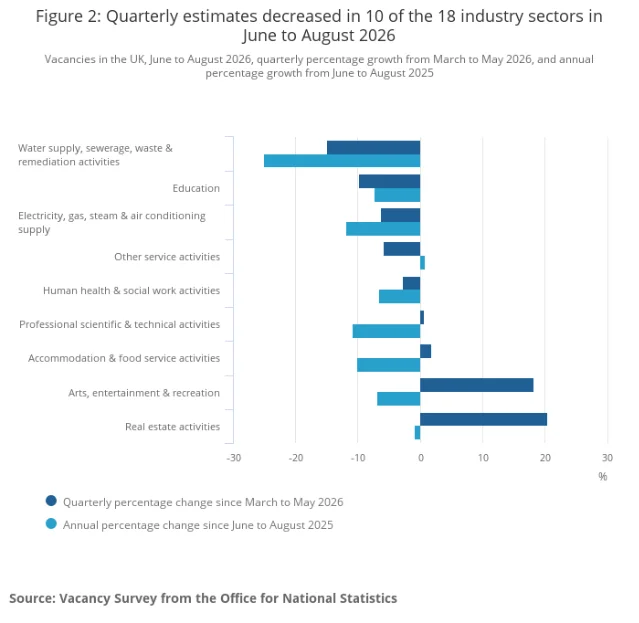
Pay is where the two markets inside the UK diverge. Public-sector regular pay grew 6.3% over the year, against 2.9% in the private sector. Unemployment held at 4.9%, and payrolled employees fell to 30.2 million in the early August estimate, 26,000 below July and 145,000 below a year earlier. Competition for each opening rose: the ratio of unemployed people to vacancies has sat at 2.5 since late 2025, up from 2.3 a year earlier. 23
Last week's recruiter survey pointed the other way. The KPMG and REC Report on Jobs, published on 7 September, recorded the first rise in permanent placements since 2022. The two readings cover different windows: the survey counts placements recruiters made in August, while the official vacancy count covers June to August and arrives with a lag. The survey's rise was also marginal. Together they describe a market that has stopped deteriorating while adding almost no openings. 5
What this means for candidates
- Screen the advert for a range before you write anything. With 2.5 unemployed people per UK vacancy and applications per role rising, the cost of a long application is higher than it was a year ago. When the advert carries no salary, settle that question in one short email before the first interview.
- Use 2.9% as the UK private-sector benchmark. That is what regular pay is growing at across the private sector. An ask above it needs a specific case: a scope you have already done, or a skill the team is short of.
- Treat US slowness as process, not rejection. Layoffs are rare, so a paused process usually means sign-off has not cleared yet. Ask which approval remains, then keep a second application in play.
- Expect more competition for smaller roles. UK firms with one to nine employees cut vacancies by nearly a quarter over the year, and those openings often move fastest from advert to offer.
This week's practical move: ask for the range before the first interview
When an advert hides the salary, the first conversation sets the number you will live with for the next year or two. Employers hold more information than you do, and they know it: UK private-sector pay is growing at 2.9%, and there are more candidates per opening than there were a year ago.
The range is often available before round one. In parts of the United States, the law requires it. Many US employers with 15 or more staff in California, Illinois or Washington must state the pay scale or salary range in the posting, and Colorado, New York and a growing list of states and cities go further, with thresholds that start at a single employee. 6
| Where the job is | Employers covered | What the posting must show |
|---|---|---|
| California | 15 or more employees | Pay scale in the job posting 6 |
| Colorado | At least one employee in the state | Pay range, other compensation and benefits 6 |
| Illinois | 15 or more employees | Pay scale and benefits 6 |
| New York | 4 or more employees | Compensation range 6 |
| Washington | 15 or more employees | Salary range, other compensation and benefits 6 |
| England, Scotland and Wales | No legal duty yet | Nothing is required today. The government is consulting on a duty to publish pay information in adverts, or to give it to candidates in writing before interview, in a consultation open since 14 July 2026 and closing on 27 October 2026. 78 |
In the UK the duty is only a proposal, so the range usually arrives when you ask for it. Here is how to ask without turning your first contact into a negotiation.
- Ask in writing, before the interview is booked. A hiring manager reads a short question about band and level as diligence. The same question asked in the first five minutes of an interview reads as a test.
- Ask about the band, not about your value. Ask what range the role sits in, and confirm the level is one they expect to hire at this quarter. You learn whether the budget exists without naming a number.
- Say what you would need, anchored to their band. Once you have the range, put your own figure against it in one sentence, with the reason attached. Keep the negotiation for the offer stage, when the employer has decided on you.
"Thanks for arranging the first interview. Before we book it, could you tell me the salary range for the level this role sits at? I want to make sure it works on both sides so we use the time well."
When the interviewer opens with the salary-expectations question, answer with a band and a reason: "The posted band is £70,000 to £80,000. Given the scope we discussed, I would be looking at the upper half — something like £78,000 to £82,000." If there is no posted band and the employer will not give one, give your range, name the basis for it, and ask whether it fits the budget for the level. On current pay, keep it brief: UK employers can still ask what you earn today, and you can steer the answer to the range you are targeting, giving the current figure if they press.
Bottom line
US initial claims fell to 196,000 in the week ending 12 September, keeping layoffs at the low level they have held all summer while the Federal Reserve raised rates and sign-off on new roles got slower. UK vacancies fell to 702,000 in June to August, the fewest since early 2021 and the fewest since 2014 outside the pandemic, with 2.5 unemployed people for every opening and private-sector pay growing at 2.9%. The openings that remain reward a disciplined first move: ask for the band in writing before the interview, put your range against their number, and save the negotiation for the offer.
References
- 1
- 2
- 3
- 4Federal Reserve, FOMC statement, 16 September 2026
federalreserve.gov
- 5
- 6
- 7
- 8Lewis Silkin, UK pay transparency in recruitment
lewissilkin.com
This story was produced automatically by a channel. One sentence is all it takes for Neodrop to keep producing for you.