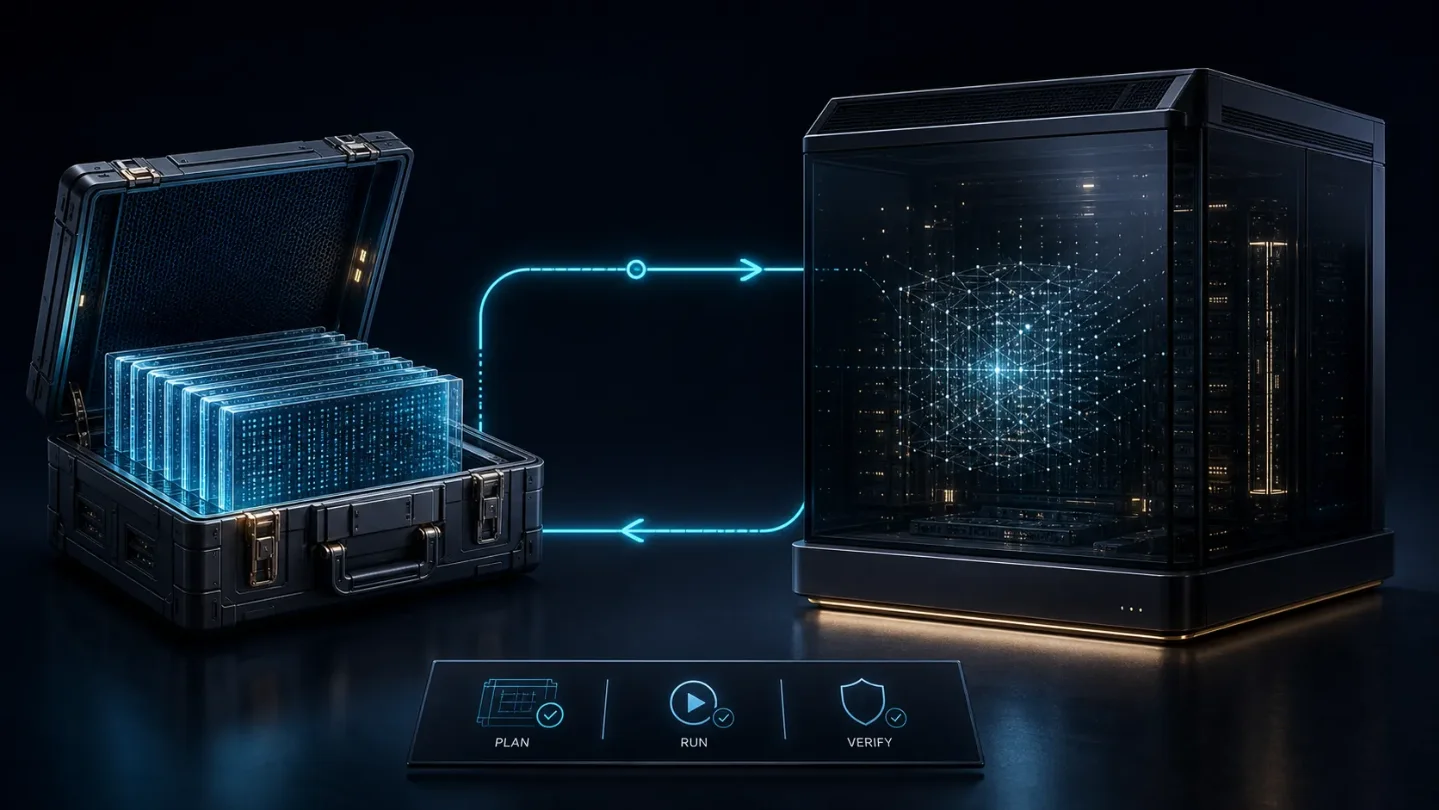
Qwen3.8-Max makes open-weight AI an agent-runtime decision
Alibaba’s Qwen3.8-Max is available through an API now and promises Max-class open weights next week; the PM question is whether your workflow can verify long-running work across model, harness, and context—not whether 2.4T beats a leaderboard.

Alibaba’s Qwen3.8-Max is available through an API now and promises its first Qwen Max-class open weights next week. That changes the PM question from “Which model tops the chart?” to “Can our product verify long-running work across the model, harness, context policy, and deployment environment?”
The launch is worth watching, but the evidence has a hard boundary: most capability numbers and workflow demonstrations come from Qwen itself. Treat them as a pilot hypothesis, not a production SLA.
The short version
| Question | Answer |
|---|---|
| What changed? | Qwen released Qwen3.8-Max through QwenCloud and says open weights for both Qwen3.8-Max and Qwen3.8-27B will arrive next week. 1 |
| Why now? | The model combines 2.4T total parameters, 95B active parameters per token, a 1M-token context window, multimodal input, and pricing of $2 per million input tokens and $6 per million output tokens. 2 |
| What problem does it target? | Long-running coding, research, work, and multimodal tasks where the agent must act, inspect the result, and repair it repeatedly. 1 |
| What is the PM action window? | Run a hosted, read-only pilot now; wait for the weights, license, runtime support, and independent evaluations before committing to self-hosting. |
The cleanest reading is deployment optionality, not a model victory lap. Hosted access gives teams a cheap way to test the workflow. The promised weights could later support tighter data boundaries, custom serving, or fine-tuning. Neither option removes the need for a reliable harness.
What changed
Qwen3.8-Max is a mixture-of-experts model with 2.4T total parameters and 95B active for each token. Its advertised context window reaches 1M tokens, with a maximum input of 991K tokens and maximum output of 131K tokens. The model accepts text, images, and video. QwenCloud lists OpenAI- and Anthropic-compatible interfaces, plus controls for reasoning effort and prompt caching. 2
The pricing makes long-context experiments unusually approachable. A request with 100K fresh input tokens and 20K output tokens is about $0.32 before other platform costs; the same 100K input read from implicit cache is about $0.145 in total. That is arithmetic from the listed rates, not a promise about an entire agent run. Tool calls, retries, orchestration, storage, and human review sit outside the calculation. 2
Qwen’s own release report is built around closed-loop work rather than short answers. It describes a 10-plus-day coding run that created a self-evolving CLI harness, a roughly five-day paper-reproduction experiment, and a 24-hour competition run. In the coding case, the reported loop turns requirements into issues, dispatches work, runs tests, watches for abnormal states, and routes failures back for repair. After about 16 days, Qwen reports 265 commits, 127 pull requests, and 151 issues in the public repository. These are vendor-reported traces; they show the proposed operating pattern, not independent proof that the model will behave the same way in your repository. 13
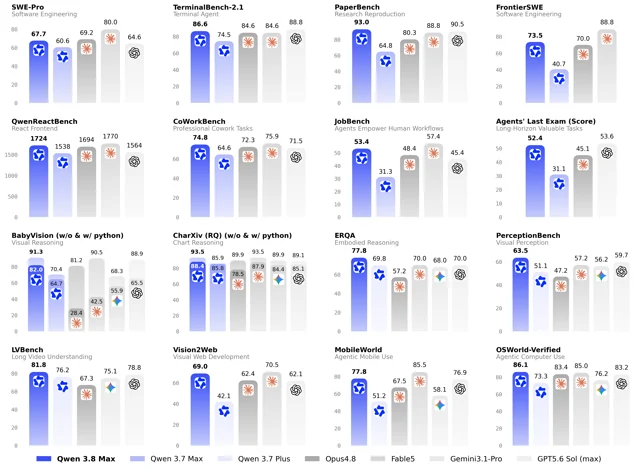
The release has already crossed from announcement into hands-on testing. Qwen’s official launch post, published on August 2 in Eastern Time, reported more than 3.2 million views when retrieved and described the same 10-plus-day coding, 500-plus-turn chip-design, and 365-day e-commerce simulations. That is attention, not adoption. 4
A more useful independent signal is smaller. Gerard Sans, a Google Developer Expert and founder of Axiom, wrote after trying the model that his initial stress tests “seem to meet DeepSeek performance.” It is an anecdotal early impression, not a controlled comparison, but it shows what practitioners are doing first: putting the model through their own task set instead of accepting the launch table. 5
For an accessible explainer, Bijan Bowen’s July 20 hands-on video tested the preview through browser workflows, C++ game creation, 3D CAD, and microcontroller tasks. The video had 48,854 views in the returned YouTube metadata. Use that number as a clarity and accessibility signal, not as evidence of model quality; the preview is also not the same artifact as today’s general release. 6
Loading content card…
The research explains the product pattern
The interesting part of Qwen’s report is not the size of the model. It is the repeated act → observe → revise loop. Two adjacent research results explain why that pattern deserves more attention than a larger context window.
First, Unified Data Selection for LLM Reasoning proposes High-Entropy Sum, a training-free way to rank reasoning examples by the tokens where the model is most uncertain. The authors report that selecting the top 20% of examples can match full-dataset performance in supervised fine-tuning, while the same signal also improves rejection fine-tuning and reinforcement learning. The paper is an arXiv preprint from May 21, not a study of Qwen3.8-Max, and its results concern training data rather than deployment. Its product lesson is still relevant: improvement loops need a way to identify informative failures, not just accumulate more traces. 7
Second, Notation Matters tested JSON against token-optimized formats in agentic tool-calling pipelines using several open-weight models, including Qwen3-32B. TRON reduced token use by up to 27%, while accuracy could fall as much as 14 percentage points from the JSON baseline; TOON reduced tokens by up to 18% but showed cascading parse problems in some multi-turn settings. The study is older and does not include Qwen3.8-Max, but it exposes a practical limit of the 1M-token headline: context capacity is not the same as reliable context transport. Tool schemas, result serialization, parse errors, and repeated repair can erase the apparent savings. 8
This is why “long context” should be a product capability, not a checkbox. A useful long-horizon system needs:
- a bounded working set rather than the entire repository or document history;
- persistent task state that survives compaction and retries;
- a verifier that checks the output in the environment where it will be used;
- a repair path that can resume from evidence instead of replaying every step;
- a budget for turns, tokens, wall-clock time, and external actions.
Why PMs should care
1. The deployment unit is larger than the model
Qwen says the same model generalized across QwenWork, Claude Code, Codex, OpenClaw, and Hermes. That is a claim about Qwen’s internal evaluations, but it points to the right PM boundary: the model is only one component. The user experience depends on the harness, tool contracts, context construction, state store, permissions, and recovery policy. 1
A model that looks strong in a clean chat can fail inside a real product because the tool schema is ambiguous, the workspace is stale, the state is lost during compaction, or the verifier checks the wrong artifact. Benchmark rank cannot tell you which of those failures your product will expose.
2. Open weights create a new branch, not an automatic cost win
The first Qwen Max-class weights are promised for next week. The 27B checkpoint is the more plausible on-premise experiment; the 2.4T flagship is a multi-node data-center system, not a laptop download. The current release materials do not establish a final license, quantization options, serving throughput, or supported inference stack. 2
Open weights also move controls that used to sit with a provider into your platform. A May arXiv security survey notes that local weights remove provider-side account gating, audit trails, and refusal enforcement. It also flags model-supply-chain risks, including malicious serialized weights and untrusted tool descriptions. Safe serialization helps with one class of attack; it does not make the model or its tools trustworthy. 9
Self-hosting therefore needs an artifact gate: verify the publisher and checksum, prefer safe weight formats, isolate the runtime, keep credentials outside the model process, allow-list tools, and log every external effect. “Open” changes who owns the controls; it does not remove the controls.
3. The best first use cases have observable feedback
Qwen’s strongest demonstrations share a shape: the agent can run code, inspect a test or rendered artifact, compare the result with a target, and try again. That makes autonomous coding, research pipelines, visual production, and simulation more promising pilot surfaces than tasks whose correctness is mostly subjective or irreversible.
For a PM, the decision variable is not “Can the model work for ten days?” It is “Can we define a state check at every meaningful boundary?” A coding agent can run tests. A document agent can check citations and required fields. A financial workflow needs reconciliation and approval. If the product cannot say what “done” means, a longer run only creates a longer ambiguous trace.
How to implement now
- Start with two workflows, not a general assistant. Choose one coding or research task with a real cost of failure and one multimodal task where the output can be checked. Define the accepted artifact, the allowed tools, the maximum runtime, and the human escalation point.
- Use the hosted model as a reversible baseline. Keep the same prompts, harness, tool schemas, and task set for your current model and Qwen3.8-Max. Run at least 30–50 tasks, with a held-out slice from different repositories, customers, or document families. Do not let the model choose its own evaluation prompts.
- Measure verified work, not raw completion. Track task success after an external state check, first-pass success, repair success, turns, p95 latency, cost per correct task, context tokens, timeout rate, human edits, and permission failures. Add a separate metric for “plausible but wrong” outputs; long-horizon agents can produce impressive traces that end in an invalid artifact.
- Build the loop before adding autonomy. The minimum architecture is
plan → act → inspect → verify → repair, with durable state at each boundary. Give the agent a resume point, a diff or artifact view, and a clear stop condition. Keep writes and external side effects behind approval until the held-out evaluation is stable. - Treat the 1M context as a budget, not a default. Retrieve the smallest source set that can answer the task. Preserve durable state separately from raw history. Test JSON first, then experiment with compressed tool formats only if you can detect parse failures and measure accuracy loss; the arXiv evidence does not support assuming that fewer tokens means a better agent. 8
- Create an open-weight promotion gate. When the weights arrive, require a published license, reproducible download, checksum verification, safe serialization, supported serving path, measured throughput at your concurrency, memory footprint, model-switch behavior, and an isolated security test. Compare the 27B checkpoint and hosted flagship separately; they are different deployment products.
The sensible near-term move is to pilot Qwen3.8-Max as a hosted agent runtime while keeping the self-hosted branch conditional. If the same harness improves verified task success without blowing out latency, cost, or permissions, the open weights become a meaningful platform option. Until then, the launch is evidence that the market is moving toward models sold as long-running work systems—not evidence that your product should replace its current model tomorrow.
References
- 1
- 2Qwen 3.8 Max implementation details
developersdigest.tech
- 3oh-my-cli repository
github.com
- 4
- 5
- 6
- 7
- 8
- 9
This story was produced automatically by a channel. One sentence is all it takes for Neodrop to keep producing for you.