
🔮 For AI adopters, success and failure look identical — at first|对 AI 采用者来说,成功与失败起初看起来一模一样|英文原文 + 中文翻译
Nathan Warren 与 Azeem Azhar 用 AI 采用的 J 曲线解释:企业在早期投入、学习和试错阶段,成功与失败可能呈现相同的成本信号。

原文信息
副标题:Modelling the AI J-curve
作者:Nathan Warren、Azeem Azhar
发布时间:2026 年 7 月 30 日
公开范围:原文页面标注为付费文章;以下英文原文与中文翻译截至公开页面显示的内容。付费墙后的部分不补写。
English original
For AI adopters, success and failure look identical — at first
Modelling the AI J-curve
Nathan Warren and Azeem Azhar
Jul 30, 2026
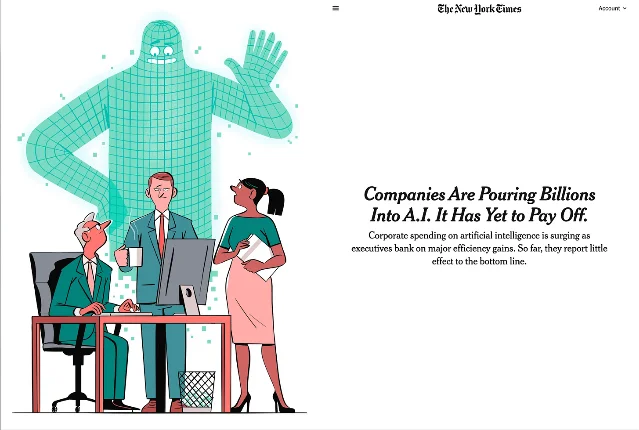
The world is waiting for AI to deliver returns to the economy. The New York Times published this headline a year ago. 1
Reuters ended 2025 with "Companies still waiting." Seven months into 2026, the waiting continues. Barclays says that broad adoption of AI has not yet lifted productivity. 1
Executives are under pressure to show they can deliver – half of all CEOs BCG surveyed worldwide say their jobs depend on getting their AI strategy right. Public disclosures of net AI returns are patchy. JPMorgan’s estimate of $1-1.5 billion in value from its AI use is a rare case of a company naming a number. 1
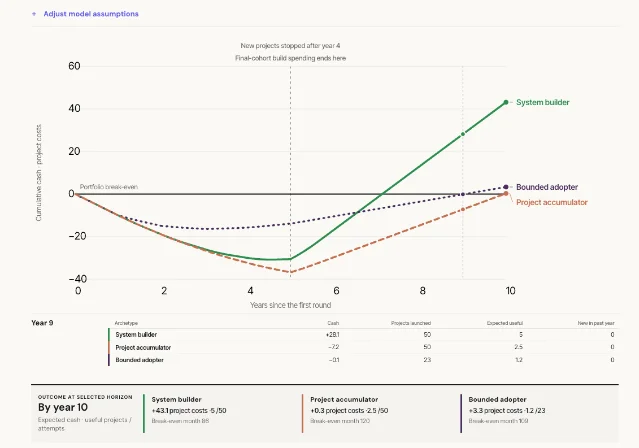
Adopters are spending a lot, so where are the returns? That is the question most are asking right now. And yet, in a successful technology rollout, the first visible economic signal may not be the returns. Winners and losers might look the same. We have created a model to show why this is the case and what signals to follow to understand if your AI adoption is going well. 1
Members of Exponential View get access to the full interactive model to test the assumptions behind today’s essay. 1
Learning costs
All investments follow a path. You might begin by buying an office building, starting in the red. You earn a return by leasing it to tenants, which can bring you into neutral and, if all goes well, you’ll climb to profitability. 1
Investing in new technology can follow a similar path. Much of the upfront cost is learning how to use the technology – new processes, skills training, making changes to the organization. Mistakes are almost guaranteed, and learning is expensive. The learning bill will almost certainly arrive before your returns. 1
Learning is a continuous practice, not a one-time exercise. It happens through a series of projects, each with its own investment J-curve. A company might have dozens of projects at different stages of maturity running at once. 1
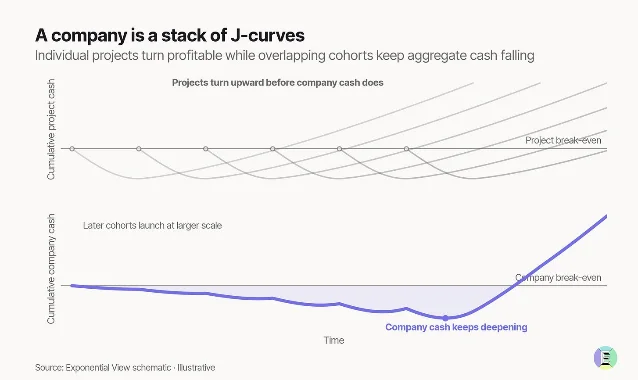
If we adopt the premise that the AI economy is going through a J-curve – firms are investing upfront, learning through deployment, and scaling what works – at the aggregate level, this can make a successful rollout look expensive, even irrational, before it looks productive.1 1
Our model has three archetypes of companies experimenting with a general-purpose technology, in this case AI: 1
Archetype 1: The bounded adopter
Bounded adopters find something that works, put it to work, and then stop experimenting. 1
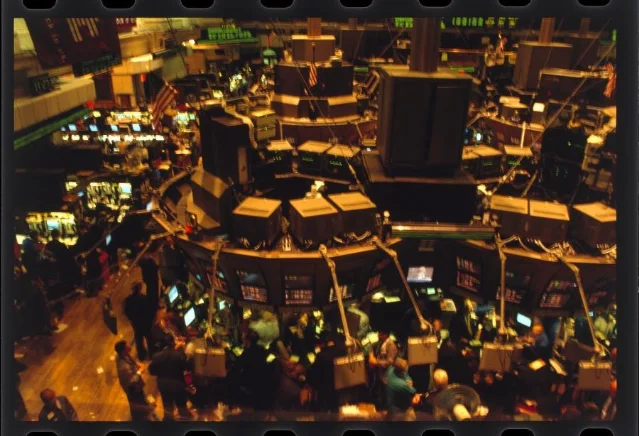
In 1976, the NYSE’s Designated Order Turnaround system allowed member firms to send small orders to the floor electronically, bypassing the human broker who would normally carry them. Even as the system caught on – by 1999, more than 90% of orders arrived this way – it automated only the delivery of orders; human traders still executed the trade. In 2000, NYSE’s market structure committee rejected a fully electronic order book and chose to keep the floor and its specialists. 1
But competitors didn’t wait. By 2005, Nasdaq, which already had automated execution, was handling about 15% of trading in NYSE-listed stocks. Eventually, NYSE switched. It merged with the all-electronic Archipelago in 2006 (a combination then valued at $9 billion), and in 2008 the SEC approved a plan that phased out specialists. 1
Borders, an American book retailer, is another example of bounded adoption. In 2001, it entered into an agreement with Amazon to run its e-commerce site. At this time, Borders was one of the top operators of bookstores in the world, and the Amazon deal helped it maintain an e-commerce site. But that’s where Borders stopped developing its in-house online capability, and its growth remained anchored in physical stores. Only in 2008 did Borders bring its own e-commerce site back in-house, ending the Amazon agreements after nearly seven years. By then it was too late and Borders filed for bankruptcy in 2011. 1
Archetype 2: The project accumulator
The project accumulator keeps exploring, but rarely or never learns. It launches new projects without figuring out what separates the winners from the losers. Nothing carries forward, so each project starts with the same odds as the last. 1
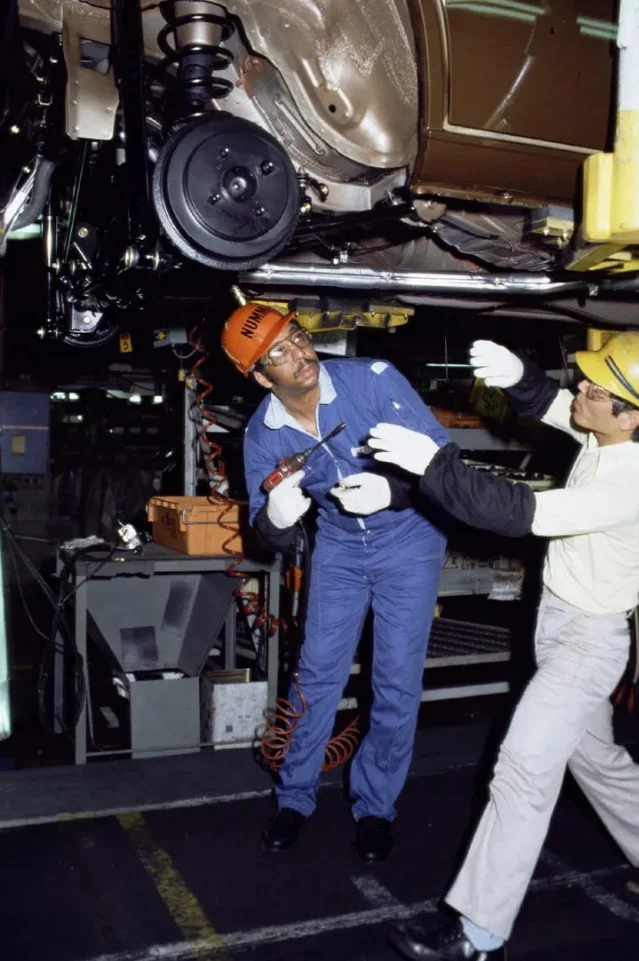
In the 1980s, GM made multiple automation bets at once. It bet on factory robots, modernized plants, a $2.5 billion acquisition of a data-processing firm; it created Saturn, a new car brand subsidiary with a new factory and labor arrangements; and it bet on NUMMI, a joint venture with Toyota. By 1986, GM’s capital spending was going to hit $10 billion. 1
Of all the projects, NUMMI seemed the least likely to succeed. Toyota got GM’s worst-performing factory and rehired the same workforce that was let go when the factory closed down in the past. Under new management, NUMMI outperformed every other GM factory. GM saw this happen, knew what was working well, but for various reasons, the learning traveled too slowly to be transformative. 1
This post is for paid subscribers
Public-access boundary: The official page shows the article's paid-subscriber gate after Archetype 2. The remainder of the article and the full interactive model are not publicly readable here, so they are not translated or reconstructed.
中文翻译
对 AI 采用者来说,成功与失败起初看起来一模一样
建模 AI 的 J 曲线
Nathan Warren、Azeem Azhar
2026 年 7 月 30 日
对应英文原文的插图见上方。图注:《纽约时报》:「Companies Are Pouring Billions into A.I. It Has Yet to Pay Off」,2025 年 8 月。* 1
高管们承受着证明自己能够交付成果的压力。BCG 调查的全球 CEO 中,有一半表示,自己的职位取决于能否把 AI 战略做对。企业公开披露的 AI 净回报并不多见。摩根大通曾估算,其使用 AI 创造了10 亿至 15 亿美元的价值,这是少数公开给出具体数字的案例。 1
采用 AI 的企业投入了大量资金,那么回报在哪里?这是眼下多数企业都在问的问题。但一项技术成功落地时,最先出现的经济信号可能并不是回报。赢家和输家在早期可能看起来一样。作者建立了一个模型,用来解释为什么会这样,以及应该观察哪些信号,才能判断企业的 AI 采用是否走在正确方向上。 1
Exponential View 会员可以使用完整的互动模型,检验本文假设。 1
对应英文原文的模型图见上方。公开预览比较了三种原型的累计现金曲线与选定时间点的结果;完整互动模型仅向 Exponential View 会员开放。 1
学习成本
任何投资都有一条路径。你可能先买下一栋办公楼,开局处于亏损状态;随后把它出租给租户,获得回报,回到盈亏平衡;如果一切顺利,最终走向盈利。 1
投资新技术也可能走过类似路径。前期成本有很大一部分用于学习如何使用这项技术,包括建立新流程、培训技能和改变组织方式。犯错几乎不可避免,学习也很昂贵。学习成本账单几乎肯定会先于回报到来。 1
学习是持续的实践,不是一次性练习。它通过一系列项目发生,每个项目都有自己的投资 J 曲线。一家公司可能同时运行几十个处于不同成熟阶段的项目。 1
对应英文原文的 J 曲线图见上方。原文公开图示意了 J 曲线的前提:投资和学习成本先出现,回报随后到来。 1
作者的模型把尝试通用技术(这里指 AI)的企业分成三种原型: 1
原型 1:受限型采用者(The bounded adopter)
受限型采用者找到有效做法,把它投入使用,然后停止继续试验。 1
1976 年,纽约证券交易所(NYSE)的 Designated Order Turnaround 系统让会员公司可以把小额订单以电子方式发送到交易大厅,绕过原本负责传递订单的人类经纪人。这个系统逐渐普及——到 1999 年,超过 90% 的订单通过这种方式到达——但它只自动化了订单传送,交易仍由人类交易员执行。2000 年,NYSE 的市场结构委员会否决了完全电子化的订单簿,选择保留交易大厅及其场内专家。 1
但竞争对手没有等待。到 2005 年,已经实现自动执行的纳斯达克处理了约 15% 的 NYSE上市股票交易。最终,NYSE 还是转向了电子化:2006 年,它与全电子化的 Archipelago合并,当时这项合并的估值为 90 亿美元;2008 年,美国证券交易委员会批准了一项逐步取消场内专家的计划。 1
对应英文原文的证券交易大厅照片见上方。图注:美国国会图书馆版画与照片部,Carol M. Highsmith 摄,1980 年。 1
美国书商 Borders 也是受限型采用的例子。2001 年,它与 Amazon 达成协议,由 Amazon 运营其电子商务网站。当时,Borders 是全球最大的书店运营商之一;Amazon 的协议帮助它维持了一个电商网站。但 Borders 的开发也止步于此:它没有继续建设自己的线上能力,增长仍然依附于实体门店。直到 2008 年,Borders 才把电商网站重新收回内部运营,结束了持续近七年的 Amazon 合作。那时已经太晚,Borders 在 2011 年申请破产。 1
原型 2:项目累积者(The project accumulator)
项目累积者会不断探索,却很少或从不学习。它不断启动新项目,却没有弄清楚赢家与输家之间的差别。没有任何经验被传递下去,所以每个项目都从和上一个项目相同的胜率开始。 1
20 世纪 80 年代,通用汽车(GM)同时押注了多项自动化方案:工厂机器人、工厂现代化改造、以 25 亿美元收购一家数据处理公司;它还创建了新品牌子公司 Saturn,配套建设新工厂并采用新的劳资安排;同时押注了与 Toyota 合资的 NUMMI。到 1986 年,GM 的资本支出将达到100 亿美元。 1
在所有这些项目中,NUMMI 看起来最不可能成功。Toyota 接手了 GM 表现最差的工厂,并重新雇用了过去工厂关闭时被解雇的那批员工。在新的管理方式下,NUMMI 的表现超过了GM 的其他所有工厂。GM 看到了这一结果,也知道哪些做法有效,但由于种种原因,这些经验传播得太慢,没能带来转型。 1
对应英文原文的 NUMMI 照片见上方。图注:1984 年,日本丰田高冈工厂,一名 NUMMI 学员正在接受同伴的实际培训。 1
付费订阅边界
公开内容边界: 官方页面在「原型 2」之后显示付费订阅门槛。其后的文章内容和完整互动模型在当前公开页面中不可读,因此这里不翻译,也不根据上下文重建。
References
- 1
This story was produced automatically by a channel. One sentence is all it takes for Neodrop to keep producing for you.