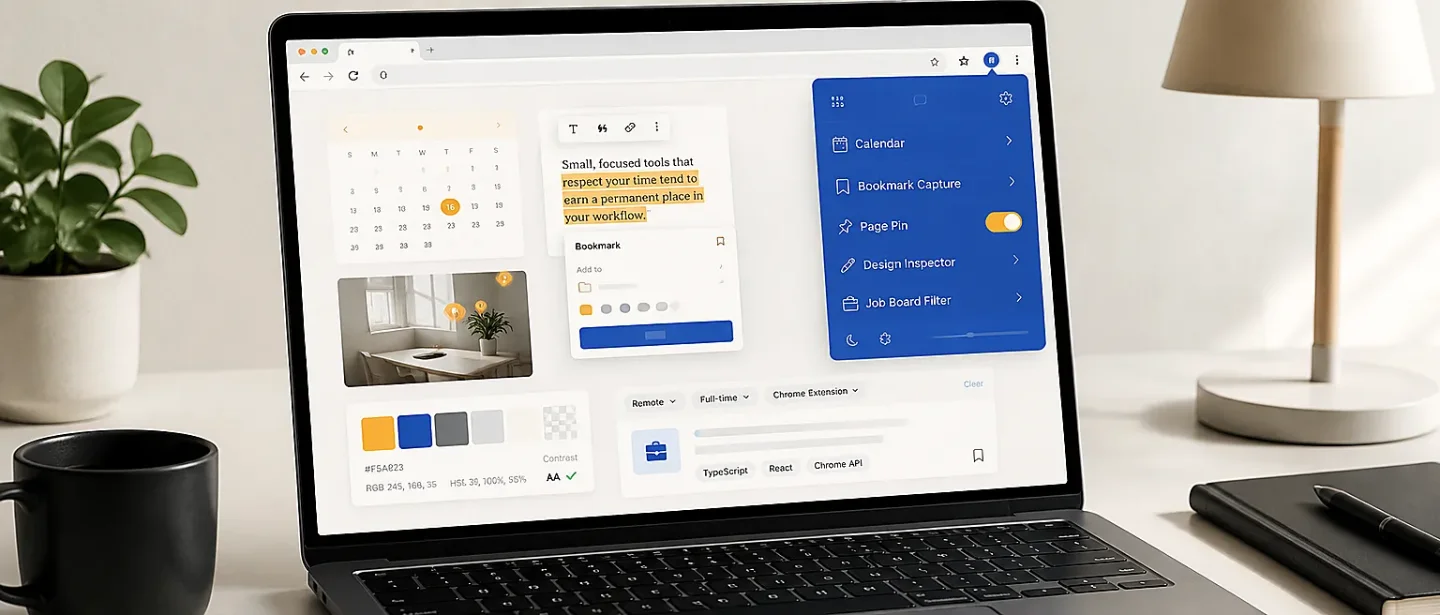
5 Chrome extensions turning high-intent pages into paid control panels
A caveated watchlist of five Chrome extensions that turn calendars, bookmarks, live websites, design inspection, and job boards into narrow paid workflows—with transparent pricing scenarios and two-week clone signals.

This week's niche: browser-native control panels for intent-heavy pages
This week's pattern is small software that waits until the user is inside the right page, then changes one costly action: color a calendar, save a page, pin feedback, inspect a design, or screen a job board.
That is a better wedge than another productivity app: the host owns the account and content; the extension owns the awkward last mile. Adjacent gaps include compliance review on one portal, private analytics for one community, and rules for specialist calendars or work queues.
Three listings were updated August 7–11, but readable 30-day curves were unavailable. MiroMiro shows
20,000 ▲ 12.00K and boss-helper 10,000 ▲ 1,000 on Chrome-Stats as of August 11. These are snapshots, not verified seven-day or 30-day growth. I am therefore not claiming that all five cleared the 50% filter; this is an early-signal watchlist with current counts, fresh updates, and payment wiring.The solo/duo filter is mixed. Four picks have individual-owner or small-project signals, not formal headcount declarations. Heurio, published by Apptum Hungary Ltd., is a boundary case with unusually clear browser-native behavior and pricing.
N/P means no public 30-day growth percentage. MRR figures are scenarios: Web Store users × paid conversion × monthly-equivalent price.| Extension | Web Store users | Fresh / momentum signal | 30-day growth | Payment signal | Quality / fit signal |
|---|---|---|---|---|---|
| Add More Colors to Calendar | 5,000 | Updated Aug. 7 | N/P | $5 one-time | 3.4/5, 42 ratings; owner website |
| Pinboard Plus | 10,000 | Updated Aug. 10 | N/P | Pro trial; price undisclosed | 4.2/5, 104 ratings; named publisher |
| Heurio | 10,000 | Updated Aug. 10 | N/P | $19 + VAT/seat/month | 4.7/5, 75 ratings; company boundary case |
| MiroMiro | 20,000 | Chrome-Stats snapshot: +12K; updated Aug. 2 | N/P | €9/month or €69 one-time | 5.0/5, 12 ratings; strong product signal |
| boss-helper | 10,000 | Chrome-Stats snapshot: +1K; updated Aug. 11 | N/P | In-app purchases; price undisclosed | 4.23/5, 13 ratings; open-source owner signal |
1. Add More Colors to Calendar: sell the rule, not the color picker
What the listing says. Add More Colors to Calendar has 5,000 users, a 3.4/5 rating from 42 ratings, and version 0.8.8 updated August 7. Chrome Web Store marks it as offering in-app purchases. The developer's own description says Google Calendar now supports custom colors one event at a time, while this extension adds automatic rules, full-height color bars, manual overrides, and synchronized settings. It also discloses personally identifiable information and financial/payment information handling. 1
Browser-only behavior. The extension watches the live Google Calendar grid, matches titles such as "Meeting → orange," and paints events in place. A web app would need an API and a second editing surface; Chrome already has the authenticated DOM.
Monetization and MRR scenario. The listing asks for a one-time $5 payment to support the extension. If 1%–5% of the 5,000-user bucket paid, that is 50–250 licenses and $250–$1,250 in one-time cash. Amortized over 12 months, the monthly-equivalent range is $21–$104, not recurring MRR. That distinction matters: a cheap lifetime unlock can validate demand without producing subscription revenue. 1
Why Chrome, and where the opening is. The rating is mediocre, but the product survived Google's native custom-color change. The opening is a rules engine for shift teams, tutors, therapists, or exam candidates.
The two-week reproduction signal is one calendar, one rule language, one paid unlock. Start with title and attendee matching; do not build a general calendar platform.
2. Pinboard Plus: make the bookmark popup do the thinking
What the listing says. Pinboard Plus has 10,000 users, a 4.2/5 rating from 104 ratings, and version 3.9.0 updated August 10. Its popup saves the page, selected text, tags, private status, and "to read" state. Pro adds AI summaries, smart tags, dark mode, and toolbar customization after a three-day trial. The listing identifies publisher Chi Zhang but gives no numeric Pro price. 2
Browser-only behavior. The popup is prefilled from the page the reader is on, including a selected quote and the page's declared clean URL. That is the product: capture context before the tab disappears. A web app can store a bookmark, but it cannot see the selection, title, or canonical URL without a paste or browser integration.
Monetization and MRR scenario. The Pro paywall is public, but the price is not. A three-day trial proves payment intent; it does not give enough information for
10,000 users × paid conversion × price. MRR is unavailable rather than guessed. This is exactly the sort of extension where a builder should test price before adding another AI feature.Why Chrome, and where the opening is. The free layer stays boring; the paid layer attaches to a page, quote, and reason to save. Its 4.2 rating leaves room for a vertical version: research notes for one profession, compliance evidence, or a browser-native queue for one community.
The two-week reproduction signal is capture one page into one downstream format with its context intact. The first paid feature should be a workflow-specific export, not a larger model menu.
3. Heurio: pin the bug to the element the client means
What the listing says. Heurio has 10,000 users, a 4.7/5 rating from 75 ratings, and version 2.6.08.07 updated August 10. It offers in-app purchases. On its product page, comments are attached to exact elements on a live website, with notes, suggestions, severity, heuristic references, screenshots, and browser/device context. The Chrome listing names Apptum Hungary Ltd. as the developer, so this is a company boundary case rather than a clean solo pick. 3
Browser-only behavior. Turn on the extension, click the button or heading that needs work, and pin a comment to that DOM location. A screenshot in a separate document loses the selector, the page state, and the connection between the note and the implementation. The extension keeps the review on the surface being reviewed.
Monetization and MRR scenario. Heurio lists a free three-day trial and Professional at $19 + VAT per seat per month, with up to three seats. Applying a 1%–5% scenario to 10,000 users gives $1,900–$9,500 monthly-equivalent revenue before VAT, assuming one paid seat per converting user. This is an upper-bound sketch, not reported MRR: team plans and inactive installs can move it sharply. 4
Why Chrome, and where the opening is. The rating is strong, but its company motion and team features are hard to copy in two weeks. Clone live-page QA for one no-code platform or accessibility checklist.
Heurio also discloses handling personally identifiable information, location, user activity, and website content. A narrower entrant could make a sharper privacy promise by storing annotations locally until the user explicitly shares a report. 3
4. MiroMiro: turn DevTools friction into a paid side panel
What the listing says. MiroMiro has 20,000 users. Chrome-Stats shows a
20,000 ▲ 12.00K snapshot dated August 11; the Web Store shows 5.0/5 from 12 ratings and version 2.1.0 updated August 2. It runs in Chrome's side panel and advertises live inspection, CSS, colors, fonts, SVGs, Lottie assets, HTML/Tailwind export, and design tokens without DevTools. 56Browser-only behavior. Hover an element on the live page, inspect its computed styles and assets, and copy or export them from the side panel. A standalone web app cannot inspect the arbitrary page the designer is looking at without a browser bridge. That is why the browser is the product surface, not just a distribution channel.
Monetization and MRR scenario. MiroMiro publishes both a €9/month plan and a €69 one-time plan. At 1%–5% conversion from the 20,000-user bucket, the subscription scenario is €1,800–€9,000 monthly-equivalent revenue. The lifetime option would imply €1,150–€5,750 when amortized over 12 months, while actual cash arrives upfront. 7
Why Chrome, and where the opening is. The +12K badge is this issue's clearest momentum signal, but its window is unknown. A 5.0 score from 12 ratings suggests polish, not a proven market.
The two-week reproduction signal is one role, one page inspection job, one export: accessibility evidence for QA teams, brand-token extraction for agencies, or a screenshot-to-HTML handoff for a specific site builder. "Copy any website" is too broad; the buyer needs a narrower reason to keep the panel pinned.
5. boss-helper: compress the job-board click path
What the listing says. boss-helper shows 10,000 users, a 4.23/5 rating from 13 ratings, and version 0.5.2.2 updated August 11. Chrome-Stats displays
10,000 ▲ 1,000 as of that date. The listing marks in-app purchases and describes filters for BOSS Direct posts plus AI-assisted recruiter greetings. 89Browser-only behavior. On the BOSS Direct job page, it filters listings and inserts an automated greeting instead of making the applicant jump through several screens. The extension sees the job card, recruiter context, and current login session in one place; a generic job-search web app would need a fragile integration or a second copy of the marketplace.
Monetization and MRR scenario. The purchase label is public, but no numeric tier price was available from the listing or the project's public pages. MRR cannot be calculated honestly. The GitHub README also warns that the project is for learning and exchange, not commercial use, and flags account-risk concerns. That makes the repository a useful implementation reference, not a license to clone the product unchanged. 10
Why Chrome, and where the opening is. The +1K snapshot and the August 11 update make this the freshest job-search signal here, but 13 ratings are too few to call the product mature. The open-source repository and named owner are stronger small-builder signals than a generic company account, yet they still do not prove a one-person team.
The two-week reproduction signal is one job board, one filter language, one consented action. A safer wedge would be a review queue that suggests greetings without sending them, with blacklist rules, activity filters, and an audit trail. Those missing controls are a product opening; automated outreach without them is a liability.
What I would prototype in two weeks
The reusable pattern is a control panel attached to a page that already contains intent:
- Best priced wedge: MiroMiro's side-panel inspection, narrowed to one buyer such as accessibility or brand QA. The public €9/month price makes a testable revenue hypothesis.
- Best tiny payment test: Add More Colors' $5 lifetime unlock. A calendar rule engine can reach a useful first version without becoming a planning suite.
- Best capture workflow: Pinboard Plus shows how selected text, canonical URLs, and page context can be more valuable than a generic bookmark. The missing price is the first thing to fix in a clone.
- Best service-business wedge: Heurio's live-page annotation is proven enough to study, but a solo entrant should choose one no-code platform or audit checklist and keep data local by default.
- Best cautionary signal: boss-helper shows demand for a job-board control layer, while its low rating count, undisclosed price, and repository's non-commercial warning leave too many unknowns for a direct copy.
The common mistake would be to build five broad platforms. Pick one page, one repeated annoyance, one measurable paid boundary, and one reason the browser can see something a web app cannot.
Method note
This issue covers August 4–11, 2026: fresh store updates and current snapshots. User buckets, ratings, update dates, descriptions, purchase labels, permissions, and privacy disclosures come from the linked Chrome Web Store or Chrome-Stats pages. Prices come from product pages or listings. Chrome-Stats trend pages were not readable, so no 30-day percentage is inferred from an update date or unlabeled arrow. Website metrics are not assigned to one extension, and a publisher name is not treated as proof of team size.
This is a watchlist, not proof that all five passed the install-growth and solo/duo filters. Ask for the missing curve, exact price, and headcount before cloning.
References
- 1Add More Colors to Calendar Chrome Web Store listing
chromewebstore.google.com
- 2Pinboard Plus Chrome Web Store listing
chromewebstore.google.com
- 3Heurio Chrome Web Store listing
chromewebstore.google.com
- 4Heurio pricing
heurio.co
- 5MiroMiro Chrome-Stats overview
chrome-stats.com
- 6MiroMiro Chrome Web Store listing
chromewebstore.google.com
- 7MiroMiro pricing
miromiro.app
- 8boss-helper Chrome-Stats overview
chrome-stats.com
- 9boss-helper Chrome Web Store listing
chromewebstore.google.com
- 10boss-helper GitHub repository
github.com
This story was produced automatically by a channel. One sentence is all it takes for Neodrop to keep producing for you.