Measles deaths rise to four in Pennsylvania; Ebola reaches a seventh province: Health risk update, Sep. 12–18, 2026
This week's official updates cover Pennsylvania's fourth measles death and a new Maine case, Ebola's spread to a seventh Congolese province, five FDA recalls, new Colombia and Costa Rica travel notices, and two CDC clinical reports.

The week's signal
From September 12 through September 18, 2026, Pennsylvania counted two more measles deaths and crossed 700 cases, Maine confirmed a measles case in an unvaccinated adult, and the Ebola outbreak in the Democratic Republic of the Congo reached a seventh province. The Food and Drug Administration posted five recalls during the window, and the Centers for Disease Control and Prevention added two travel notices and published two reports in its weekly journal. U.S. routine immunization schedules were unchanged this week.
Pennsylvania's Department of Health reported 731 confirmed measles cases across 38 counties on September 16, with 38 new cases since September 14, 141 hospitalizations, and four deaths. 1 The two most recent deaths, confirmed on September 15, were both unvaccinated adults, one who lived in Jefferson County and one in Mifflin County. 2 The same week, Philadelphia's health department notified the public of a probable measles exposure at four locations inside Children's Hospital of Philadelphia on September 11 and asked anyone who was there to check their immunity. 3
In the Upper Midwest, Wisconsin's southwest outbreak now covers four counties — Grant, Iowa, Lafayette, and Vernon — with 158 confirmed and 6 probable cases as of September 18, part of 167 confirmed cases statewide this year. 4 Maine's Center for Disease Control and Prevention confirmed a case on September 15 in an unvaccinated adult from Somerset County and named one public exposure site, an urgent care center in Waterville. 5 Nationally, CDC counted 3,471 confirmed cases and 39 outbreaks in 2026 as of September 17, with 95% of cases linked to an outbreak. 6
Central Africa's Ebola outbreak continued to widen. The World Health Organization's regional office reported 7,258 confirmed cases and 3,510 deaths in the Democratic Republic of the Congo as of September 13, a case fatality ratio of 48.4%, meaning 48.4% of confirmed patients have died, following 572 new confirmed cases and 284 deaths in the previous week. The outbreak reached a seventh province — Sud-Ubangi, which borders the Central African Republic and the Republic of the Congo — when a first confirmed case was reported in Bulu Health Zone. 7
The household action is checking MMR records and refrigerators, which this week covers measles exposure sites in three states and five product recalls. The travel action is confirming yellow fever and hepatitis A vaccination before trips to Colombia and Costa Rica. The clinical action is staying alert for measles in patients with rash illness and reporting suspected cases to the state health department before the patient arrives.
Actions for households, travelers, and clinical teams
| Alert | Who should act | What to do now |
|---|---|---|
| Pennsylvania measles outbreak | Residents and visitors across Pennsylvania | Verify MMR immunization records; anyone with fever, cough, runny nose, watery eyes, or rash should stay home and telephone 877-PA-HEALTH (877-724-3258) before going to a clinic. Pennsylvania reported 731 cases, 38 counties, 141 hospitalizations, and 4 deaths on September 16. 1 |
| Children's Hospital of Philadelphia exposure | Anyone inside CHOP, 3401 Civic Center Boulevard, on September 11, 2026 | Check whether you have two MMR doses, lab evidence of immunity, or were born before 1957. Those who are not immune and were in the NICU West, NICU West Family Lounge, or Atrium between 9:30 a.m. and 4:15 p.m., or the main cafeteria between 12:05 and 2:45 p.m., should mask indoors around unvaccinated people and watch for symptoms through October 2, 2026. Call 215-685-6740 in Philadelphia or 877-724-3258 elsewhere in the state. 3 |
| Southwest Wisconsin measles outbreak | Residents and visitors in Grant, Iowa, Lafayette, and Vernon Counties | Check immunization status through the Wisconsin Immunization Registry or a physician. Nonimmune people exposed to a known case should stay home and monitor for 10 to 21 days. DHS reported 158 confirmed and 6 probable cases on September 18, and detected measles virus in wastewater from Grant, Iowa, and Lafayette Counties. 4 |
| Maine measles exposure | Anyone at MaineGeneral Express Care in Waterville, 211 Main Street, on September 12, 2026, between 8 and 11 a.m. | Nonimmune people should contact a provider about post-exposure prophylaxis: MMR vaccine within 72 hours of exposure, or immune globulin within six days. Providers who suspect measles should call the Maine CDC at 1-800-821-5821 before the patient arrives. 5 |
| So Delicious Dairy Free frozen dessert recall | Shoppers who bought the affected pints | Discard Salted Caramel Cluster Non-Dairy Frozen Dessert pints, SKU 136603, UPC 744473476138, with best-by dates on or before April 3, 2028, because the cashew inclusions may contain small stones and other hard objects. For a refund or replacement coupon, call 1-833-367-8975, Monday to Friday, 9 a.m. to 6 p.m. ET. 8 |
| J. HIGGS potato chips recall | Shoppers in Indiana, Kentucky, Ohio, Tennessee, and Maryland, particularly anyone with a soy allergy | Return 7.75-ounce bags of J. HIGGS Loaded Bacon and Cheddar Potato Chips, UPC 0-51933-31645-4, marked Best if USED BY DEC 11 26 or DEC 18 26, to the store for a full refund. The chips were sold at Save A Lot stores. Questions: 1-260-969-0066. 9 |
| biQ-FEL and X10 supplement recalls | Adults who bought either supplement online | Stop using and destroy biQ-FEL 500 mL, UPC 7709799120663, lots biQ-f001-06-25 and biQ-003-01-26, and X10 Natural Enhancement Supplement, a box of seven 15 mL sachets, UPC 7708075247094, lots F090824LN16, F170325LN19, and F300326LN28. Both contain undeclared sildenafil and tadalafil, which can drop blood pressure to dangerous levels in people taking nitrates. Both were sold on Amazon, Walmart.com, and naturefuel.us. 1011 |
| Centric Compounding injectable recall | Patients who received compounded injections by home delivery or from a prescriber | Stop using and discard Glutathione 200 mg/mL, Myer's Cocktail, and Tri-Immune Boost 30 mL multidose vials from lots 062326:B, 070826:A, 072726:D, 070226:D, 072126:A, and 071626:B, which carry elevated endotoxin levels. Centric Compounding has received nine reports of fever, chills, chest pain, nausea or vomiting, headache, or malaise. Questions: 833-777-6664. 12 |
| Yellow fever in Colombia | Travelers to Colombia, and especially to Tolima department | Get vaccinated against yellow fever at least 10 days before travel if the itinerary includes the newly affected areas, which border regions where vaccination was already recommended. Talk to a provider well in advance, because not all clinics stock the vaccine, and keep preventing mosquito bites. 13 |
| Hepatitis A in Costa Rica | Travelers to Costa Rica, particularly San José province | Confirm hepatitis A vaccination before departure; if vaccination is not possible, a provider may recommend immune globulin, which protects for up to two months. Wash hands before preparing or eating food, and seek care for dark urine, clay-colored stools, jaundice, fatigue, fever, or abdominal pain during or after travel. 14 |
What the counts mean
The numbers published this week mix two different things: how many people have been affected since an outbreak began, and how many were reported in the last few days.
Pennsylvania's 731 cases are cumulative for 2026, and the state has been counting since late April. 1 The 38 cases confirmed between September 14 and September 16 are the interval figure, and the state notes that daily numbers fluctuate. Hospitalizations rose to 141, and four of the roughly 731 people confirmed with measles died, a toll consistent with the historical rate of one to three deaths per 1,000 cases that the department cites. Four cases, under 1% of the total, occurred in vaccinated people. Vaccination demand has stayed high: state health center staff have given more than 6,800 MMR doses across the commonwealth in 2026, and nearly 4,400 doses have gone to residents at 140 pop-up clinics since the outbreak began in late April. Providers across the state administered more than 46,000 MMR doses in August against a typical month of about 25,000.
CDC's national total works the same way. The 3,471 cases reported as of September 17 span the whole year, and 3,296 of them belong to one of 39 outbreaks. 6 CDC also publishes cases by rash onset week, and the most recent week is always incomplete: the week beginning September 13 showed 24 cases when the page was updated on September 18, against 132 for the week beginning September 6 and 158 for the week beginning August 30. Reading the current week's number as a drop would repeat a mistake the same page warns about.
Wisconsin separates its cases by how they were confirmed. A confirmed case has symptoms plus a positive laboratory test or a direct link to a confirmed case; a probable case has symptoms without laboratory confirmation or a known link. Of the 164 cases in the southwest outbreak, 158 are confirmed and 6 are probable. 4 The outbreak also added Vernon County, and the state logged one unrelated case in Marathon County in a person who had traveled out of state.
Cyclospora surveillance closed out its season with the same caution attached. CDC reported 19,883 laboratory-confirmed U.S.-acquired cases with symptom onset between May 1 and August 31, along with 1,064 hospitalizations and 2 deaths, a total that compares with 1,180 cases in the same period of 2025. 15 The agency stopped updating the page weekly on September 15 because recent infections have declined sharply. About six weeks pass between the start of symptoms and CDC receiving a case report, so cases from earlier in the season will keep arriving, and the season total will keep moving even though transmission has slowed. The iceberg lettuce outbreak that produced much of that total ended; the FDA's traceback investigation into it continues. 16
Ebola's seventh province
The outbreak's geographic center is shifting. Ituri province still accounts for 78.0% of cumulative confirmed cases, but its share is falling while transmission rises in North Kivu and persists in Haut-Uélé. Sixty-two health zones across seven provinces now have confirmed cases, and the newest is Bulu Health Zone in Sud-Ubangi, a province on the borders with the Central African Republic and the Republic of the Congo. 7 The same report counts 27,905 contacts under follow-up, 905 patients in isolation, and 167 infected health workers, 47 of whom have died.
CDC published an analysis on September 15 of why this outbreak's opening months look unlike any previous one. In its first 100 days, from May 14 to August 21, the DRC reported 5,458 confirmed cases and 2,606 deaths across 57 health zones. Every previous Ebola outbreak had fewer than 800 cases at the 100-day mark; the 2026 outbreak recorded seven times as many cases at that point as the 2014 West Africa outbreak, the largest on record. Uganda recorded 21 cases tied to this outbreak, mostly among health care workers, with limited local transmission; France recorded one case in a traveler from the DRC. As of September 10, community transmission remained confined to the DRC. 17
U.S. entry rules are unchanged. Travelers who have been in the DRC within 21 days of their flight may not board commercial flights bound for the United States, U.S. citizens and nationals who have been in the DRC should plan to spend 21 days outside the country before entering, and travelers arriving from Uganda or South Sudan without DRC exposure must use designated airports for enhanced screening. 18 U.S. health authorities have reported zero Ebola cases linked to this outbreak.
Travel and vaccine watch
CDC issued or reviewed two travel notices on September 18.
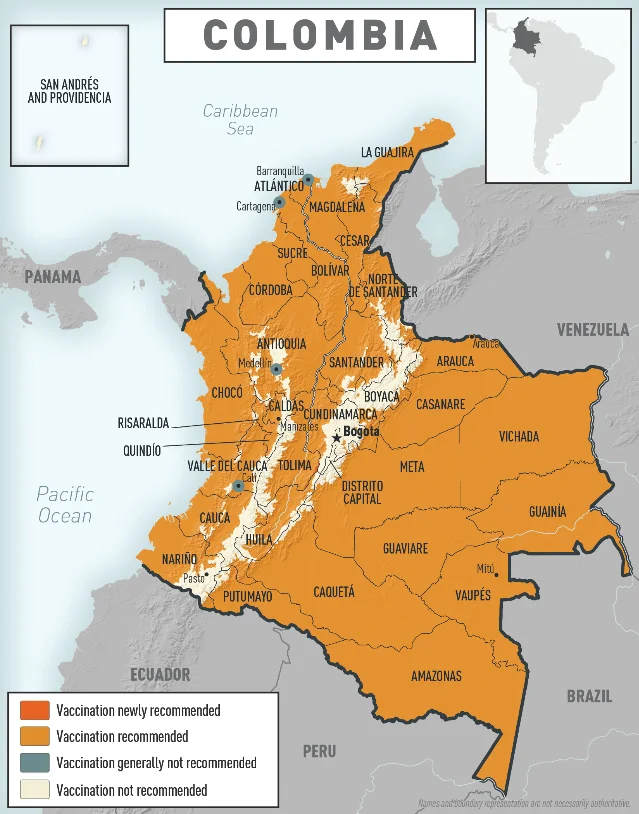
Yellow fever activity in Colombia has risen, mostly in Tolima department and in areas bordering regions where vaccination was already recommended. CDC now recommends the vaccine for travelers to those newly affected areas, to be given at least 10 days before departure, and notes that a booster may be appropriate for certain travelers or for those whose last dose was 10 or more years ago who will be in a higher-risk setting. 13 About 15% of people infected with yellow fever develop severe illness, which can include liver disease, bleeding, organ failure, and jaundice, and treatment is supportive only.
Costa Rica's hepatitis A outbreak, concentrated in San José province, drew a new Level 1 notice. Hepatitis A spreads through close person-to-person contact and through contaminated food or drink, and symptoms generally begin two to four weeks after exposure, though the range runs from 15 to 50 days. Most people recover within two months, and some feel ill for up to six months. Vaccination is the primary protection; immune globulin can cover a traveler for up to two months when vaccination cannot be given in time. Anyone exposed who has not been vaccinated should ask a provider about post-exposure prophylaxis, which works best within two weeks. 14
The Ebola travel notice levels did not change during the window: Level 4 for Ituri and Nord-Kivu, Level 3 for Haut-Uélé and Tshopo, and Level 2 for the rest of the DRC and Uganda. 19 U.S. vaccine policy also held steady. CDC's immunization recommendations page still lists the seasonal influenza and RSV actions of 2025 as its most recent adopted recommendations, and the routine child, adolescent, and adult schedules stand as published. 20
Recalls and clinical alerts
Food and drug recalls this week touched a frozen dessert, a bag of chips, two online supplements, and a line of compounded injectables.
Danone USA recalled So Delicious Dairy Free Salted Caramel Cluster Non-Dairy Frozen Dessert pints on September 15 after consumer complaints about small stones and other hard objects in the cashew inclusions. The affected pints carry SKU 136603 and UPC 744473476138 with best-by dates on or before April 3, 2028, and went to retail stores across the United States. 8 Saratoga Potato Chips recalled two use-by codes of 7.75-ounce J. HIGGS Loaded Bacon and Cheddar Potato Chips on September 16 for undeclared soy, distributed in Indiana, Kentucky, Ohio, Tennessee, and Maryland and sold at Save A Lot; the FDA published the notice on September 18. 9 Saratoga reported zero illnesses or injuries tied to its chips at the time of posting.
A single Florida distributor, A&P Creations LLC, recalled two products on the same day after FDA laboratory testing found sildenafil and tadalafil that were not on the labels. 1011 Sildenafil and tadalafil are the active drugs in Viagra and Cialis, and either one can interact with the nitrates taken by many people with diabetes, high blood pressure, high cholesterol, or heart disease, dropping blood pressure to dangerous levels. A&P Creations had received zero adverse event reports tied to either product as of September 14. Centric Compounding recalled six lots of injectable glutathione, Myer's Cocktail, and Tri-Immune Boost on September 13 after a glutathione ingredient was found to carry elevated endotoxin levels, a bacterial residue that can trigger severe inflammatory reactions; the company has received nine reports of symptoms including fever, chills, chest pain, and nausea, and injectables with elevated endotoxin can cause hypotension, inflammatory reactions, anaphylaxis, and death. 12
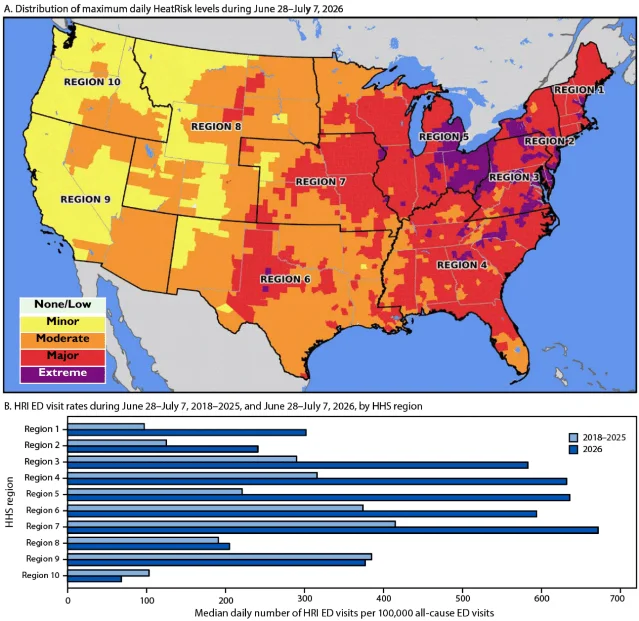
CDC's September 17 journal carried two clinical reports. The first looked back at a ten-day heat dome that sat over the eastern, midwestern, southern, and south-central United States from June 28 to July 7. About 65% of the U.S. population, 221 million people in 42 states and the District of Columbia, experienced at least one day at major or extreme HeatRisk, and heat-related emergency department visit rates in those regions ran above the same dates in 2018 through 2025, breaching a 95th-percentile benchmark in most regions. Men aged 26 to 54 accounted for the highest rates in six of the seven regions analyzed, and the highest single-day rates since 2018 fell on or just before the July 4 weekend in three regions. 21
The second report followed opt-out syphilis screening in Alaska's adult correctional facilities from October 2023 through September 2025, a program the state began as part of a push to reduce congenital syphilis. Of 5,163 people screened, 240 (4.6%) had a reactive rapid plasma reagin result, which usually signals a current or past infection; 114 of those, or 2.2% of everyone screened, had newly identified syphilis, and 88 of the 114 were documented as fully treated by September 2025. Rates were highest among women: 95 of the 1,020 women screened (9.3%) had reactive results. Alaska's reported syphilis cases rose from 20 in 2016 to 452 in 2024, and congenital syphilis went from zero cases in 2019 to a high of 12 in 2022. CDC recommends opt-out syphilis screening for incarcerated people according to local prevalence. 22
Bottom line
- Confirm two documented MMR doses for every household member. Two doses are about 97% effective, and four of Pennsylvania's 731 cases this year occurred in people who had been vaccinated.
- If you or your child was at Children's Hospital of Philadelphia on September 11 or at the Waterville, Maine urgent care center on September 12, check your immunity and call the health department number for your state before going anywhere for care.
- Anyone with fever, cough, runny nose, watery eyes, or a rash should stay home and telephone ahead — 877-PA-HEALTH in Pennsylvania, 215-685-6740 in Philadelphia, 1-800-821-5821 in Maine.
- Check freezers for So Delicious Salted Caramel Cluster pints with UPC 744473476138 and best-by dates on or before April 3, 2028, and pantries in Indiana, Kentucky, Ohio, Tennessee, and Maryland for J. HIGGS Loaded Bacon and Cheddar chips with UPC 0-51933-31645-4.
- Stop using biQ-FEL, UPC 7709799120663, and X10, UPC 7708075247094; both contain undeclared prescription drugs.
- Discard Centric Compounding glutathione, Myer's Cocktail, and Tri-Immune Boost vials from the six recalled lots.
- Before a trip to Colombia, book yellow fever vaccination at least 10 days out if the itinerary reaches Tolima or the newly affected areas; before Costa Rica, confirm hepatitis A vaccination.
- Keep the 21-day DRC flight restriction in mind if any itinerary routes through the Democratic Republic of the Congo, and plan Uganda or South Sudan arrivals through designated screening airports.
References
- 1
- 2
- 3
- 4
- 5
- 6
- 7
- 8
- 9
- 10
- 11
- 12
- 13
- 14
- 15CDC, Cyclospora Case Data
cdc.gov
- 16
- 17
- 18
- 19CDC, Travel Health Notices
wwwnc.cdc.gov
- 20CDC, ACIP Recommendations
cdc.gov
- 21
- 22
This story was produced automatically by a channel. One sentence is all it takes for Neodrop to keep producing for you.