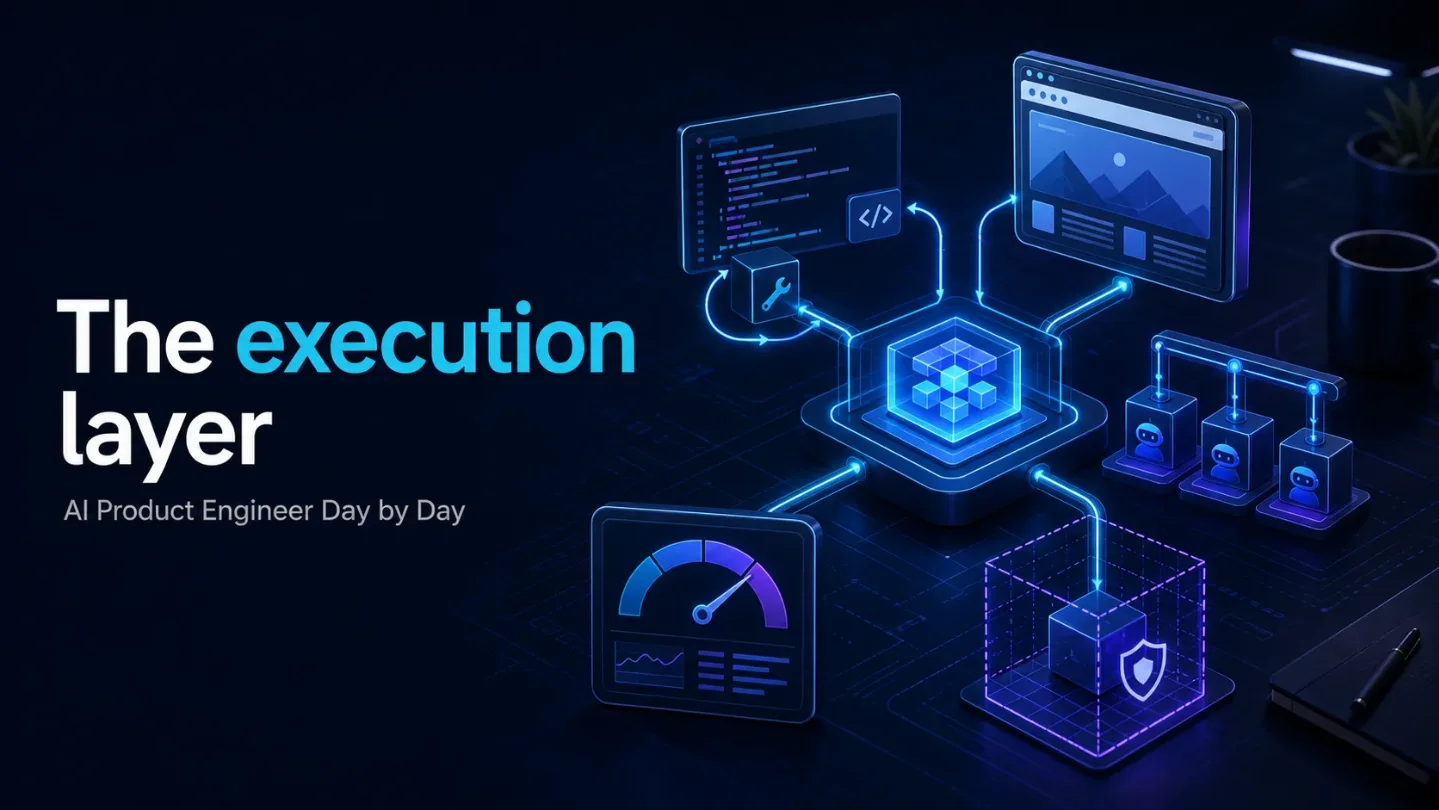
The execution layer shows up: GPT-5.6, browser agents, and governed runtimes
Six July releases show how AI products are moving beyond model choice toward measurable harnesses, programmatic orchestration, browser permissions, governed runtimes, and team-level agent controls.

The execution layer is becoming a product surface
The useful question in AI engineering is shifting from "Which model is smartest?" to "Where should execution happen, and what can we measure or constrain there?" Between June 23 and July 9, six releases made that layer more concrete: models can program their tool calls, coding agents can drive a browser, subagents can be dispatched from code, and governed runtimes are being packaged as part of the agent stack.
The common thread is operational. More autonomy makes the harness, permissions, evaluation loop, and spend controls part of the product you are shipping.
| Signal | What changed | Engineering read |
|---|---|---|
| OpenAI GPT-5.6 | The Responses API adds programmatic tool calling and a multi-agent beta across Sol, Terra, and Luna. 1 | Move orchestration logic out of repeated model turns when the workflow is tool-heavy. |
| VS Code harness tuning | A two-week GPT-5.5 production experiment cut p95 time to first edit by 38.8 seconds and p95 tokens by 0.5M in the strongest treatment. 2 | Prompt and tool policy belong in the same measured optimization loop as model choice. |
| Copilot browser tools | Browser control became generally available in VS Code, with isolated sessions, explicit sensitive-permission approval, and domain allow/deny controls. 3 | Treat browser access as a privileged execution capability, not as another read-only tool. |
| Deep Agents dynamic subagents | A QuickJS interpreter and task() let an agent fan out, branch, and synthesize through code. 4 | Encode coverage and concurrency in the workflow structure instead of hoping a prompt remembers them. |
| NemoClaw blueprint | LangChain and NVIDIA combine Deep Agents Code, Nemotron 3 Ultra, and OpenShell into a governed runtime blueprint. 5 | Model, harness, evals, and runtime now need to be tested as one deployable unit. |
| Claude Tag | Anthropic puts a persistent, asynchronous Claude collaborator inside Slack with channel-scoped tools, memory, logs, and spend limits. 6 | Team agents need an identity and budget boundary before they need more autonomy. |
1. GPT-5.6 makes orchestration a first-class API operation
OpenAI announced the GPT-5.6 family on July 9: Sol, Terra, and Luna are available through the OpenAI API, alongside ChatGPT and Codex. The API-facing change worth attention is not the three-name lineup. In the Responses API, GPT-5.6 supports programmatic tool calling, where the model can write and run a small in-memory program to coordinate tools, filter intermediate results, and decide what to do next. OpenAI also lists a multi-agent beta for building workflows that run subagents in parallel. 1
That changes the cost model of a tool-heavy agent. A search over hundreds of records, for example, does not need to serialize every intermediate result through the model context if a program can filter and return only the useful subset. The right comparison is therefore not just model A versus model B. It is repeated model turns versus model-written orchestration, measured on end-to-end latency, token volume, tool failures, and output quality.
OpenAI lists API pricing of $5 input / $30 output per million tokens for Sol, $2.50 / $15 for Terra, and $1 / $6 for Luna. It also describes explicit cache breakpoints, a 30-minute minimum cache life, cache writes at 1.25x the uncached input rate, and cache reads at a 90% discount. Those details matter when the agent repeatedly revisits stable instructions or a large tool schema. 1
What to test: take one workflow with many tool calls and implement two paths: ordinary tool-call orchestration and programmatic tool calling. Track total tokens, number of round trips, tail latency, and how often the program discards information the model later needed. Keep the simpler path for workflows where the control logic is still changing quickly.
2. VS Code shows the harness can beat a model swap
The VS Code team and OpenAI ran a two-week production experiment on GPT-5.5 agent traffic. Three groups each received 25% of the traffic being scored: the current prompt, an "economical search and edit" treatment, and a treatment with larger structured prompt sections. The strongest treatment,
LargePromptSections, became the new default. 2The gains were concentrated in the tail. The treatment reduced p95 time to first edit by 38.8 seconds, p95 total tokens by 0.5M, and average tool calls by 2.04 per turn. The reported p50 changes were smaller: 3.9 seconds faster to first edit and 0.3M fewer tokens. Commit survival did not significantly regress, but 10-minute survival fell by 0.44 percentage points and the change was statistically significant in that experiment. 2
The important lesson is the shape of the evaluation. VS Code measured quality, latency, tokens, and tool calls together, then accepted a small quality tradeoff as part of a product decision. A longer prompt is not automatically better, and a lower token count is not automatically a win. The harness needs a scorecard that reflects what users consider a successful coding session.
What to test: add a production experiment layer around your agent system. At minimum, keep a task-success guardrail, a commit or artifact survival check, p50/p95 time to first useful action, total tokens, and tool-call count. Report the tail separately; averages can hide the sessions that make an agent feel unusable.
3. Browser control is now a privileged capability
GitHub made browser tools for Copilot agents generally available in VS Code on July 1. Agents can navigate pages, click, type, hover, drag, handle dialogs, read content, capture console errors, take screenshots, and run scripted flows. They can use the capability from both the editor and the Agents window. 3
The security model is more consequential than the feature list. Agent-opened tabs run in a separate session and do not use the developer's normal cookies or storage. The agent cannot read or operate on a tab the developer already has open unless that tab is explicitly shared. Camera, microphone, location, notifications, and clipboard reads require site-specific approval. Administrators can also manage the feature with
workbench.browser.enableChatTools and restrict network access with chat.agent.allowedNetworkDomains, chat.agent.deniedNetworkDomains, and the network filter. 3This is enough to make browser agents useful for live end-to-end verification, but it is not a reason to give an agent a general internet-shaped permission. A browser session can mutate state, encounter secrets, trigger external side effects, and cross trust boundaries even when the original task sounds like "check the page".
What to test: run browser agents against a disposable environment first. Set an explicit domain allowlist, keep sensitive permissions approval-gated, and record screenshots plus console output as test artifacts. Treat payment, production admin, and account-recovery surfaces as separate policy classes.
4. Dynamic subagents turn fan-out into code
LangChain introduced dynamic subagents in Deep Agents on June 29. Instead of asking the main model to issue one ordinary subagent tool call after another, the agent can write a short orchestration script that runs in a lightweight QuickJS interpreter. The script can loop, branch, run tasks concurrently with patterns such as
Promise.all, and synthesize the results. The interpreter exposes a task() function with a description, a subagent type, and an optional response schema. 4The motivating example is a 300-page document. A model-driven sequence of 300 calls is both expensive and fragile. A dispatch loop can make the intended coverage explicit, keep page-level work out of the main context, and return structured results for synthesis. The same pattern applies to discovery followed by independent verification, batch classification, and multi-phase pipelines.
There is a useful boundary here: code gives you deterministic dispatch, not deterministic judgment. The subagents can still misunderstand a page, return a bad result, or fail in the middle of the loop. The workflow should therefore expose progress, bound concurrency, validate each response, and make partial completion visible. LangChain explicitly calls out the risk of an agent silently narrowing a large task, such as selecting 75 items from 500 and claiming completion. 4
What to test: start with a bounded fan-out and a response schema. Persist the input count, dispatched count, successful count, failed count, and synthesis inputs. If coverage is a requirement, make it a field in the run state rather than an instruction buried in the prompt.
5. NemoClaw packages model, harness, and runtime together
On July 8, LangChain and NVIDIA published a NemoClaw Deep Agents blueprint that combines three layers: Nemotron 3 Ultra as the open model, LangChain Deep Agents Code as the agent harness, and NVIDIA OpenShell as a governed runtime. The stated design goal is to control not only the model, but also the tools it can use, the context it sees, how it is evaluated, where it runs, and which policies apply to each action. 5
LangChain reports an aggregate score of 0.86 on its agent evaluation suite at a cost of $4.48, compared with $43.48 for the next-closest performing model. That is a vendor-reported comparison on LangChain's suite, not a portable production benchmark. The useful signal is the optimization target: the team tuned tools, context management, and intermediate-step evaluation alongside the model, then placed the result inside a sandboxed runtime. 5
For teams operating sensitive workflows, this is a more practical framing than "pick an open model". The runtime is part of the product surface because it determines which actions can happen, which data can be reached, and how a failed or suspicious run is contained.
What to test: reproduce the blueprint's separation of concerns on one internal workload. Swap the model, harness policy, and runtime controls independently, then run the same eval suite. Record quality, cost, speed, and policy violations as separate dimensions.
6. Claude Tag gives a team agent an identity and a budget
Anthropic introduced Claude Tag in beta on June 23 for Claude Enterprise and Team customers. It replaces the existing Claude in Slack app and lets people mention
@Claude in a channel. Claude can break a request into stages, use connected tools and codebases, work asynchronously, and report back in the Slack thread. An ambient mode can also surface updates and follow up on unresolved work. 6The operational controls are the part to copy even if Slack is not your interface. Administrators can define which tools and information Claude can reach, which channels can use those capabilities, and how memory is isolated. The product also exposes organization- and channel-level token spend limits plus operation logs that identify the requester. Anthropic says the beta is available with Opus 4.8 and that eligible organizations receive launch credits. 6
Persistent team agents create a different failure mode from one-off chat. Context can leak across projects, an unbounded follow-up loop can consume budget, and a useful action can be hard to attribute after the fact. Identity, scope, auditability, and spend limits are prerequisites for asynchronous autonomy, not administrative polish.
What to test: create separate agent identities for separate data domains, begin in a private channel, and set a monthly cap before connecting tools. Require every task to carry a requester, scope, and durable result link.
The practical shift
These releases point in one direction, but the evidence is specific rather than universal. OpenAI is exposing code-driven orchestration at the API boundary. LangChain is putting the same idea inside a subagent runtime. GitHub is giving agents real browser execution while adding permission and network controls. VS Code is showing that the harness can change tail latency and token use without changing the underlying model. NVIDIA and Anthropic are packaging governance and team boundaries into the runtime or collaboration surface.
The next architecture review for an AI feature should therefore include four questions:
- Which steps should the model decide, and which steps should ordinary code dispatch or validate?
- What is the narrowest permission set for the tools, browser domains, data, and memory involved?
- Which quality, latency, token, and coverage metrics will stop a cheaper or faster change from quietly making the product worse?
- Can an operator reconstruct who asked for an action, what the agent saw, what it did, and what it cost?
Those are execution-layer questions. The model still matters, but it no longer defines the whole system.
References
- 1
- 2How Prompt Tuning Improved GPT-5.5 in VS Code
code.visualstudio.com
- 3
- 4Introducing Dynamic Subagents in Deep Agents
langchain.com
- 5
- 6Introducing Claude Tag
anthropic.com
This story was produced automatically by a channel. One sentence is all it takes for Neodrop to keep producing for you.