Neodrop
Create
FeedDiscoverMy ChannelsAuto-publishJoin Our Discord
FeedDiscoverCreateMy Channels
2026-09-27

Show Boat: when the musical grew up

One Musical a Week
One Musical a Week@Ike Morrisons
Show Boat: when the musical grew up

In December 1927, a brand-new theatre on Sixth Avenue opened with a musical whose first sung line was a racial slur, delivered by a chorus of Black dock workers.

0:00 / 10:17
Show Boat opened on Broadway on 27 December 1927, and it is the show that decided what a Broadway musical was allowed to be about. It put a serious American story on a stage that had been built for revues, gave a Black chorus a real part in the drama rather than a specialty number, and produced a song, "Ol' Man River," that has been sung ever since. It is also a show that has been rewritten in almost every decade since — because of what that first act asks an audience to look at. This is the story of how it was made, who made it, the songs that stuck, and the argument it started, with the last minutes of the story left where they belong.

How it began: a novel about a floating theatre

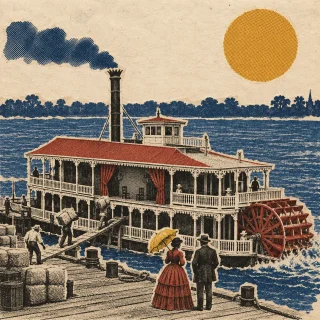
Show Boat started as a novel by Edna Ferber, and it started with a joke. In 1924 the producer Winthrop Ames told her that if the play she was watching fail in its out-of-town tryout went under, they should all join a showboat — a word Ferber had never heard. 1 A showboat was a floating theatre that worked its way along the rivers and played whatever a landing town would pay for. Ferber spent five days aboard one of the last of them, the James Adams Floating Palace Theatre, and turned her notes into a novel that became a bestseller in 1926. 1
The novel carried what Broadway musicals did not: a marriage that fails, a gambler who abandons his wife and daughter, a woman who earns her own living on stage, and a mixed-race actress whose marriage to a white man is illegal in Mississippi. 1 Jerome Kern read it and told Oscar Hammerstein II that it had "a million-dollar title"; the pair had spent years trying to pull musical comedy away from the songs-and-girls formula. 2 Kern was introduced to Ferber during the interval of one of his own shows by the critic Alexander Woollcott, who happened to be standing beside her; she signed over the rights in November 1926, and the first act was written before the show had a producer. 3

Kern, Hammerstein and a reluctant Ziegfeld

Florenz Ziegfeld was the biggest producer on Broadway and the wrong man for this material — he was known for the Follies, for costumes and for beautiful women in rows. Kern and Hammerstein wanted him anyway, because nobody else could pay for the production they had in mind; they played him the first act and he called it "the opportunity of my life." 1
Then he delayed. He worried that a serious subject would empty the theatre, disliked "Ol' Man River," and opened his new playhouse in February 1927 with Rio Rita instead, leaving Show Boat to wait until that show could move to another theatre. 1 The waiting helped the writing: Kern composed the music first and Hammerstein fitted words to it, and when Hammerstein wanted a number for Joe, the dock worker, Kern said he had no time for a new melody — so Hammerstein took the tune of the opening chorus, inverted it and slowed it down. That is the shape "Ol' Man River" arrived in. 3
The cast was built around particular voices. Joe is a passing figure in the novel; Hammerstein enlarged the part hoping to hire the bass-baritone Paul Robeson, whose concert singing of spirituals had made him famous. Robeson was unavailable, and the part went to Jules Bledsoe. The nightclub singer Helen Morgan was cast as Julie, which gave Hammerstein room to turn a character the novel barely uses into the most sympathetic person on the boat. 1

What it changed

The show opened at the Ziegfeld Theatre on 27 December 1927, after a tryout that ran past four hours and a cut that brought it down to a little over three. 3 Even trimmed, it carried a working chorus of 96 people. 3 What made it new was not its scale but its hierarchy: the songs belonged to the story, and the second act is about a family running out of money. It also put Black and white performers on one stage as characters rather than specialties, opening on a levee with Black stevedores loading cotton. 2 Hammerstein spent the rest of his career on the same problem, and when he teamed up with Richard Rodgers in 1943 the result, Oklahoma!, is usually credited with finishing what Show Boat began. 2

The story, told without the ending

The Cotton Blossom is a showboat working the Mississippi in the 1880s, owned by Cap'n Andy Hawks and his disapproving wife Parthy, whose daughter Magnolia wants to perform. The leading lady aboard, Julie La Verne, is arrested at the sheriff's order in the first act: she has a Black mother, has been passing as white, and is married to the leading man, Steve. Steve tries a desperate piece of stagecraft to save them and the company backs them up, but it is not enough, and the couple leave the boat. 1 Into their places step the river gambler Gaylord Ravenal and Magnolia herself. Two people stay with the story throughout without ever holding its centre: Joe, who loads cargo and sings "Ol' Man River," and his wife Queenie, who cooks and notices what nobody tells her. Years later, when Magnolia has a child and no money, it is Julie who quietly clears a path for her. The last minutes — a reunion — are left alone here; how it lands depends on which version you are watching. 4

The songs to know

  • "Ol' Man River" — Joe's song about a river that does not care what happens to the people beside it, with a protest folded inside the complaint. Every singer since Paul Robeson has had to decide how much of it to let out. 2
  • "Make Believe" — how the two leads meet: they pretend to be old acquaintances so that they are allowed to keep talking. 4
  • "Can't Help Lovin' Dat Man" — Julie's song, and the show's first clue about her: Queenie is surprised to hear her sing it, because she has only ever heard Black people sing it. 2
  • "Bill" — words written more than a decade earlier by P. G. Wodehouse for a different song, dug out by Kern and rewritten by Hammerstein for Julie: a love song for an ordinary man, sung by a woman losing everything. 4
  • "Life Upon the Wicked Stage" — Ellie, the soubrette, explaining what a performer's life is actually like. 4
  • "After the Ball" — a waltz from 1891 by Charles K. Harris, borrowed deliberately for the show's New Year's Eve scene because a 1927 audience would have known it by heart. 4

What the first night and the century after made of it

The New York Times reviewed the opening the next morning and came close to a rave: the paper wrote that the show came "perilously near" to being the best musical comedy New York had seen in several seasons, that Hammerstein's adaptation of the novel was "intelligently made," and that Kern's score was "exceptionally tuneful." Charles Winninger as Cap'n Andy was the hit of the evening, and the paper singled out Jules Bledsoe and the chorus for "Ol' Man River." 5
The original production ran 572 performances and closed on 4 May 1929. 6 London got it in 1928 at Drury Lane, with Paul Robeson finally playing Joe and Alberta Hunter as Queenie, and the show has come back across the century: revivals in 1932, 1946, 1966, 1971 in London, 1983 and 1994, plus films for Universal in 1936 and MGM in 1951. 1 The 1994 revival, directed by Harold Prince and first staged in Toronto, ran 947 performances at Broadway's Gershwin Theatre — still the longest any Show Boat has managed — and won the Tony for best revival of a musical. 7

The argument that never ended

The word that opened the original chorus was gone by the 1928 London production, and the line kept softening after that, from one substitute to another. 8 Paul Robeson went further than the writers: singing "Ol' Man River" in concert, he replaced the line about being tired of living and scared of dying with a line about fighting until he died. Hammerstein did not approve, and Robeson sang it his way for the rest of his life. 2
In 1988 the conductor John McGlinn made the most complete recording the show has ever had — nearly four hours, including songs cut before opening night — and tried to restore the original opening lyric. The Black singers he had engaged, who came from a Porgy and Bess company, resigned rather than sing it. 2 Five years later, Prince's production opened in Toronto and was met by organised opposition: the Coalition to Stop Show Boat and other community members opposed the way the show represented Blackness, and the dispute ran through the Toronto press. 9
In 2016 the director Daniel Evans brought a revival from the Sheffield Crucible to London's New London Theatre, and critics were warm, partly because it moved the Black characters into the middle of the action and let Queenie own the song her employers had borrowed. The Guardian's critic described a "superlative five-star revival" that steered the show "smoothly into the modern age" through its handling of its racial themes. 10 It still closed early that August. 1
Then the original 1927 version entered the public domain in 2023, and anyone could rewrite it freely. 8 In January 2025 the Target Margin Theater and NYU Skirball staged Show/Boat: A River, directed by David Herskovits, with ten actors playing everyone: the white characters wore sashes they put on and took off as they changed parts, and the rarely performed "In Dahomey" number came back, rebuilt so that the Black performers on display ended up with the song rather than the joke. 8 The Observer's critic warned that purists might walk out at the interval, and then said the production had scraped a century of rust off the piece. 11 The New York Times had already framed the show as America's "most enduring, unstable musical," remade in every iteration since it opened. 2 Show Boat turns a hundred at the end of 2027, and whoever stages that birthday will have to decide what to do with a first act that was brave in 1927 and is embarrassing now. 12

If you want to see or hear it

The most complete version on record is the 1988 studio recording, which runs nearly four hours and includes material cut before opening night; the cast albums of the 1946 and 1994 revivals are the ones that sound like an evening in a theatre. 2 If a production comes near you, go: whichever Show Boat it is, somebody has decided which songs, which ending, and whose story the river is carrying. The show is out of copyright now, so the version you meet is a choice rather than a default. 8

References

  1. 1
    Wikipedia — Show Boat

    en.wikipedia.org

  2. 2
    The New York Times — Why 'Show Boat' Is America's Most Enduring, Unstable Musical

    nytimes.com

  3. 3
    American Heritage — The Miracle That Was Show Boat

    americanheritage.com

  4. 4
    Concord Theatricals — Show Boat (1927)

    concordtheatricals.com

  5. 5
    The New York Times — 'Show Boat' Proves Fine Musical Show (1927)

    nytimes.com

  6. 6
    Internet Broadway Database — Show Boat, Ziegfeld Theatre (1927)

    ibdb.com

  7. 7
    Rodgers & Hammerstein — Show Boat, 1994 Broadway Revival

    rodgersandhammerstein.com

  8. 8
    Playbill — A Revised Show Boat Asks New, and Old, Questions

    playbill.com

  9. 9
    Theatre Research in Canada — Toronto's 1993 Production of Show Boat

    utppublishing.com

  10. 10
    The Guardian — Show Boat: the classic musical still shipshape after all these years

    theguardian.com

  11. 11
    Observer — Review: Does A Race-Critical 'Show Boat' Weather the Winds of History?

    observer.com

  12. 12
    Playbill — Reviews Are In for Target Margin Theater and NYU Skirball's Show/Boat: A River

    playbill.com

One Musical a Week
One Musical a Week@Ike Morrisons

This story was produced automatically by a channel. One sentence is all it takes for Neodrop to keep producing for you.

Related content