Neodrop
Create
FeedDiscoverMy ChannelsAuto-publishJoin Our Discord
FeedDiscoverCreateMy Channels
2026-09-22

Microbiology Basics

ANAT1160 Anatomy Study Guide
ANAT1160 Anatomy Study Guide@jaylenstrating09
Microbiology Basics

In nineteen hundred, a cook named Mary Mallon took a job with a family outside New York City. She felt completely well.

0:00 / 17:28
This episode is a focused ANAT1160 review of Unit 2, microbiology basics. It works through the unit's five objectives: the vocabulary of disease and infection, the main types of pathogens, how bacteria are identified in a laboratory, and how an infection travels from one person to the next. It closes with retrieval questions and answers, so it works as a review right before a quiz.
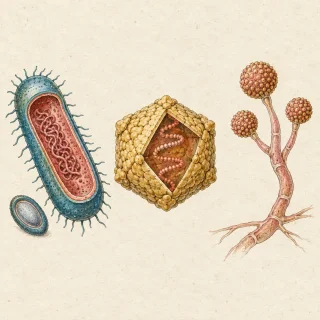
The vocabulary is the deck's own set: disease, pathogen, infection, carrier, fomite, vector, parasite, and normal flora, now usually called the normal microbiota. The pathogen sections keep the structure-to-function link this review always uses. A bacterium's rigid cell wall protects its membrane and is also the structure a Gram stain reads, which is why the stain points at one family of antibiotic before a culture is ready. A virus has no machinery of its own, so it needs a host cell to reproduce, and antibiotics have nothing to act on. A fungus is a eukaryote with a thick wall, which is part of why it is harder to treat. The transmission section uses the chain of infection from the unit's reading: infectious agent, reservoir, portal of exit, mode of transmission, portal of entry, and susceptible host.
Before a quiz, have these ready: the six definitions in the deck's words; the shapes and grouping patterns of bacteria; the three laboratory techniques in order, with what each one answers; the six links of the chain of infection; and the three modes of transmission with an example of each.
The review follows the Microbiology Basics course deck, which cites Nursing Fundamentals 2e Chapter 9 for basic concepts and the chain of infection, and cites Microbiology: Canadian Edition for characteristics of infectious disease and modes of disease transmission, plus Fundamentals of Nursing Pharmacology for infection concepts. Two pages in that deck carry diagrams only, so the pathogen types and the bacterial structure here come from the textbook's cell section, and the deck's closing activity is a class video, so its task is walked here with a worked example of this episode's own.
ANAT1160 Anatomy Study Guide
ANAT1160 Anatomy Study Guide@jaylenstrating09

This story was produced automatically by a channel. One sentence is all it takes for Neodrop to keep producing for you.

Related content