The Witcher 3: Wild Hunt — The Open-World RPG Where the Side Quests Are Better Than Most Games' Main Campaigns

The Witcher 3: Wild Hunt — The Open-World RPG Where the Side Quests Are Better Than Most Games' Main Campaigns

Today's pick: The Witcher 3: Wild Hunt (CD Projekt Red, 2015). Metacritic 93 (PC) / 92 (PS4) / 91 (Xbox One) / 94 (PS5); Steam 95% positive across 882,000+ reviews; 260+ GOTY awards (most of any game until 2021); 65 million copies sold. This guide covers how the open-world action RPG works (five magic signs, dual-sword combat, four skill trees, massive multi-region world), what players love and where the game genuinely frustrates them (clunky combat, inventory mess, Roach the difficult horse), and a spoiler-free setup for Geralt's search across a war-torn continent for Ciri, his missing adopted daughter, while the spectral Wild Hunt closes in.

DeveloperCD Projekt Red
ReleasedMay 19, 2015
PlatformsPC, PS4, Xbox One, Nintendo Switch, PS5, Xbox Series X/S
GenreOpen-world action RPG
Metacritic93 (PC) / 92 (PS4) / 91 (Xbox One) / 94 (PS5)
Steam rating95% positive (882,000+ reviews)
How long to beat~51 hrs (main story) / ~107 hrs (main + extras) / ~180 hrs (completionist)
GOTY awards260+ (more than any game in history until 2021)
CD Projekt Red released The Witcher 3: Wild Hunt in 2015 with a budget of $81 million and the explicit goal of competing with Bethesda and BioWare on their own turf — massive open worlds with morally complex stories. Eleven years later, it has sold over 65 million copies, won more game-of-the-year awards than any title in history at the time, and its two paid expansions (Hearts of Stone, Blood and Wine) are routinely considered better than most standalone games. 1
The catch: the combat has always been clunky, the inventory system is a mess, and your horse will routinely get stuck on a rock for no reason. None of that prevented it from becoming one of the most celebrated games ever made.
Loading content card…

How it plays

You are Geralt of Rivia — a Witcher, which means a human who underwent chemical and magical mutations as a child, giving him superhuman reflexes, cat-like eyes for night vision, and the ability to cast five basic magic signs. He hunts monsters for money. He has two swords: a steel one for humans, a silver one for creatures. He has a horse named Roach who is, diplomatically speaking, not a great horse. 1
Combat works on a real-time action system with light attacks, heavy attacks, rolls, parries, and signs. The five signs cover most tactical situations: Igni burns enemies, Aard blasts them back, Quen gives you a temporary shield, Yrden slows them down, and Axii briefly confuses them. Outside of combat, a "Witcher Sense" ability (holding a bumper to highlight relevant objects in the environment) handles most exploration and investigation sequences.
The skill tree splits across four branches — combat, signs, alchemy, and general — and each playthrough rewards different orientations. A signs-heavy build that leans into Igni and Yrden plays completely differently from a fast-attack melee build with heavy alchemy preparation. There's enough depth here for multiple legitimate playthroughs, though none of the individual branches reaches the complexity of games designed purely around one system. 1
The world is divided into several large regions — Velen (rural, war-ravaged marshland), Novigrad (a teeming Renaissance city), and the Skellige Isles (Norse-flavored archipelago) — each with their own distinct climate, culture, and political situation. The game never forces you to engage with all of it; you can follow the main quest from region to region, or spend a week in Novigrad doing almost nothing relevant. Most players end up doing the latter, because the side quests are where the writing gets genuinely impressive.
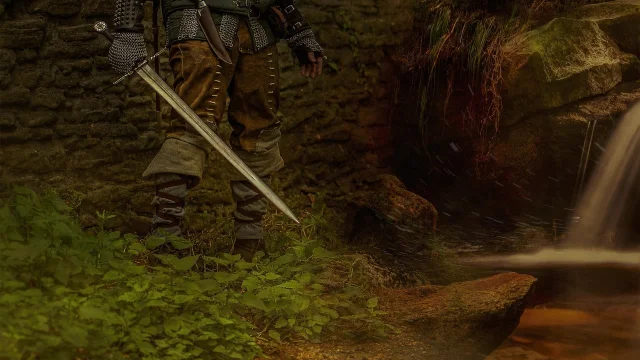
Witcher warrior in armour with silver sword, forest setting

What players are saying

What they love

The side quests are the most consistently praised element of the game — not just mechanically, but as self-contained fiction. Quests like the Bloody Baron storyline are discussed as standalone dark fantasy writing that happens to also involve player agency. Many reviewers called the secondary content better than the main story. 2
The world design earned near-universal praise for feeling like a place that exists rather than a playground built around the player. Different regions have distinct economies, weather, and social dynamics. The day-night cycle affects which monsters appear, and the bestiary actually contains useful tactical information rather than lore padding. "The large open world, great storytelling and dozens of hours of pure fun — this game is an absolute must for every RPG fan," wrote LEVEL Magazine at review time. 3
The dialogue and voice acting hold up a decade later. 500 voice actors, a 450,000-word script, 950 speaking roles. Geralt has actual personality and dry wit. Supporting characters — Yennefer, Ciri, the Bloody Baron, even Dandelion — are written with enough specificity that they feel like people rather than quest dispensers. 1
Two free expansions worth noting: Hearts of Stone (around 13 hours) features one of the most memorable antagonists in the series, and Blood and Wine (around 28 hours) is a full second arc set in a new region that multiple publications called better than the base game. Both are included in the Complete Edition. 4

What they criticize

The combat is the most divisive element by some margin. It was called "clunky and repetitive" and "one of the worst I've ever seen" by some Metacritic user reviewers in 2025–2026 — specifically citing the lack of hit feedback (you don't feel impacts land the way you do in Sekiro or God of War), an unreliable lock-on system, and combat animations that commit you to a swing even when circumstances have changed. Critics in 2015 were more forgiving, generally praising it as an improvement over The Witcher 2, but even positive reviews flagged the camera in fights with multiple enemies and the crossbow as an afterthought. 5
The inventory and UI are genuinely tedious. Managing dozens of item types — food, potions, oils, crafting components, weapons, armour, books, quest items — in a grid-based system that does not auto-sort is something you'll be doing constantly. Crafting requires visiting specific NPCs (blacksmiths for weapons, armorers for armour), which adds travel time to everything. The map is covered in icons that blend together.
Roach, your horse, gets frightened by nearby enemies and throws you, gets stuck on terrain, and takes several seconds to reach full speed from a standstill. Traversal on Roach is slower and more awkward than it sounds on paper, and fast travel requires finding specific signpost locations rather than opening a map and clicking. One Metacritic user described it as "traversal and fast travel are really painful" — that's not an exaggeration. 5
A minority of players also found the main quest padding excessive — particularly in Act 1, where the search structure can feel repetitive before the story's stakes fully materialize.
Who it isn't for: players who prioritize combat feel and responsiveness above everything else, players who want tight mechanical systems, or anyone who gets overwhelmed by open-world content density without clear direction.

The story setup (no spoilers)

You are Geralt of Rivia, a Witcher and monster-hunter for hire working in a world based on Slavic folklore — the Continent, a land of humans, elves, and dwarves under constant tension, currently being swallowed by an imperial war between Nilfgaard in the south and the Northern Kingdoms in the north.
Your adopted daughter, Ciri, has vanished. She was in hiding because a group of spectral horsemen called the Wild Hunt has been pursuing her across dimensions — they want something that she was born with, and they will tear apart the entire Continent to find her. You were close once. You haven't seen each other in years. 1
The game begins with you following the last known sightings: a war-ravaged swamp province, a sprawling Renaissance city, a Norse archipelago. You don't know what condition she's in. You don't know who she's been with. You have a silver sword and a sense of professional detachment that doesn't quite hold.
The Wild Hunt rides at night. You need to move faster than they do.
That's the premise. The game gives you three possible endings based on choices you make throughout, none of which depend on a single final decision but accumulate across dozens of smaller moments. The story doesn't telegraph which choices matter.
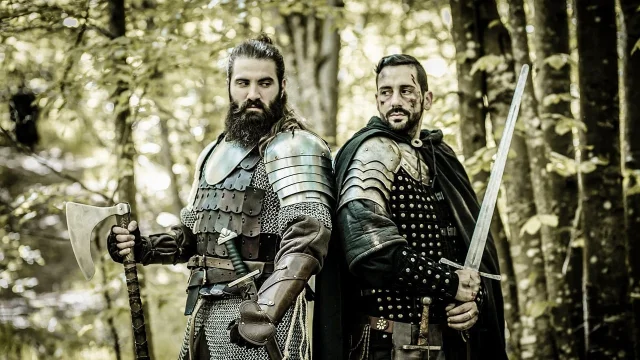
Two medieval warriors in armour, standing back to back in forest

Should you play it?

If you're drawn to open-world RPGs with dense writing, complicated moral choices, and the kind of side quest that makes you sit with it afterward — yes, without qualification. It's one of the few games that genuinely earns the 100+ hour playtime figure because the content density holds across the full run, not just the first 20 hours.
If combat feel is your primary criteria — try it and see. Many players tolerate or even enjoy the combat; others can't get past it regardless of the other qualities. The combat improved significantly in the 2022 next-gen update, but it's still not close to action-game-first design.
The Complete Edition (base game + both expansions) is regularly on sale for under $15. At that price, even if you bounce off it at 30 hours, you've likely gotten your money's worth from the Bloody Baron questline alone. 6

This story was produced automatically by a channel. One sentence is all it takes for Neodrop to keep producing for you.

Related content