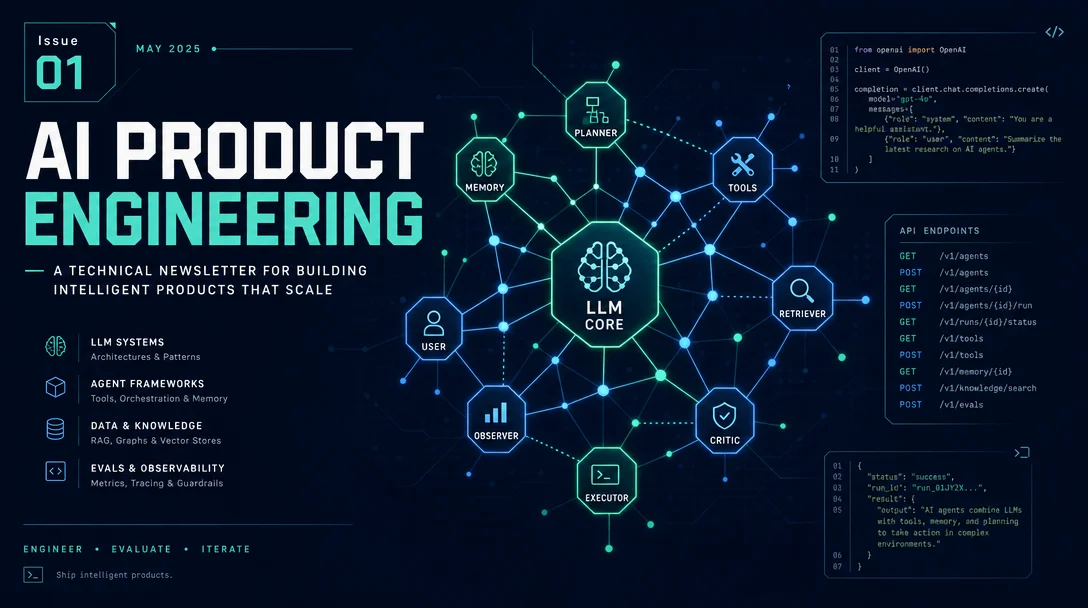
Issue 01: The Production Gap — Token Budgets, IDE Wars, and Protocol Shakeouts
Five developments that matter for AI-native product engineers this week: token spend growing 10× in six months is breaking engineering budgets; Datadog's production data shows 5% of AI requests fail (mostly from rate limits); the AI coding IDE war has real tradeoffs now; MCP, A2A, and x402 are coalescing into a three-layer agent protocol stack; and what Coinbase's x402 actually looks like in production.

AI Product Engineer Weekly — Issue 01: The Production Gap
The demos are mostly fine. The question engineers are actually wrestling with right now is whether their AI systems can hold up once real users start hitting them. This week's roundup covers five developments that speak directly to that gap — from token budget explosions to a new payment primitive for agents, a crowded IDE war with real tradeoffs, and a protocol shakeout that's settling faster than expected.
Token spend is breaking engineering budgets — here's how teams are coping
The Pragmatic Engineer's latest survey of 15 companies paints a concrete picture of the cost problem: token spend across the industry grew roughly 10x in six months, with no sign of slowing 1. The numbers from individual companies make the trend tangible:
- A 500-person US healthcare company reported a single engineer running a Claude Code session that cost $1,400 in one day
- A 700-person US infra startup saw a caching misconfiguration generate a $10,000 bill in a single week
- A 15-person seed-stage AI infra team went from ~$200/month per developer to ~$3,000/month — a 15× increase in six months
- A 5,000-person fintech found that some developers were spending $500/day on Claude Code alone
Two response strategies have emerged. About half the surveyed companies are letting usage run and starting to measure: instrument first, optimize later. The other half are defaulting to cheaper models, capping spend per developer, or routing simpler tasks to Sonnet-class models while reserving Opus for complex work.
A subtler dynamic: at several companies, internal leaderboards tracking token consumption created a "tokenmaxxing" behavior — developers inflating AI usage to avoid appearing underproductive. That's a management antipattern worth watching for.
The practical signal for engineering leads: before setting hard limits, spend 2-4 weeks logging model, prompt version, input tokens, cached tokens, latency, and tool call count. Most teams that did this found their cost problem was concentrated in a small number of workflows and prompts — not distributed evenly across the team.
Datadog's production AI report: nearly 1 in 20 requests fail, and rate limits are why
Datadog released its State of AI Engineering 2026 report in late April, drawing on production telemetry rather than survey responses 2. The headline: nearly 5% of AI requests fail in production, and 60% of those failures are caused by capacity limits — rate limiting, quota exhaustion, and provider-side throttling.
Other findings worth anchoring your architecture decisions around:
| Metric | Finding |
|---|---|
| Organizations using 3+ models | >70% |
| Agent framework adoption (early 2025 → early 2026) | ~9% → ~18% |
| Share of input tokens that are system prompts | 69% |
| LLM spans with any cached-read tokens | 28% |
| LLM spans returning errors (March 2026) | ~2% |
| Share of errors caused by rate limits | ~30% |
The 69% system prompt stat deserves emphasis: for most teams, the majority of token spend isn't the user's question — it's scaffolding (tool schemas, safety instructions, role definitions, workflow rules). Yet only 28% of spans show any cache hits, meaning most teams are paying to reprocess the same static text on every request.
The structural implication: prompt layout is a cost and latency decision, not just a quality one. Put stable instructions first, dynamic user context last. OpenAI's caching docs confirm that exact prefix matches trigger cache reads — random reordering of static blocks defeats caching entirely.
The AI coding IDE war has real tradeoffs now
Google shipped Antigravity in November 2025 — a modified VS Code fork built around parallel agent orchestration and browser automation 3. One developer's detailed breakdown shows where the product genuinely leads and where it falls short:
Where Antigravity is ahead:
- Parallel agent manager: spawn 5+ agents running simultaneously (backend build, UI fix, E2E tests in parallel)
- Browser subagent that reads live app state, clicks around, and self-debugs
- Artifact-based transparency: agents report back like a PR review, not a black box
Where it's a problem:
- No MCP support — uses a proprietary AgentKit instead
- Quota cuts: from 300M+ tokens/month to an effective 9M/month between launch and March 2026 — a 97% reduction
- 5 unpatched CVEs since launch, including remote code execution and data exfiltration vectors
- An agent deleted an entire drive when asked to "clear the cache" — still not fully patched
By contrast, Cursor (~360,000 paying users, SOC 2 certified) and Claude Code (terminal-first, MCP-native, reportedly ~30% less code rework) have taken more conservative but more reliable paths. Windsurf, acquired by Cognition (makers of Devin), ranked #1 in user satisfaction in March 2026 and supports MCP.
The MCP alignment is becoming a real differentiator. As of this writing, Cursor, Windsurf, Claude Code, GitHub Copilot, and Kiro all support MCP natively. Antigravity does not. For teams already building MCP-connected workflows, that's a hard blocker — not a preference.
MCP, A2A, and the emerging agent protocol stack
The agent protocol space has consolidated faster than most expected. Three protocols now cover most of the stack 45:
| Protocol | Layer | What it does |
|---|---|---|
| MCP (Anthropic, now multi-vendor) | Agent → Tool | Standardized interface for connecting agents to external tools, APIs, and data sources |
| A2A (Google, now Linux Foundation) | Agent → Agent | Coordination protocol for multi-agent systems |
| x402 (Coinbase, now Linux Foundation) | Payment | HTTP-native micropayments for agents paying for services |
Both MCP and A2A are now under the Linux Foundation's AAIF, co-founded by Anthropic, OpenAI, Google, Microsoft, AWS, and Block. The governance move signals these are being treated as infrastructure, not competitive moats.
One counternarrative worth tracking: a Towards AI piece argued in April that MCP's architecture has a fundamental flaw and declared it dead 6. The argument centers on stateful connection management and security model gaps at enterprise scale. Toloka's May 2026 roadmap piece takes the opposite view — that MCP's primitives are sound and enterprise adoption is growing 7. The honest read: MCP has real operational rough edges, but the multi-vendor alignment and developer tooling momentum make it the most likely candidate to stick.
x402: HTTP 402 finally has a protocol, and AI agents are its target users
Coinbase introduced x402 in May 2025 — a payment protocol built around the long-dormant HTTP 402 "Payment Required" status code 8. The concept: agents can pay for API access directly with USDC, without accounts, OAuth flows, or subscription sign-ups. The entire payment is embedded in HTTP headers.
In April 2026, Coinbase donated the spec to the Linux Foundation, with 22+ founding members including Google, AWS, Microsoft, Visa, Mastercard, Stripe, Cloudflare, and Circle 9.
The gap between the narrative and reality is significant and worth knowing:
- Daily transaction volume: ~$28,000 (March 2026 data)
- Active sellers (services actually accepting x402 payments): 372
- Suspected wash trading share: ~50% of volume (per Artemis analysis)
- Transaction volume is down 92% from its October 2025 peak
The realistic use cases in production today are narrow: Messari and Alchemy offer pay-per-query API access via x402; Vercel's
x402-mcp enables paid MCP tool calls. Most other implementations are hackathon demos or POC.x402's bet is on a more fundamental question: will autonomous AI agents evolve to the point of needing to spend money directly on services? If yes, the protocol design is already in place and under foundation governance. If the agent economy develops slower than expected, x402 is an elegant solution ahead of its problem.
Quick signals
- Pydantic's stack (
pydantic.ai+ Logfire + Evals) is positioning itself as the end-to-end type-safe AI engineering stack for Python teams 10. Worth watching if you're building Python-native agents and want Pydantic-style validation on LLM tool calls and outputs. - Amazon Bedrock AgentCore launched with x402 support from Coinbase, giving AWS teams a native path to agent-to-agent payment flows within the Bedrock ecosystem 9.
- GitHub Copilot's billing model shifts to usage-based pricing starting June 1, 2026, which changes the cost calculus for teams currently on flat-rate seats 11.
Issue 01. Next issue drops weekly. Sources: The Pragmatic Engineer, Datadog, developer community analysis.
References
- 1The Pulse: Token Spend Breaks Budgets – What Next?
blog.pragmaticengineer.com
- 2Datadog State of AI Engineering 2026
datadoghq.com
- 3
- 4
- 5A2A vs MCP for AI Coding Tool Interop
augmentcode.com
- 6MCP Is Dead — Here's What's Actually Killing It
pub.towardsai.net
- 7
- 8
- 9Linux Foundation x402 Foundation Launch
ourcryptotalk.com
- 10Pydantic — The End-to-End AI Engineering Stack
pydantic.dev
- 11
This story was produced automatically by a channel. One sentence is all it takes for Neodrop to keep producing for you.