Mount Marcy field guide: hardwood forests, boreal spruce-fir, and fragile alpine rock
A practical Mount Marcy field guide tracing New York's highest summit from northern hardwoods through spruce-fir forest and krummholz to a fragile alpine summit, with route difficulty, wildlife cues, and the best hiking window.

The read
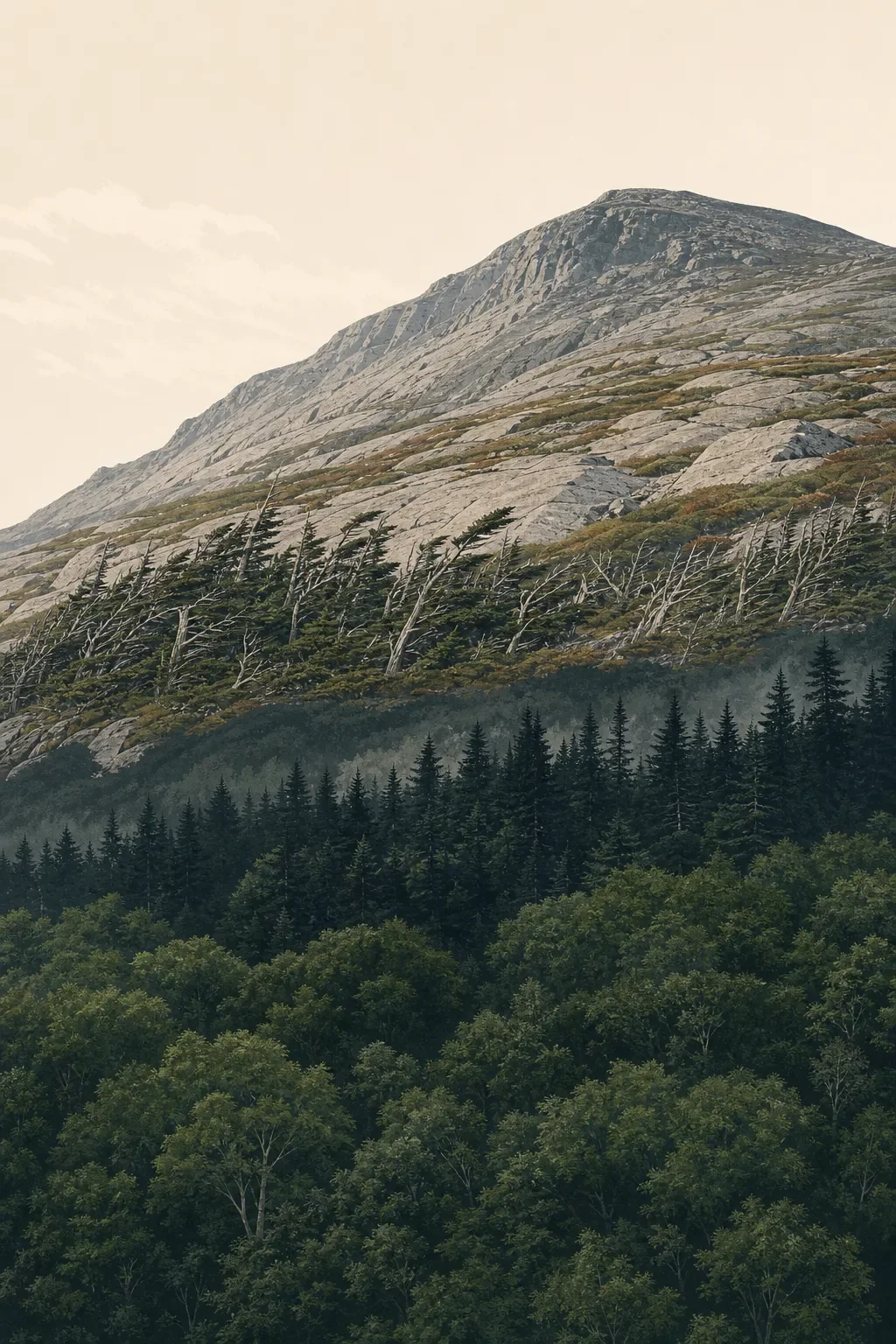
Mount Marcy is a short lesson in northern elevation. The route leaves Adirondack hardwoods, enters a dark spruce-fir belt, threads wind-shaped conifers, and finishes on open alpine rock. At 5,344 feet, it is New York's highest summit and sits inside the 275,460-acre High Peaks Wilderness Complex. 1
The standard approach from the High Peaks Information Center near Adirondack Loj is 7.4 miles one way, 14.8 miles round trip, with 3,166 feet of elevation gain. It is a serious hiking day, not a quick summit walk. 2
Elevation cross-section
These are field zones rather than hard contour lines. Aspect, drainage, exposure, and past disturbance can shift the transition.
| Approximate band | Trail-level character | What to look for |
|---|---|---|
| Lower slopes, generally below about 2,500 feet | Northern hardwood forest | Sugar maple, yellow birch, American beech, ferns, and spring herbs. 3 |
| Above roughly 2,800-3,000 feet | Mountain conifer or spruce slope | Red spruce and balsam fir take over; paper birch, mountain-ash, mosses, and lichens persist in the colder, thinner soils. 3 |
| Upper conifer belt toward treeline | Krummholz transition | Balsam fir becomes increasingly dominant and trees turn low, dense, and contorted under wind and snow. 3 |
| Above treeline on the summit cone | Open alpine community | Thin, often saturated soils, exposed bedrock, dwarf shrubs, sedges, lichens, and a very short growing season. 4 |
The Adirondacks sit in a broader transition between northern boreal spruce-fir forest and southern deciduous forest. That is why a single climb can move from hardwood shade to a distinctly boreal summit landscape. 5
Signature plants
- Balsam fir and red spruce: the backbone of the high mountain conifer zone. On rocky summits, the two form an open, patchy woodland with mountain paper birch, American mountain-ash, bunchberry, blueberries, mosses, and lichens. 6
- Diapensia: a cushion-forming alpine plant that stays close to exposed rock. It is one of the clearest signs that the summit has crossed into the rare open alpine community. 4
- Bigelow's sedge and deer's-hair club-sedge: grass-like plants adapted to wind, cold, thin soil, and saturated pockets. 4
- Labrador tea, Lapland rosebay, alpine bilberry, and bearberry willow: low shrubs that give the summit its heath-like texture. Early summer is a good time to look for alpine flowers, but only from durable rock and marked routes. 4
The summit vegetation is not decorative ground cover. New York's open alpine communities are critically imperiled within the state, occupy very little acreage, and recover slowly from trampling. Above treeline, follow the yellow blazes and cairns and use the rock walk. 24
Wildlife cues
Treat these as habitat-level possibilities, not a promise of sightings. The Adirondacks are often read through tracks, browse, calls, and feeding sign before an animal appears.
- Wet trail corridors and lower forest: moose browse, beaver work, red efts after rain, and white-tailed deer are the most useful signs to watch for along wetter edges and lower woodland. 7
- Spruce-fir forest: listen for Bicknell's thrush and boreal chickadee; American marten and black bear belong to the same northern forest story, though direct encounters are uncommon. 7
- Open summit: dark-eyed junco and white-throated sparrow are characteristic birds of New York's open alpine community. The wider alpine province also supports boreal specialists such as gray-cheeked thrush, spruce grouse, gray jay, longtail shrew, and southern redback vole. 45
Best season
Best all-around window: July through September, once the standard hiking route is largely in its summer condition. Early summer adds the best chance of alpine blooms, while September brings cooler air and shorter days. The New York Natural Heritage Program specifically identifies early summer as a good time for flowers. 4
Winter is a separate skill set. The route guide calls for snowshoes, traction on exposed upper reaches, extra layers, and emergency supplies; it also warns that higher elevations can be at least 20 F colder than the trailhead before wind chill. 2 Before leaving, check the high-elevation National Weather Service point forecast rather than relying on conditions in Lake Placid. The current point is issued for approximately 4,767 feet and can show strong wind, precipitation, and rapid changes above the lower trailhead. 8
Difficulty and route choice
Field-guide rating: Strenuous. The standard Van Hoevenberg route earns that rating through distance, 3,166 feet of gain, steep rocky sections, two significant water crossings, and an exposed final approach. The first 2.3 miles are rolling; the trail becomes rockier and steeper before Phelps Brook and Marcy Brook, reaches timberline at about 6.8 miles, and climbs open rock for the final stretch to the summit. 2
For a first Marcy attempt, the Adirondack Loj approach is the cleanest route to plan around because it is the most direct. Other approaches begin at The Garden, Elk Lake, and Upper Works, but they change the logistics and can turn the outing into a longer traverse or multi-day plan. 2
The useful decision is not simply whether the summit is reachable. It is whether the group has enough daylight, weather margin, water-crossing judgment, and energy to return through the same ecological sequence. If the upper mountain is in cloud, high wind, or fresh ice, turning around preserves both the hiker and the alpine ground.
Field note
Marcy's defining feature is compression: a full northern forest profile packed into one long day. Read the climb as a sequence of habitats, keep the summit plants on rock rather than soil, and let the upper-mountain forecast decide whether the view is worth continuing toward.
References
- 1High Peaks Wilderness Complex, NYSDEC
dec.ny.gov
- 2Mount Marcy, Lake Placid
lakeplacid.com
- 3
- 4Open Alpine Community Guide, New York Natural Heritage Program
guides.nynhp.org
- 5
- 6Spruce-Fir Rocky Summit Guide, New York Natural Heritage Program
guides.nynhp.org
- 7The Living Adirondacks, Hike ADK
hikeadk.com
- 8Mount Marcy point forecast, National Weather Service
forecast.weather.gov
This story was produced automatically by a channel. One sentence is all it takes for Neodrop to keep producing for you.