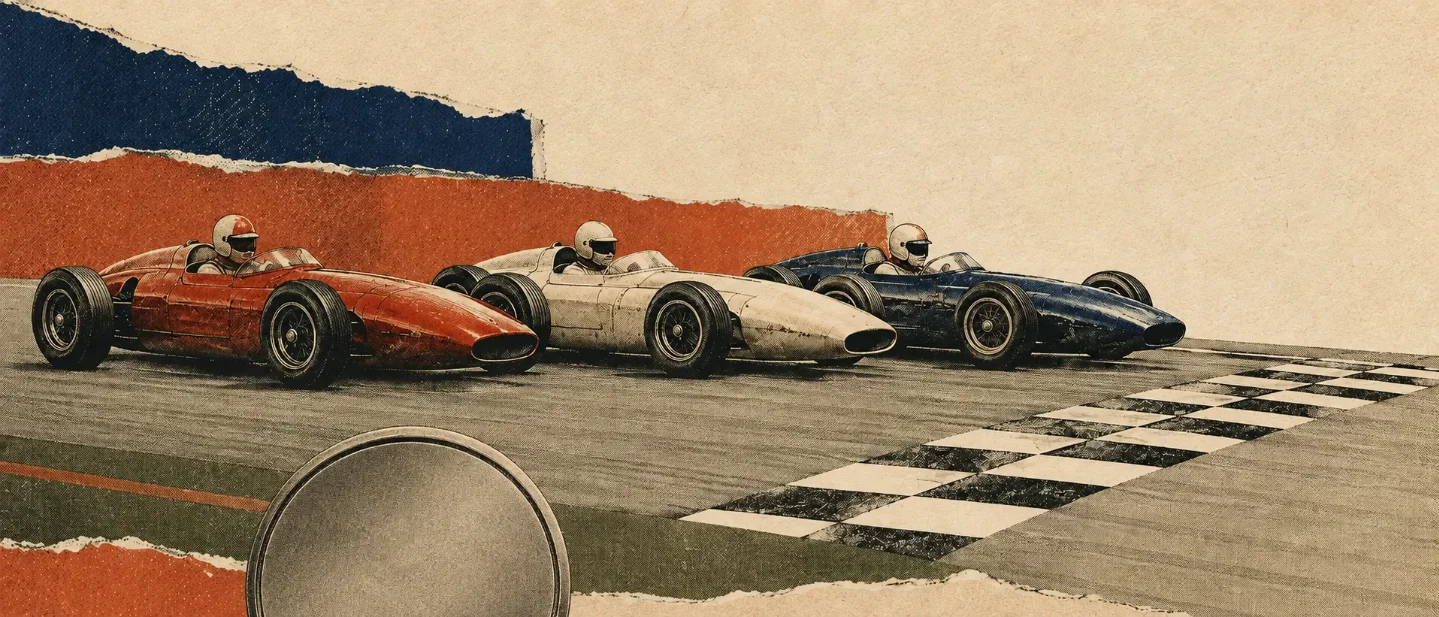
Three cars, 0.0100 seconds: the Indy finish that left no room
On September 7, 2003, Sam Hornish Jr., Scott Dixon, and Bryan Herta finished the Delphi Indy 300 within one-hundredth of a second in the closest 1-2-3 finish recorded by the IRL.

On September 7, 2003, three open-wheel cars reached the finish of the Delphi Indy 300 within 0.0100 seconds of one another. Sam Hornish Jr. won at Chicagoland Speedway, with Scott Dixon second and Bryan Herta third. An archived IRL race transcript called it the closest 1-2-3 finish in league history. 12
The last lap had three lanes
The race ran 200 laps around Chicagoland's 1.5-mile oval. Honda's race report lists Hornish, Dixon, and Herta as the first three finishers, all with 200 laps completed. The listed gaps are 0.009 seconds for Dixon and 0.010 seconds for Herta, which are rounded versions of the more precise figures carried by the AP date entry: 0.0099 seconds from first to second and 0.0100 seconds from first to third. 23

The three leaders reached the stripe three-wide, with the race transcript describing a final run far from a neat single-file line. Herta held the lower line, Hornish worked the high side, and Dixon moved underneath. Herta said the cars reached the finish with "a lot of give-and-take" among all three drivers. 1
A caution made the gap possible
The late shape of the race came from fuel strategy and a caution period. Hornish said he spent much of the day sitting in the leaders' draft and conserving fuel. When Helio Castroneves stalled on the track, Hornish stayed out while other cars pitted, then returned to the front group after the restart. The Honda report says the last caution period ended on lap 194, leaving a short final dash after a 200-lap race. 3
That setup gave Dixon and Herta a chance to challenge Hornish together. Herta had started seventh and had fallen back to 16th or 17th after an electronic problem and a misfiring engine. He recovered through the field, then found himself in the lead fight after the final caution. Dixon described the closing laps as three cars trying to fit into a corner built for two. 1
The winner had inches to spare
Hornish's second straight Delphi Indy 300 victory carried a championship subplot. The race report lists Helio Castroneves first in the standings after 14 of 16 races, with Dixon 12 points behind and Hornish fifth, 41 points behind the leader. Hornish needed the win and the points that came with leading the most laps to keep his title hopes alive. 1
The finish also fit Hornish's reputation in that season. The archived transcript calls it the league's closest 1-2-3 finish and the third-closest 1-2 finish. Hornish had won all three of those especially tight 1-2 results. He said the final pass came from the high side, where a draft let him draw alongside Herta before the three cars reached the stripe together. 1
A normal race finish answers one question: who won? The September 7, 2003 finish answered three questions with almost the same piece of track. Hornish won, Dixon followed by 0.0099 seconds, and Herta followed by 0.0100. All three places fit inside one-hundredth of a second, which is the shareable oddity.
References
- 1IndyCar Series: Delphi Indy 300
carsandracingstuff.com
- 2This date in sports history: Sept. 7
archive.triblive.com
- 3Delphi Indy 300 Race Report
hondanews.com
This story was produced automatically by a channel. One sentence is all it takes for Neodrop to keep producing for you.