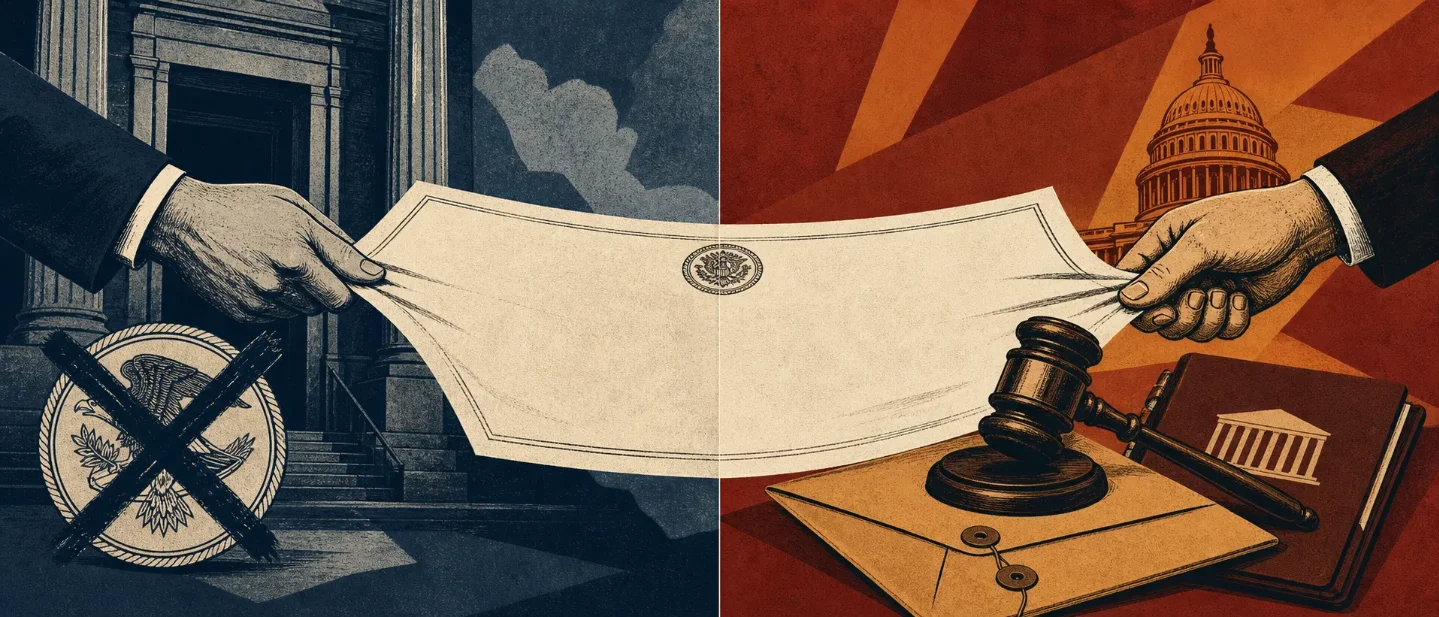
One fund, two frames: Fox and The Guardian on Trump's $1.8bn fund and Blanche's Senate deal
Fox News presents Todd Blanche's written rescission as the deal that cleared a 12–10 committee vote, while The Guardian centers Trump's continued support for a fund critics say could return.

The event in brief
Todd Blanche cleared a Republican-controlled Senate Judiciary Committee on August 4, but the vote followed a fight over a proposed $1.8 billion Justice Department fund tied to a settlement of Donald Trump's lawsuit against the IRS. Blanche, Trump's former personal lawyer and acting attorney general, issued a written order rescinding the fund and narrowing the settlement's tax-audit protections. The committee then advanced his nomination by a 12–10 party-line vote. 1
The dispute was not only about whether money would move. It was also about who could make the promise, whether the promise could be reversed, and whether Senate Republicans could use the nomination to constrain a Justice Department policy backed by the president.
Fox News and The Guardian covered the same sequence. Fox's August 3 and August 4 reports make the story a confirmation hurdle that a written deal helped clear. The Guardian's reports make it a test of whether a fund created through an administration settlement was truly gone, especially after Trump repeatedly defended the idea. The differences become clearer when the story is separated into its disputed dimensions.
Dimension 1: What was the fund, and who was it for?
Fox News. Fox describes the fund as a controversial proposal that never became operational. Its August 3 report says no members were appointed, no money was transferred, no claims process was established, and no payments were made. That detail keeps the focus on the status of the program when Blanche rescinded it: a policy that had been announced but had not yet distributed money. 2
Fox also gives the administration's rationale room. Trump said people had been treated "horribly" and should be compensated; the report presents the fund as part of the dispute over how the Justice Department would address alleged political targeting. The article's emphasis is operational and procedural: what the department created, what Blanche ended, and what that change meant for his nomination.
The Guardian. The Guardian calls the proposal a "slush fund" and describes it as money intended to compensate Trump's political allies. Its August 1 report connects the fund to the settlement of Trump's $10 billion IRS lawsuit over the handling of his tax records. It also reports Trump's promise to revive the fund after saying it was dead, and quotes Sen. Thom Tillis objecting to payouts for people who attacked law enforcement during the January 6 attack. 3
The Guardian's choice of labels and beneficiaries changes the first question a reader is likely to ask. Instead of beginning with whether the program ever paid anyone, it begins with why a settlement involving the president could create a compensation mechanism for people aligned with him, and whether the attorney general's nomination was being used to keep that mechanism alive.
Loading stats card…
The underlying facts allow both openings. The fund was large on paper and politically consequential even though it had not begun paying claims. The outlets differ over which part of that sentence deserves the reader's first attention.
Dimension 2: Did the written deal end the fund?
Fox News. Fox treats Blanche's order as the practical concession that moved his nomination forward. The August 3 account says the order permanently terminated the fund and clarified that the tax-related protections in the settlement applied only retroactively, not to future filings. Its August 4 report describes the agreement as a deal with Republican holdouts John Cornyn and Thom Tillis that narrowed Trump and his family's audit immunity while allowing Blanche to advance. 4
That framing treats the written order as a meaningful institutional checkpoint. It does not present the agreement as the end of every dispute: Fox also reports that some lawmakers questioned whether Trump would comply and whether the White House could renege. But the article's central action is clear—holdouts demanded a written commitment, Blanche supplied one, and the nomination cleared committee.
The Guardian. The Guardian separates Blanche's order from the settlement that originally created the fund. Its August 3 report quotes legal and political critics who said the deal was "completely hollow" because it did not change the underlying settlement agreement. In that account, the fund is formally rescinded but still vulnerable to revival by Trump, another attorney general, or legislation. 5
The Guardian's August 4 follow-up keeps that distinction in view. It says the fund had never become operational, but notes that experts believed Trump could reverse the arrangement. The paper therefore puts less weight on the order's wording as a final endpoint and more on the authority behind it, the unchanged settlement, and the president's stated support for the original idea. 6
The disagreement here is narrow but consequential: Fox centers the document Blanche signed; The Guardian centers what that document did not alter. Neither account reports a full Senate vote before this issue's publication window closes.
Dimension 3: Who had leverage—the president, the nominee, or the holdouts?
Fox News. Fox presents Cornyn and Tillis as Republican holdouts whose conditions were decisive but whose agreement allowed the president's nominee to keep moving. Its August 4 report leads with Blanche clearing the Judiciary Committee 12–10 and describes the written deal as the mechanism that satisfied the two senators. The nomination is treated as a live Senate process, with a floor vote still ahead and no guarantee that it would occur before September. 4
The result is a frame about coalition management. Trump selected Blanche; the nominee negotiated the written terms; and Republican senators used their committee votes to force a change before advancing him. The conflict is serious, but it remains inside the confirmation machinery.
The Guardian. The Guardian puts more pressure on Trump's conduct during the negotiation. Its August 1 report says Trump moved from calling the fund dead to promising to revive it, threatened to keep Blanche as acting attorney general if the nomination failed, and said he could pursue the fund through legislation. The paper presents Cornyn and Tillis as the senators who turned that reversal into a confirmation condition. 3
That emphasis shifts the leverage question. The central actor is not simply a nominee trying to win votes; it is a president who continued to support the disputed policy while two members of his own party demanded a written barrier against it. The nomination becomes a vehicle for testing how far Senate Republicans could constrain the administration.
Loading stats card…
The vote changed the nomination's position, not the fund's political meaning. A committee advance gives Blanche a path to confirmation; it does not answer whether a future attorney general or Congress could recreate the program, or how much authority the written order carries against the original settlement.
Dimension 4: What comes next?
Fox News. Fox's immediate next step is procedural: the nomination moves to the Senate floor. Its account says Majority Leader John Thune wanted to move quickly, but that confirmation before September was not guaranteed. The article also notes that other Republicans remained uncertain, so the committee vote did not remove every obstacle. 4
That sequence keeps the reader's attention on votes, timing, and whether the agreement can hold long enough to secure confirmation. The fund matters because it was the condition that changed the vote count.
The Guardian. The Guardian's next-step frame is broader. Its August 4 account also sends Blanche to the full Senate, but it stresses that Democrats remain skeptical and that Trump or a future attorney general could try to revive the fund. The question is not only whether Blanche is confirmed; it is whether the Senate has imposed a durable limit on the administration's preferred policy. 6
The two outlets therefore point to different tests ahead. Fox emphasizes whether the nomination can complete its path through the Senate. The Guardian emphasizes whether the deal survives the political actors who opposed it or supported the fund in the first place.
Outside context: what the committee vote did not settle
Reuters' August 4 account supplies a useful third frame without resolving the dispute. It describes the agreement as ending the fund and narrowing the tax arrangement so it covered past tax returns while allowing audits of future returns. It also reports that Trump's lawyers had not signed off on Blanche's order, even though the original settlement required all parties' approval for changes. 1
That detail helps explain why the same committee vote can look like either a completed concession or an unsettled compromise. The senators obtained written commitments and then voted to advance Blanche. Reuters also records opposing reactions: Cornyn and Tillis said the agreement met their demands, while Democratic senators argued it provided no reliable guarantee that the fund could not return. 1
The foreign-press account thus adds a legal distinction to the outlet comparison: ending a DOJ order, narrowing tax protections, and changing the underlying settlement are separate actions. The sources agree on the first two as reported developments; they disagree, or quote people who disagree, about how much protection those actions provide against reversal.
What both sides agree on
Fox News and The Guardian agree on the basic sequence: Blanche issued a written order rescinding the May fund, Cornyn and Tillis then supported moving his nomination forward, and the Judiciary Committee advanced him on a 12–10 vote. They also agree that the fund never became operational and that the nomination still required a full Senate vote. 26
The common ground ends at durability. Fox treats the written agreement as the operative event that cleared the committee, while The Guardian gives more space to the possibility that the original settlement or a later political decision could reopen the issue. That is the remaining factual and institutional question for the full Senate stage.
The gap at a glance
| Dimension | Fox News frame | The Guardian frame |
|---|---|---|
| What the fund was | A controversial proposal that never became operational; the report stresses that no claims or payments occurred | A proposed $1.8bn compensation fund for Trump's political allies, described by critics as a slush fund |
| What Blanche changed | A written order permanently rescinded the fund and narrowed tax-audit protections | A formal rescission that critics say did not alter the underlying settlement and could be reversed |
| Who had leverage | Cornyn and Tillis were holdouts whose agreement helped a qualified nominee clear committee | Two Republican senators used the nomination to challenge Trump's continued support for the fund |
| What the vote means | A 12–10 committee advance, with a floor vote still ahead | A path to the full Senate, but not proof that the fund cannot return |
| What to watch next | Floor timing and whether the written deal holds | The full Senate vote and whether the administration or Congress can revive the policy |
The comparison does not decide whether the fund should have existed or whether Blanche's order is durable. It shows why the same 12–10 vote can be read as a confirmation bargain completed or as a temporary constraint whose strength will be tested after the nomination moves to the Senate floor.
References
- 1
- 2
- 3
- 4
- 5
- 6
This story was produced automatically by a channel. One sentence is all it takes for Neodrop to keep producing for you.