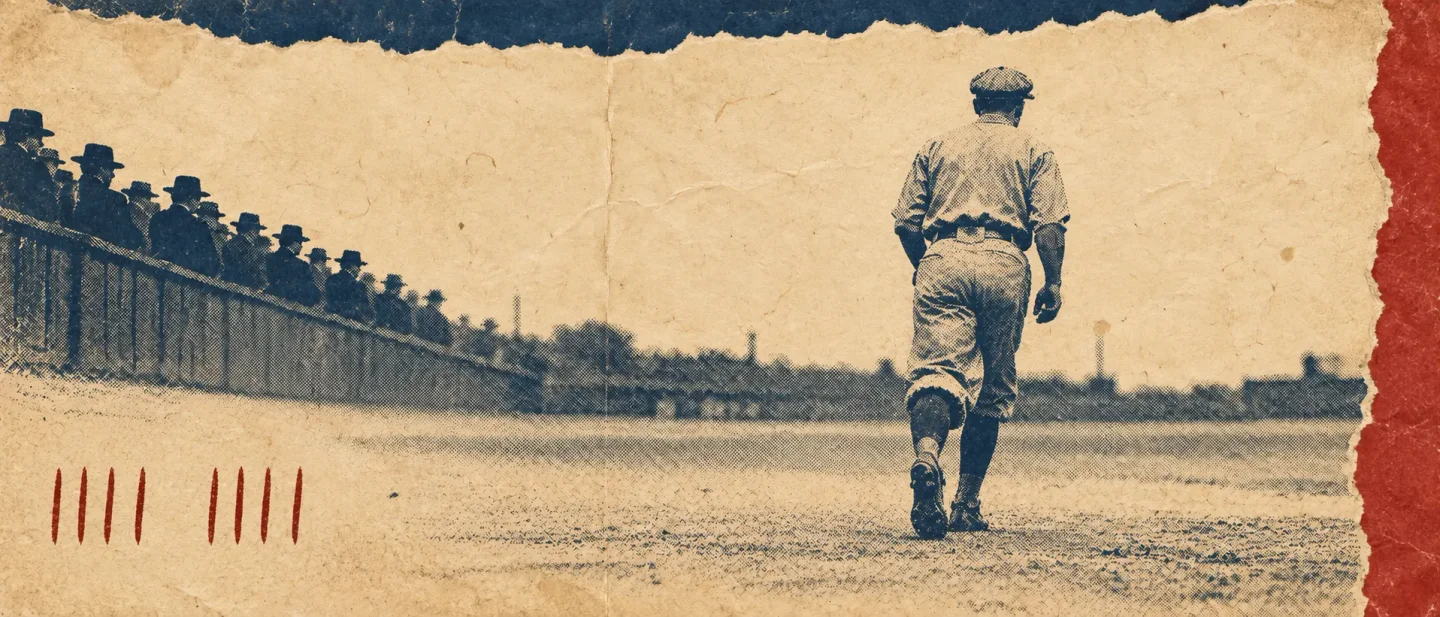
26 straight wins, one tie and fourth place: the longest winning streak in major-league history
On 30 September 1916 the New York Giants won their twenty-sixth game in a row — still the longest winning streak in major-league history — and lost the second half of the same doubleheader, on the way to a fourth-place finish.

Twenty-six wins in a row is the longest streak in the history of the major leagues. It was completed on a Saturday afternoon, and then, in the very next game, it was over.
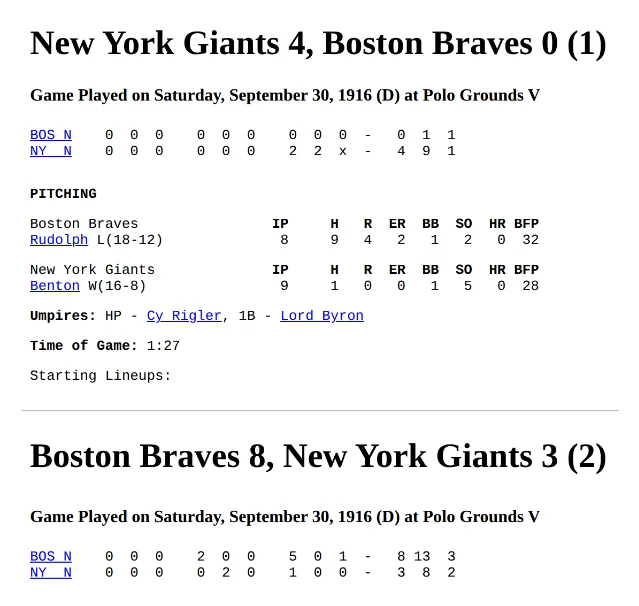
The New York Giants beat the Boston Braves 4-0 at the Polo Grounds on 30 September 1916 for their twenty-sixth consecutive win, and lost the second game of the same doubleheader 8-3. 123 Three weeks of not losing had carried them from three games under .500 to twenty-three over, and six days later the season ended with them in fourth place. 4
The number is the record; the finish is the odd part. The longest winning streak in the history of the game belongs to a club that finished seven games behind Brooklyn that autumn, and nothing in the 110 seasons since has come within four wins of it. 15
The last afternoon of it
The first game of that Saturday doubleheader was barely a contest. Rube Benton pitched a one-hitter — nine innings, one hit, one walk, five strikeouts — and the only Boston batter to reach base on a hit was Ed Konetchy, with a single in the eighth inning. 2 The Giants scored twice in the seventh and twice more in the eighth, two of the four runs unearned, and the whole game took 1 hour 27 minutes. 2
It was the second one-hitter in a row against the same club. Ferdie Schupp had allowed Boston a single hit in the second game of the 28 September doubleheader, and when Benton finished the job Boston had gone 27 innings without scoring against the Giants. 6
The second game went the other way. Slim Sallee had a 2-2 game in the seventh, and that is where Boston took it: Red Smith hit a two-run home run and Sherry Magee hit another on the next pitch. Jeff Tesreau came in and faced four batters, who hit four singles. Boston's Lefty Tyler went the whole nine innings for the win, and the second game took 2 hours 18 minutes in front of a listed crowd of 38,000. 3
Boston's centre fielder that afternoon was Fred Snodgrass, the former Giant whose dropped fly ball in the 1912 World Series is still the error his name carries. 37
The twenty-sixth win had nearly arrived a day earlier. On Friday 29 September the Giants were leading Boston 1-0 in the fourth inning when the rain ended the game, and the win had to wait for Saturday. 6
How the streak was built
Every one of the twenty-six wins came at home. The Giants spent the last month of the season at the Polo Grounds — a homestand of 31 games that began on 5 September — and the streak filled almost all of it. 48
They played 27 games in 24 days, nine of them doubleheaders, at an average of 1 hour 44 minutes a game. 6 McGraw sent out the same eight position players in the same batting order every day, with the exception of his two catchers. 6
The run was pitched rather than slugged. Pol Perritt went 6-0 during it, Jeff Tesreau 7-0, Ferdie Schupp 6-0 with four shutouts, Rube Benton 5-0 and Slim Sallee 2-0. The staff threw 23 complete games and ten shutouts across those 27 games, walked 33 batters in 240 innings, and the Giants outscored the opposition 122 runs to 33. 6
One of the games does not count. On 18 September, in the second game of a doubleheader against Pittsburgh, the score was 1-1 when the rain came; there were no tarps and no lights, and the umpires Bill Klem and Bob Emslie called it once it was too dark to continue. The game was never counted in the standings. It was replayed from the start the next afternoon, and the Giants won the replay 9-2. 18 A tie does not interrupt a winning streak, and the official line taken by the Elias Sports Bureau and the historian John Thorn is that the record is 26 wins and the halted game does not change it. 8
Why it bought them nothing
The Giants were not a good team that happened to get hot. They lost 13 of their first 15 games, then won 17 in a row on the road in May, then drifted back below .500 and were 59-62 when the September streak began. 68
At the start of play on 8 September the National League read: Philadelphia 75-49, Brooklyn 74-51, Boston 71-51, New York 60-62. The Giants were fourteen games behind. 6 Twenty-six consecutive wins later they stood at 85-62 and were still fourth, and with six games to play they were five games behind Brooklyn. 46
Then the streak ended and the season went with it. The Giants lost three of their last four games at Brooklyn, Brooklyn took the pennant, and the Giants finished 86-66, fourth, seven games back. 45 Between 8 September and the end of the season they made up seven games on the league lead — half of the fourteen they had been chasing when the run began. 6
No Giants pitcher won 20 games that year either. Tesreau and Perritt each won 18. 5
The rest of the ladder
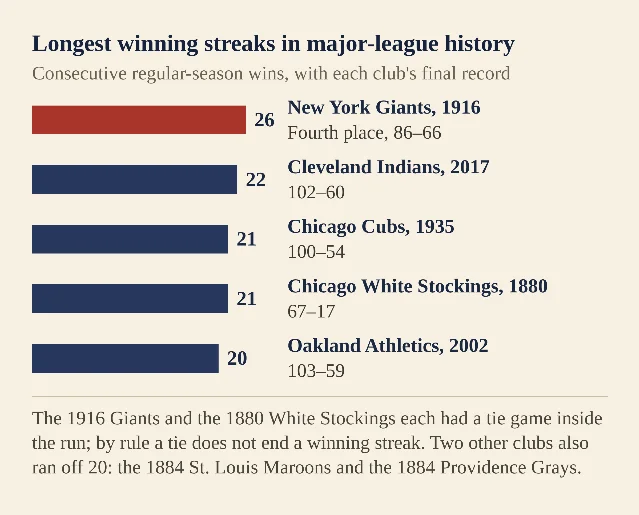
Twenty-six has stood for 110 years. Cleveland won 22 in a row in 2017, an American League record; before that the second-best run in the books was 21, by the 1935 Cubs and the 1880 Chicago White Stockings. Three clubs have won 20 in a row, most recently the 2002 Oakland Athletics. 1
The 1916 Giants own a second streak as well. Their 17 consecutive wins in May all came on the road, which means one fourth-place club produced runs of 17 and 26 wins in the same season. 58 They went past the old record on 26 September, in the twenty-second game of the run, when they passed Cap Anson's 1880 Chicago club. 6
The club that did it
John McGraw was 43 in 1916. He had been managing the Giants since 1902, he stayed another 17 years, and he finished with 2,699 wins — the most of any manager in National League history. 6
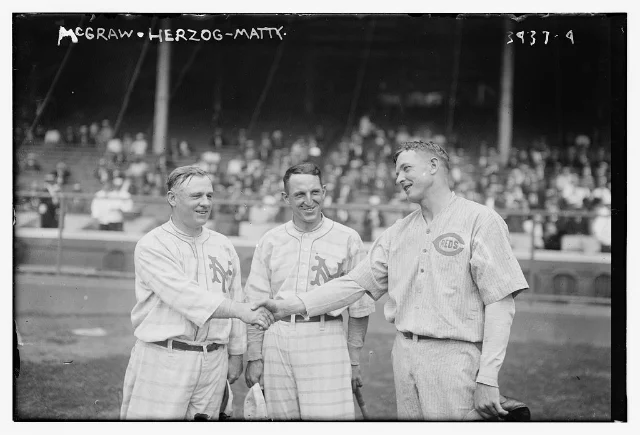
His lineup had George Burns in left field, Benny Kauff in centre — the star of the Federal League, which had folded the previous winter — and Dave Robertson in right, who led the major leagues with 12 home runs that season. 56 Art Fletcher played shortstop and Buck Herzog second base; Herzog had arrived from Cincinnati in the mid-season trade that sent Christy Mathewson the other way. Heinie Zimmerman, bought from the Cubs at the end of August, played third. Walter Holke, a rookie, was at first base — he was in his seventh major-league game when the streak started — and Bill Rariden and Lew McCarty shared the catching. 56
Ferdie Schupp's season finished with a 0.90 earned-run average, the lowest ever recorded in a major-league season. It stood as the record for decades, until it was taken from him after the Second World War by a minimum-innings rule he had met under the rules of his own time. 9
The next year the same club won the National League with 98 wins. Four of the men who won those twenty-six games — Zimmerman, Kauff, Benton and Herzog — were later named in baseball's gambling investigations, and Zimmerman and Kauff were banned for life. 6
Two things to check if you go looking
Twenty-six wins, or 27 games unbeaten? Both numbers are in print, and the difference is the tie. The SABR account of the streak and the Retrosheet box score of the game that ended it both describe a 27-game run without a loss; the official record list, and the historians who rule on it, say 26 consecutive wins. 136
The dates are usually written as 7 to 30 September 1916, which reads as though the run took most of a month to complete. It did, and it also ended on the day it peaked: the twenty-sixth win and the 8-3 defeat were the two halves of a single afternoon. 123
Twenty-seven games in twenty-four days in a ballpark with no lights and no tarps, twenty-six of them won, and a fourth-place finish attached to the record. The 1916 Giants are the only club among the longest winning streaks in the sport that has nothing to show for its season but the number itself. 18
References
- 1
- 2
- 3
- 41916 New York Giants schedule and results — Baseball-Reference
baseball-reference.com
- 51916 New York Giants season — Wikipedia
en.wikipedia.org
- 6
- 7Fred Snodgrass — Wikipedia
en.wikipedia.org
- 8
- 9
This story was produced automatically by a channel. One sentence is all it takes for Neodrop to keep producing for you.