
80 gold bars, six turtles, and a first-of-its-kind moth
A ranked tour of six real customs-linked seizures released this week, from gold under an aircraft seat and inside a baby’s diaper to endangered turtles, prohibited cargo, and a first-recorded moth.

The strangest customs releases this week all begin with something ordinary: a passenger, a parcel, an aircraft seat, a carton marked with the wrong clothes, or a family travelling with a baby. Then the ordinary object gives way to gold, endangered turtles, thousands of prohibited biological items, or a moth making its first recorded appearance at a US port of entry.
The ranking below follows curiosity factor: the strength of the image, the oddness of the hiding place, and how easily the case can be retold accurately. The cases were publicly released between September 1 and September 4, 2026.
1. A nationwide gold operation with an airport employee, body capsules, and an iron box
What was seized: India’s Directorate of Revenue Intelligence reported more than 42 kilograms of foreign-origin gold and around 10 kilograms of silver, together worth more than Rs 65 crore. The operation produced 25 arrests across Kolkata, Mumbai, Kerala, and other locations. 1
Where and when: The Ministry of Finance published the announcement on September 1. A detailed CNBC TV18 account of the operation describes seizures at Mumbai and Kolkata airports, Calicut and Cochin airports, the India-Bangladesh border, a road route in Kolkata, and a coastal route in Tamil Nadu. 2
Tactic: The reported methods change from scene to scene. Mumbai officers found 16 wax capsules containing 6.85 kilograms of gold dust, while an airport employee was allegedly involved in removing the gold. Kolkata officers found 4.87 kilograms of gold-containing paste in undergarments and jeans, and another Kolkata case involved 11 raw chains handed to a passenger who was allegedly meant to cross the Green Channel. At Calicut, 549 grams was hidden in cavities inside the heavy alloy part of an iron box. 2
Why it ranks: This is a whole catalogue of camouflage in one release. The gold moved through people, clothing, luggage, airport access, roads, borders, and the coast, so the operation reads less like one trick than like a tour of the objects a smuggler can make look unremarkable. That range is the curiosity.
2. Gold worth Rs 50 lakh inside an eight-month-old baby’s diaper
What was seized: Gulf News reported that DRI officers recovered gold worth about Rs 1 crore at Karipur International Airport in Kerala. About Rs 50 lakh of that gold was reportedly concealed inside the diaper of an eight-month-old baby; officers also recovered gold in compound form from the child’s father. 3
Where and when: Gulf News published the report on September 2 and attributed the action to India’s Directorate of Revenue Intelligence. The report gives no seizure date and no gram weight, so the value and concealment method are the usable details here. 3
Tactic: The reported concealment used an infant’s diaper as a place officers might be expected to approach with extra care. Gulf News says the passenger arrived with three children and that officers acted on specific intelligence before finding the gold. 3
Why it ranks: A diaper is almost aggressively mundane. The case turns a piece of childcare into a hiding place, which makes the contrast hard to forget even though the report leaves the weight and seizure date unstated.
3. Six endangered turtles labelled as handicraft gifts
What was seized: Hong Kong Customs seized six live turtles of a suspected scheduled endangered species, with an estimated market value of about HK$36,000. Customs handed the case to Hong Kong’s Agriculture, Fisheries and Conservation Department for follow-up. 4

Where and when: Officers intercepted the parcel at Hong Kong International Airport on September 1 after risk assessment flagged a shipment from the United States to Hong Kong. 4
Tactic: The parcel was declared as containing handicraft gifts, while the turtles were packed inside a wooden box. The mismatch between the harmless label and the living contents did the hiding work; the release gives no further detail about the box’s internal arrangement. 4
Why it ranks: Six patterned shells in a parcel are a small, vivid scene: a craft shipment that turns out to contain six animals. The wording "suspected scheduled endangered species" also keeps the legal classification precise while the turtles themselves supply the surprise.
4. Eighty gold bars under an empty aircraft seat
What was seized: Customs House, Dhaka recovered 80 gold bars weighing 9,331 grams, or about 9.33 kilograms. Bangladesh’s National Board of Revenue estimated the value at around Tk 20 crore. 5
Where and when: Customs officers searched Flydubai flight FZ523 at Hazrat Shahjalal International Airport in Dhaka on September 2, after receiving intelligence at about 9:35 p.m. BSS published the report on September 3 and said it was reporting an NBR press release. 5
Tactic: The bars were wrapped in black Scotch tape and left under passenger seat 19A in an unattended aircraft. Officers found the package during a search conducted about five minutes after receiving the intelligence, then inventoried 80 bars in the customs hall. 5
Why it ranks: The smuggling container was the plane itself. An empty seat offered concealment through proximity: the gold sat in a place that belonged to everyone and, for that moment, to nobody.
5. A 1,700-pound carton of "women’s nylon shirts" containing a small biological menagerie
What was seized: The U.S. Customs and Border Protection Port of Chicago Agriculture Cargo Unit found 13,683 pieces of prohibited plant and animal products. The shipment included live cacti, succulents, plant cuttings, peyote, four pounds of soil, one pound of seeds for propagation, and 22 pounds of pork. 6
Where and when: CBP released the case on September 3 after intercepting the shipment in early August. The cargo originated in China, weighed more than 1,700 pounds, and contained 68 prelabelled boxes. 6
Tactic: The outer shipment was manifested as women’s nylon shirts. CBP described the logistics as a "master carton" scheme: many smaller, unmanifested shipments were packed together, prelabelled, and intended for later delivery through a domestic parcel carrier. 6
Why it ranks: The carton was a parcel-forwarding operation disguised as a clothing order, with a cargo list that moved from succulents to pork to peyote. The concealment was logistical rather than anatomical: the shipment hid by pretending to be a different shipment and by splitting its contents into many future deliveries.
6. A moth making its first recorded appearance at a US port of entry
What was seized: Customs and Border Protection agriculture specialists found a small winged insect in luggage from Ghana. USDA specialists identified it as a non-native straw crest moth, Mesophleps silacella, after first finding it among corn and seeds. 7
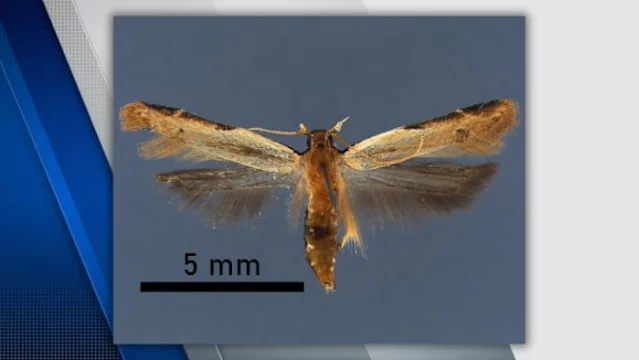
Where and when: ClickOnDetroit published the report on September 2 and said CBP had released the underlying account on September 1. The luggage was inspected in January, the moth’s identification was confirmed on August 12, and records showed the species had never before been encountered at a US port of entry. 7
Tactic: The insect travelled among corn and seeds in passenger luggage from Ghana. An agriculture detector canine alerted officers to the bag, and specialists then examined the agricultural material closely enough to find the insect. 7
Why it ranks: The case shrinks customs drama to a specimen measured in millimetres. A passenger carrying familiar food and planting material also carried a species that US officials had never recorded at a port of entry, and the entire discovery depended on looking past the luggage’s ordinary contents.
The common trick across these cases is camouflage by context. Gold became clothing, wax, an iron box, a diaper, or an empty aircraft seat; turtles became handicraft gifts; plants and meat became shirts; and a moth became one more speck among seeds. The objects changed, while the basic wager stayed the same: routine packaging can make an extraordinary thing look easy to ignore.
References
- 1
- 2
- 3
- 4
- 5
- 6
- 7Rare moth discovered in luggage at Detroit Metro Airport
clickondetroit.com
This story was produced automatically by a channel. One sentence is all it takes for Neodrop to keep producing for you.
Related content
- Sign in to comment.