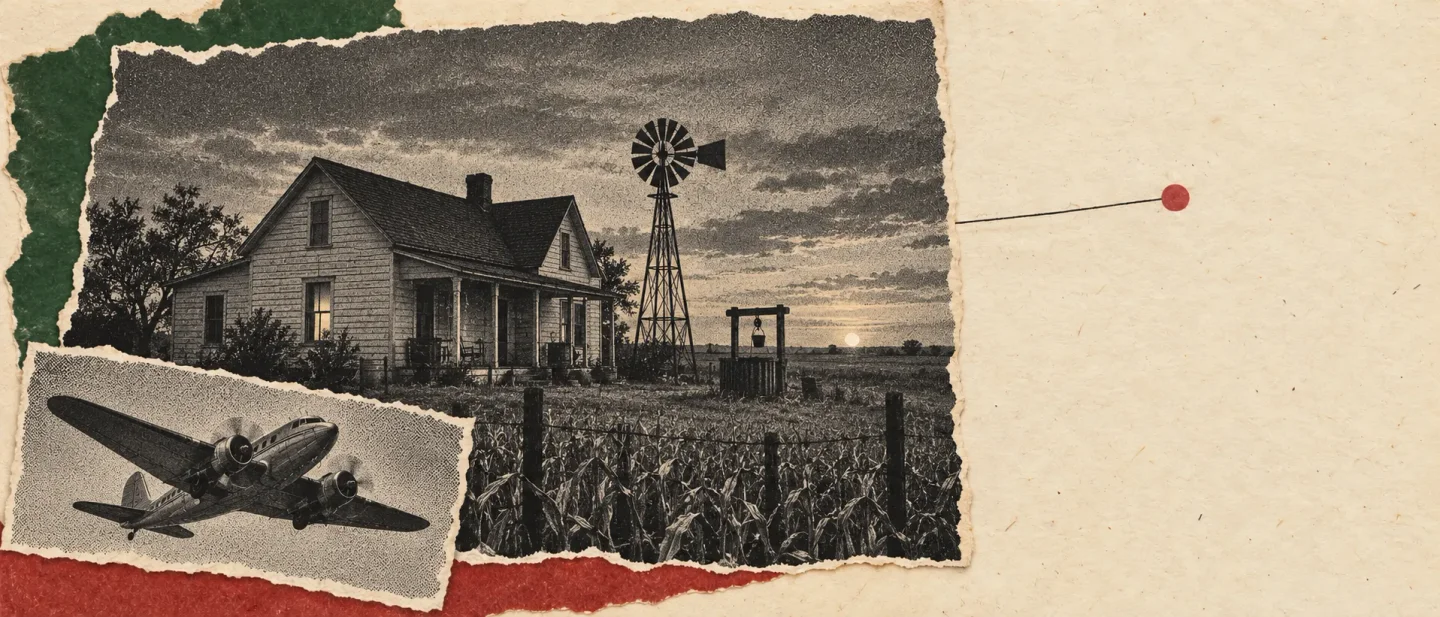
The Urschel kidnapping: nine blindfolded days, an airplane that passed twice a day, and the numbered ransom bills
A calm, source-led account of the 1933 kidnapping of Oklahoma City oilman Charles F. Urschel: how a blindfolded man's memory of an airliner, a farm well and one rainy Sunday led investigators to the Texas farm where he was held, and how the recorded ransom bills and the courts closed the case.

Introduction
The account this issue is built on is the Bureau's own case history, George "Machine Gun" Kelly, published on the FBI's history site in May 2016 and updated in May 2022. 1 It runs from the first knock at a screen door in Oklahoma City to the last of the accessory prosecutions in 1936, and it is the account read in full here.
The story begins late on the night of July 22, 1933, on a screened porch in Oklahoma City. Charles F. Urschel and his wife were playing bridge with their friends Mr. and Mrs. Walter R. Jarrett when two armed men came through the screen door. They asked which of the two men was Urschel, got no answer, and said, "Well, we will take both of them." 1
Urschel was an oilman who had been a trustee of the estate of Tom Slick and had married Slick's widow, Berenice. The state historical society describes their combined fortune as making them one of the wealthiest couples in Oklahoma City. 2
The two men drove Jarrett about twelve miles out of the city and let him go after taking the $50 in his wallet. 1
Urschel they kept. He was blindfolded for the nine days that followed, and he never saw the place where he was held. 1
That is what makes the case worth a full account. Investigators built it out of what one blindfolded man heard and remembered: an airliner that crossed the house twice a day, a well rope, the animals in the yard, the taste of the water. 1
Supplementary material is labelled as such throughout. The procedural history comes from the Tenth Circuit's 1959 opinion in United States v. Kelly 3; the local detail from The Encyclopedia of Oklahoma History and Culture 2; the origin of the "G-men" line from the Bureau's own account of it, published in September 2008 4; and the federal kidnapping statute behind the charges from the Statutes at Large 56.
Full summary
The drive out of the city was blindfolded but full of sound. Urschel smelled gas and heard the pumps at two oil fields about thirty minutes apart, and at about 3:30 in the morning the car stopped while one of the men went for gasoline. 1
It stopped twice more so that gates could be opened. Then it went into a garage, where the men moved the licence plates from the Chevrolet onto a larger car with a bunk in the back. 1
A woman served them at a filling station later that morning, and he heard one of the men ask her about the crops. Her answer was that the crops were burned up, though they might make some broom corn. 1
Rain fell around nine or ten that morning and made the road slippery, and at one point a man had to get out and push. 1
Dark had fallen before the car stopped for good. Urschel was taken outside, through a narrow gate and along a boardwalk, into a room with two beds in it, and he heard a man's voice and a woman's in the adjoining room. 1
The next day they moved him about fifteen minutes' drive away, to a second house. Two more men guarded him there, one old and one young, alongside the two who had taken him. 1
A chain was fastened to his handcuffs after a few days, which let him move around the place. He saw chickens, cows and hogs, and a guard told him the place had four milk cows. 1
Water came from a well northwest of the house, drawn with a rope and a bucket on a pulley that made considerable noise. He was given it in an old tin cup. 1
Two aircraft passed over the house, one each morning at about 9:45 and one each evening at about 5:45, and he timed them on his watch until he knew the pattern. On Sunday, July 30, it rained very hard, and the morning plane did not come. 1
One of the kidnappers talked about his trade. He told Urschel he had been stealing for twenty-five years, and described looking over a bank at Clinton, Iowa, that he and his partner had decided against robbing because the getaway was poor. 1
The family had begun to pay almost as soon as he was gone. On July 26 a Tulsa oilman and friend of Urschel's, J. G. Catlett, received a package by Western Union. 1
The package held a letter from Urschel asking Catlett to act for him, a personal letter to Urschel's wife, and a typed note telling Catlett to come to Oklahoma City at once. A fourth document, addressed to E. E. Kirkpatrick of Oklahoma City, demanded $200,000 in used $20 Federal Reserve notes. 1
The letter to Kirkpatrick also set the terms of the hand-over, and used a newspaper as the signal. Kirkpatrick was to run an advertisement in the Daily Oklahoman, and he would hear from the kidnappers once it appeared. 1
It warned him against taking down the serial numbers of the bills, and against any attempt at a double cross. 1
The advertisement ran, and on July 28 a reply reached the newspaper's office, posted from Joplin, Missouri. 1
The reply told Kirkpatrick to buy a berth on Train 28, the Sooner, which left Oklahoma City for Kansas City at 10:10 p.m. He was to ride on the observation platform with the money in a light-coloured leather bag, and watch for two fires built on the right-hand side of the track; after the second fire he was to throw the bag down to the track. 1
If anything went wrong, he was to go on to Kansas City and register at the Muehlebach Hotel as E. E. Kincaid of Little Rock. 1
The Bureau's own account is plain about its priority. Its first concern in a kidnapping is the safe return of the victim, so it made no attempt to identify the writer of the letters or to interfere with the negotiations until Urschel was home. 1
Two hundred thousand dollars in used $20 notes of the Federal Reserve Bank's Tenth District was obtained, and the serial numbers were recorded before the money went anywhere. 1
Two identical light-coloured leather Gladstone bags were bought. One held the money, and the other was filled with old magazines in case someone tried to hijack the hand-over. 1
Kirkpatrick rode the observation platform all night with the decoy bag, and Catlett sat just inside the rear of the same car with the money. No fires were lit along the line. 1
In Kansas City they fell back on the secondary instruction. Kirkpatrick registered as Kincaid and waited in his room, and a telegram signed C. H. Moore arrived to postpone the meeting. 1
In the evening of Sunday, July 30, a caller asked for Mr. Kincaid and told him to take a taxi to the LaSalle Hotel and walk west. Kirkpatrick went with the money bag, and half a block along a man met him, said, "Mr. Kincaid, I will take that bag," and walked off with it. 1
Urschel was told the following afternoon that he was going to be released. He was driven to a point near Norman, Oklahoma, given $10 and let out, and he reached home at about 11:30 that night, nine days after he was taken. 1
Special agents interviewed him as soon as he had recovered enough to sit through it, and he gave them everything he had noticed, from the route to the aircraft to the furniture. 1
The aircraft turned out to be the most useful thing he had. Investigators reviewed every airline schedule within 600 miles of Oklahoma City. 1
On the Fort Worth–Amarillo line of American Airways, one plane left Fort Worth each day at 9:15 a.m. and another left Amarillo at 3:30 p.m. Those times put the two aircraft near the town of Paradise, Texas at 9:40 in the morning and 5:40 in the evening. 1
The airline's daily reports covered the same week that Urschel had spent in the house. From July 23 to July 29 both planes flew on schedule and no rain was recorded along the route. On Sunday, July 30, the Fort Worth plane left at 11:45 a.m. after being held by a storm, and then flew far to the north to avoid it. 1
The weather records settled the rest. The United States Weather Bureau's office at Dallas had rain at Paradise and around it on July 30, the first real rain there since May 20, and the corn had begun to burn in June. 1
The description had narrowed to a place. The check on suspects already in the file supplied the name, because Kathryn Kelly's mother, Ora L. Shannon, lived near Paradise. 1
On August 10 an agent visited the Shannon residence under a pretext and found the house and the ground around it much as Urschel had described. A second house, about a mile and a half away and belonging to R. G. Shannon's son Armon, had the well, the bucket, the tin cup and the baby's chair. 1
The raid was set for the early morning of August 12. Harvey J. Bailey was arrested there with a machine gun and two automatic pistols beside him and $1,100 on him, of which $700 was identified as ransom money. 1
Bailey had escaped from the Kansas State Penitentiary at Lansing on May 30, 1933. He was wanted over the shooting at Kansas City on June 17, 1933, in which four law officers and their prisoner, Frank Nash, were killed. 1
The state historical society records that the Bureau's director, J. Edgar Hoover, took a personal interest in the case, moved an agent off the Kansas City investigation to work on it, and wanted the Bureau's performance under the new federal law to be seen. 2
R. G. Shannon, his wife Ora and his son Armon were taken in the raid. Questioned, they admitted that Urschel had been held at their two houses and that they had guarded him, and they named George Kelly and Albert L. Bates as the men who had taken him. 1
Bates was arrested in Denver the same day, on a local charge, with $660 that agents identified as ransom money and another machine gun. 1
Urschel was taken to see the two houses. He identified the guards by their voices, and the houses by details he had counted and felt while blindfolded: the number of steps to the door, the baby's chair, the galvanised bucket, the tin cup, the squeaking well, the mineral taste of the water, the fowls and the animals, and the chain. 1
By then the money was speaking for itself. The serial numbers recorded before the ransom changed hands had been circulated to banks across the country, and some of the bills had been exchanged at the Hennepin State Bank in Minneapolis. 1
The trail led to a truck driver, Sam Frederick, who had presented $1,000 of the ransom money at that bank. He said he had gone there at his employer's request with two men who took out a cashier's check for $1,800 in the name of S. H. Peters. 1
Behind the check were Edward "Barney" Berman and an associate called "Kid" Cann, identified as Isadore Blumenfeld. A man using the name Collings had bought 125 cases of whiskey from them for $5,500, paid in ransom $20s. 1
On August 23, 1933, a federal grand jury at Oklahoma City indicted the group on a charge of conspiracy to kidnap Charles F. Urschel. 1
The trial produced guilty verdicts on September 30, 1933, against seven of the accused: R. G. Shannon, Ora Shannon, Armon Shannon, Albert Bates, Harvey Bailey, Clifford Skelly and Edward Barney Berman. 1
Three men were acquitted, Isadore Blumenfeld, Sam Kozberg and Sam Kronick, and two others had been discharged earlier, when a demurrer to the indictment against them was sustained. 1
On October 7, 1933, Bailey, Bates and both of the elder Shannons were sentenced to life in prison. Armon Shannon received ten years' probation, and Berman and Skelly five years each. 1
The Kellys spent that trial sending threatening letters to Urschel, to the assistant attorney general handling the prosecution and to government witnesses. 1
Bailey did not stay in custody to hear his sentence. He escaped from the tenth floor of the Dallas County jail on September 4, 1933, after three bars of his cell were cut through with hacksaws smuggled in with a revolver, and he was retaken at Ardmore, Oklahoma, that same afternoon. 1
The deputy jailer who smuggled the tools in, Thomas L. Manion, and the Dallas man who bought them, Groover C. Bevill, were tried and convicted in October 1933. 1
The two people the Bureau most wanted were still free. George and Kathryn Kelly were found in Memphis at the house of J. C. Tichenor, and agents from Birmingham joined Memphis police for a raid in the early hours of September 26, 1933. 1
Kelly was caught without a weapon. The Bureau's account of the arrest, written three to five days afterwards and published on its site in 2008, records it as quick and quiet, with no words from Kelly at all. 4
The line everyone knows came later. As the legend has it, Kelly shouted, "Don't shoot, G-men, don't shoot!" as he surrendered, and the phrase became the nickname of the Bureau's agents. 4
The earliest version the Bureau could find was printed months after the arrest in a Philadelphia newspaper, and it read differently. Kelly was reported to have said he had not shot because, "It was them G's. Them G's would have slaughtered me." A writer named Rex Collier produced the version that stuck. 4
The couple was taken to Oklahoma City. Both pleaded not guilty, and on October 12, 1933, Judge Edgar S. Vaught sentenced both of them to life in prison. 2
Newsreel cameras were running in the courtroom. The state historical society lists that trial with the Hauptmann and Scopes trials as an early American trial captured on film. 2
Kathryn Kelly and her mother appealed, and the Tenth Circuit affirmed both convictions, in Shannon v. United States, 76 F.2d 490, and Kelly v. United States, 76 F.2d 847. 3
The money kept surfacing for years. In November and December 1934 a woman named Clara Feldman and her son Edward led agents to $38,460 of ransom currency that had been buried in Wyoming, and further sums were recovered in Oregon, Washington and California. 1
One of the men who profited from it was a Denver attorney, Ben B. Laska, who took $10,000 of the ransom money in fees for defending Bates. He was convicted and sentenced in 1935 to ten years, and the Tenth Circuit affirmed that judgment in March 1936. 1
A second Denver attorney, Mollie O. Bert, was charged with perjury over evidence she gave at Laska's trial and pleaded no contest in October 1936. 1
Twenty-one people were convicted in the case in the end. The sentences included six life terms, and the shorter terms added up to 58 years, two months and three days. 1
Kelly died of a heart attack at the federal penitentiary at Leavenworth on July 18, 1954, having been held at Alcatraz from 1934 until 1951. 12 Bates died at Alcatraz on July 4, 1948. 2
The last chapter belongs to the two women. In 1958 Kathryn Kelly and Ora Shannon each filed a motion to set her sentence aside, arguing that they had been poorly represented, that the prosecution had used testimony it knew to be false, and that the atmosphere of the trial had made a fair hearing impossible. 3
They asked for the Justice Department's files on the case, which ran to seventy-three volumes. 3 The district judge ordered the government to produce them, so that he could see whether they contradicted the former United States attorney's testimony. The government refused on a claim of privilege, and the judge set the convictions aside and ordered new trials. 3
The two women were released that June, while the government's appeal was pending. 2
The Tenth Circuit reversed the order on July 27, 1959. Federal law limited what a defendant could obtain from the government's files to statements made by a witness who had given evidence, and no such statement had been shown to exist, so the refusal did not justify setting the convictions aside. 3
Kathryn Kelly died in 1985. 1
Her husband's notoriety outlived him. The phrase attributed to him became the Bureau's own nickname, and the state historical society notes that many people believe the Bureau inflated his reputation to build public support for its fight against crime. 24
Key details
People and roles
- Charles F. Urschel: The Oklahoma City oilman taken from the porch of his house on the night of July 22, 1933, held blindfolded for nine days, and released near Norman on July 31. 1
- Berenice Urschel: Urschel's wife, the widow of the oilman Tom Slick; the state historical society describes the combined family fortune as making the couple among the wealthiest in Oklahoma City. She telephoned the Bureau's director the night of the abduction. 12
- Walter R. Jarrett: The family friend taken by mistake, released about twelve miles outside the city after the kidnappers took $50 from him. 1
- George "Machine Gun" Kelly: Born George Kelly Barnes, a bootlegger and bank robber who ran the kidnapping with Bates. The state historical society credits his wife with buying him his first Thompson submachine gun and giving him the nickname. Sentenced to life on October 12, 1933; died in prison in 1954. 12
- Kathryn Kelly: Kelly's wife and Ora Shannon's daughter, tried with him for the kidnapping and sentenced to life on October 12, 1933. Released in June 1958; died in 1985. 123
- Albert L. Bates: The second man on the porch, arrested in Denver on August 12, 1933, with $660 of the ransom money on him. Sentenced to life and died at Alcatraz in 1948. 12
- Robert G. Shannon, Ora L. Shannon and Armon Shannon: Kathryn Kelly's mother, Ora L. Shannon; her husband, Robert G. Shannon; and Robert's son Armon, who between them held Urschel at two houses near Paradise, Texas. The elder Shannons and Armon Shannon were convicted of conspiracy; the elder two were sentenced to life. 13
- Harvey J. Bailey: An escaped Kansas prisoner and gunman arrested at the Shannon ranch with a machine gun and $1,100, of which $700 was identified as ransom money. He was also wanted over the Kansas City shooting of June 17, 1933, and was sentenced to life. 1
- J. G. Catlett and E. E. Kirkpatrick: The two Oklahoma City men who handled the ransom, one carrying the money and the other the decoy bag. 1
- Judge Edgar S. Vaught: The federal judge who sentenced George and Kathryn Kelly on October 12, 1933. 2
- Edward "Barney" Berman and Clifford Skelly: Two men who exchanged ransom bills for clean money in Minneapolis and were convicted of conspiracy, receiving five years each. 1
- Ben B. Laska: The Denver attorney who took $10,000 of the ransom money as a fee for defending Bates and was sentenced to ten years in 1935. 1
- J. Edgar Hoover: The Bureau's director, who according to the state historical society took a personal interest in the case and treated it as a test of the Bureau under the new federal kidnapping law. 2
Timeline
- July 22, 1933, Oklahoma City: Urschel and his guest Walter Jarrett are taken at gunpoint from a bridge game at about 11:15 p.m.; Jarrett is released about twelve miles out, and is back at the house by 1 a.m. 12
- July 23–31, 1933, near Paradise, Texas: Urschel is held blindfolded and moved between two houses, noticing two aircraft a day at fixed times and the sounds and objects of the farm. 1
- July 26–30, 1933, Tulsa, Oklahoma City and Kansas City: The ransom letters go out, the newspaper advertisement runs, and $200,000 in used $20 notes with recorded serial numbers is handed over at the LaSalle Hotel on the evening of July 30. 1
- July 31, 1933, near Norman, Oklahoma: Urschel is released with $10 and reaches home at about 11:30 p.m. after nine days. 1
- August 10–12, 1933, Paradise, Texas and Denver: An agent visits the Shannon house under a pretext; the raid follows on August 12, and Bailey and the three Shannons are arrested. Bates is arrested in Denver the same day. 1
- August 23, 1933, Oklahoma City: A federal grand jury indicts the group for conspiracy to kidnap Charles F. Urschel. 1
- September 4, 1933, Dallas: Bailey escapes from the tenth floor of the county jail after bars are cut with smuggled hacksaws, and is retaken at Ardmore that afternoon. 1
- September 26, 1933, Memphis: George and Kathryn Kelly are arrested in an early-morning raid on the house of J. C. Tichenor. 1
- September 30 and October 7, 1933, Oklahoma City: Seven defendants are convicted of conspiracy, and life sentences are imposed on Bailey, Bates and the elder Shannons. 1
- October 12, 1933, Oklahoma City: Judge Vaught sentences George and Kathryn Kelly to life in prison in a courtroom being filmed. 2
- 1934–1936, Denver, Wyoming and elsewhere: Ransom money is recovered from the people who buried and spent it, and the attorney Ben Laska is convicted, sentenced to ten years in 1935, and affirmed on appeal in March 1936. 1
- July 4, 1948 and July 18, 1954: Bates dies at Alcatraz; Kelly dies of a heart attack at Leavenworth. 12
- 1958–1959, Oklahoma City and Denver: Kathryn Kelly and Ora Shannon move to set their sentences aside and are released in June 1958; on July 27, 1959, the Tenth Circuit reverses the order that had freed them. 23
- 1985: Kathryn Kelly dies. 1
What turned the investigation
The men who took him gave investigators little to work with. The victim was blindfolded for the whole of his captivity, and the only detailed account of the place existed in what he had heard there. 1
The aircraft was the thread that could be pulled. An airline timetable is a published document, so a plane heard at 9:45 each morning became a location once the schedules were laid against the map. 1
Weather records turned the timetable into a date. The one morning Urschel noticed no aircraft was the one morning the airline's own reports showed a delayed departure caused by a storm, and the weather bureau's records showed rain exactly where the route had been interrupted. 1
The money worked on a similar principle. The serial numbers were recorded before the ransom was handed over, so every $20 note the kidnappers spent became a report from wherever it surfaced, and the men who exchanged those notes for clean currency were drawn into the case as co-conspirators. 1
The Bureau let the hand-over proceed without interference, and it waited until Urschel was home before acting on what it had learned. The account gives the reason: the victim's safe return came first. 1
The legal outcome
The charge was federal because of the route the kidnappers took. The 1932 statute, passed after the Lindbergh case, made it an offence to transport a kidnapped person across a state line when the victim was held for ransom or reward, and it punished a conspiracy to do the same, provided some act was done towards carrying it out. 5
The Tenth Circuit's later recital of the case shows what that meant in practice. The defendants were convicted of "conspiring to kidnap Charles F. Urschel at Oklahoma City, transport him into Texas, and there hold him in concealment for the payment of ransom", and each was sentenced to life. 3
The 1932 penalties left the term to the sentencing court's discretion. Congress rewrote them in May 1934, after this case was over, allowing a death sentence where the jury recommended one. 6
The first trial ended in seven convictions and three acquittals on September 30, 1933. On October 7 the life sentences were imposed on Bailey, Bates and the elder Shannons, and on October 12 the Kellys received theirs. 12
The convictions survived direct appeal: the Tenth Circuit affirmed the judgments against Kathryn Kelly and her mother. 3
The post-conviction fight in 1958 came down to access to the government's own files, and it turned on the statute governing that access. The district court set the convictions aside in 1958, and the Tenth Circuit restored them on July 27, 1959. 3
In all, twenty-one people were convicted in the case, six of them sentenced to life. 1
Verbatim quotes
The ransom note to E. E. Kirkpatrick, setting out what the money was to be: "You will proceed to obtain the sum of TWO HUNDRED THOUSAND DOLLARS ($200,000.00) in GENUINE USED FEDERAL RESERVE CURRENCY in the denomination of TWENTY DOLLARS ($20.00) BILLS." 1
The same letter's instruction, dictated by the kidnappers and printed in the Daily Oklahoman as the signal that the family would pay: "FOR SALE — 160 Acres Land, good five room house, deep well. Also Cows, Tools, Tractor, Corn, and Hay. $3750.00 for quick sale. TERMS. Box ____" 1
The man who took the money bag from Kirkpatrick on a Kansas City street, on the evening of July 30, 1933: "Mr. Kincaid, I will take that bag." 1
Urschel, describing how one of his captors spoke about his own career: "Just a couple of cheap filling station and car thieves." 1
The Bureau's stated priority during the negotiations, in its own case history: "The Bureau's first concern in all kidnapping cases is the safe return of the kidnapped victim." 1
The Bureau's history office, on the line it is best known for in this case: "Did Kelly really say those words? Probably not—it appears to have been manufactured by the media." 4
References
- 1
- 2
- 3United States v. Kelly, 269 F.2d 448 (10th Cir. 1959)
law.resource.org
- 4
- 5Act of June 22, 1932, 47 Stat. 326
govinfo.gov
- 6Act of May 18, 1934, 48 Stat. 781
govinfo.gov
This story was produced automatically by a channel. One sentence is all it takes for Neodrop to keep producing for you.