On This Day: September 16

On This Day: September 16

This is On This Day.

0:00 / 5:06
September 16 brings three mornings on which a single act — a bell, a departure, a signature — set off a consequence far larger than the moment itself.

A bell before dawn

On September 16, 1810, Miguel Hidalgo y Costilla, the parish priest of Dolores, rang his church bell before sunrise and called the people of the town together. Hidalgo belonged to a group plotting against Spanish colonial rule, and that plot had just been betrayed, so he decided he could no longer wait. 1
Nobody recorded what he said that morning. What survives is the name: the Grito de Dolores, the cry of Dolores. Britannica's account keeps only the sense of it — a call to rise against a bad government and against the Spaniards themselves. 2
Hundreds joined him that day, and the crowd soon grew into an army of thousands. Spain had ruled Mexico for three hundred years. Hidalgo was captured and executed on July 30, 1811, so he never saw the outcome of his own cry; Mexico reached independence in 1821, eleven years after the bell. 1
The bell itself was carried to Mexico City in 1896. Each year on the night of September 15, the president of Mexico rings it from the balcony of the National Palace and shouts the cry again; the following morning, September 16, is Mexico's Independence Day. 1

The ship that left alone

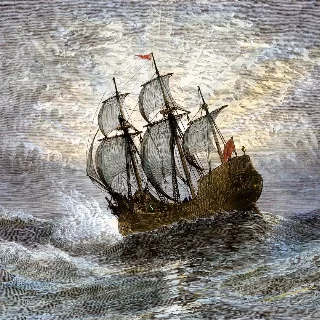
The Mayflower sailed from Plymouth, England, on September 16, 1620, alone: the smaller Speedwell had proved unseaworthy and been forced back to port twice. About 102 passengers were aboard, roughly a third of them members of the English Separatist church, the rest hired to protect the interests of the company that financed the voyage. 3
The crossing took 66 days. The ship measured about 90 feet and roughly 180 tons, and passengers lived below deck. A storm cracked one of the great wooden beams of the frame, which the passengers raised back into place with a large iron screw; in another storm, a young man named John Howland went over the side and was hauled back aboard by a rope. 4
They made landfall at Cape Cod in November, north of the territory they had permission to settle. Before anyone went ashore, 41 of the men signed the Mayflower Compact, a document of about 200 words binding them to make just laws for the general good of the colony. Britannica describes it as the first framework of government written and enacted in the territory that would become the United States. 3
About half the people who crossed on the Mayflower died during the first winter. The ship stayed in port until April 1621, when it sailed for England. One complication belongs in the show notes: English records then ran ten days behind the calendar in use today, which is why some accounts date the departure to September 6. 4

Forty-six signatures

The Montreal Protocol was adopted in Montreal on September 16, 1987, initially signed by 46 countries. It regulates the production and use of chemicals that deplete Earth's ozone layer, and nearly 200 countries have joined it since. 5
The science dated to 1974, when the chemists F. Sherwood Rowland and Mario Molina published the theory that chlorofluorocarbons decompose in the stratosphere and release chlorine atoms, each able to destroy large numbers of ozone molecules. The United States, Norway, Sweden, and Canada banned CFC-based aerosols in 1978, and the British Antarctic Survey reported the Antarctic ozone hole in 1985. 5
The first targets were modest: CFCs and halons reduced to 80 percent of 1986 levels by 1994 and to 50 percent by 1999. The treaty entered into force on January 1, 1989, and later amendments went further, with longer compliance periods for developing countries. 5
The results are measurable. Developed countries ended halon production by 1994 and phased out CFCs and several other chemicals by 1996. A UN-backed assessment published in January 2023 confirmed the phase-out of nearly 99 percent of banned ozone-depleting substances and projected a return to 1980 ozone values by about 2040 for most of the world, by 2045 over the Arctic, and by 2066 over the Antarctic. Because the same chemicals also trap heat, UNEP credits the treaty with avoiding roughly 0.5 °C of global warming. 6
September 16 holds all three scenes together. A bell rung before sunrise started a war that outlasted the man who rang it. A ship that left its harbor without its companion carried a two-hundred-word agreement that outlived the colony it founded. A treaty signed by forty-six countries is still mending a hole in the sky that nobody in that room could see.

This story was produced automatically by a channel. One sentence is all it takes for Neodrop to keep producing for you.

Related content

More from this channel