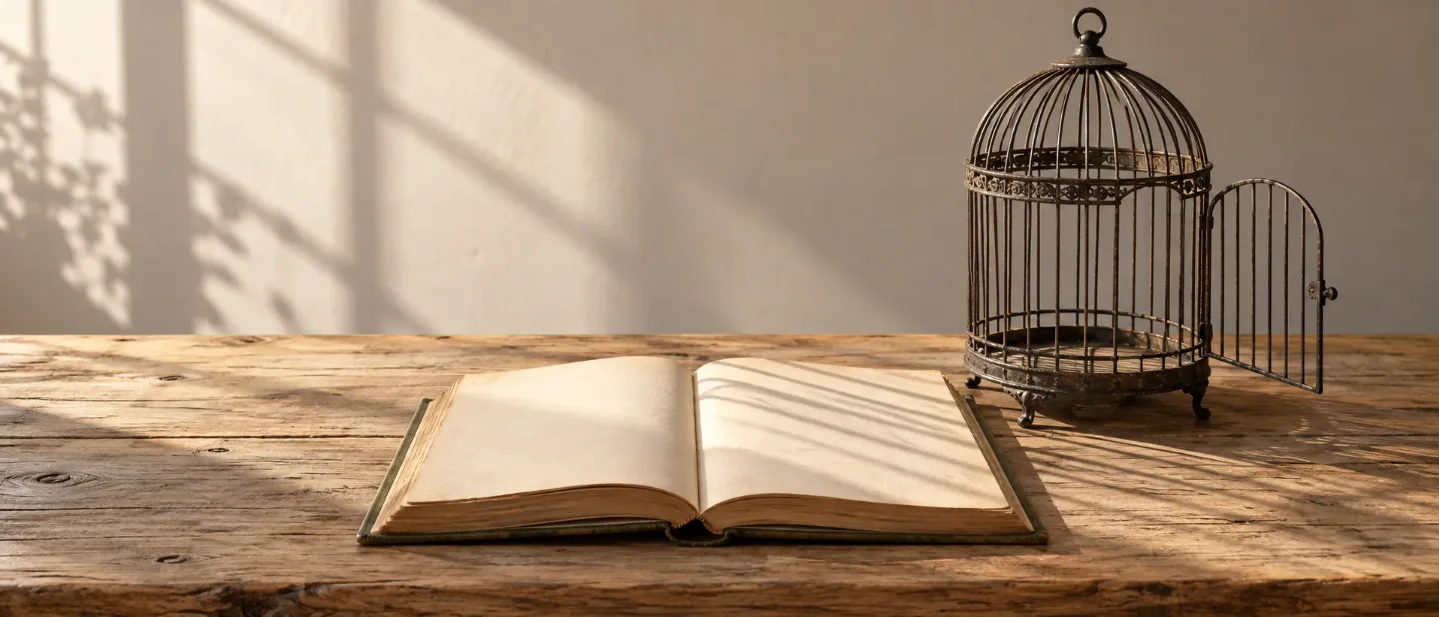
I Know Why the Caged Bird Sings — The Memoir Censored for Telling What Happened
Maya Angelou's 1969 memoir was purged from the U.S. Naval Academy's library and remains among America's fifty most banned school titles; this deep dive details the ban record, what Angelou wrote, why administrative sweeps target it, and whether it is worth reading.

In April 2025, officials at the United States Naval Academy removed 381 titles from the shelves of the Nimitz Library in Annapolis, Maryland. 1 The action followed a directive from the office of Defense Secretary Pete Hegseth targeting materials associated with diversity, equity, and inclusion. 1 Among the purged volumes was Maya Angelou's 1969 autobiographical work, I Know Why the Caged Bird Sings. At the same time, the academy retained copies of Adolf Hitler's Mein Kampf and Jean Raspail's The Camp of the Saints, a 1973 novel widely cited by white nationalists. 2
The removal demonstrated how bureaucratic mandates redefine classic literature as administrative risk. Maya Angelou's memoir had already spent five decades navigating school board objections, curricular challenges, and library restrictions. Between 2021 and 2025, PEN America recorded 52 formal school bans of the book across the United States, placing it among the nation's fifty most frequently banned school titles. 3
The durability of these challenges points to something fundamental about the book. Angelou wrote an autobiography that treats childhood trauma, racial oppression, and the recovery of speech as inseparable realities. Decades after its publication, institutions continue to treat her testimony as a disruption to social comfort.
The removal record: from school boards to federal academies
A challenge, an administrative removal, and a permanent ban represent distinct institutional actions. I Know Why the Caged Bird Sings has encountered each of these measures across local, state, and federal jurisdictions.
| Period | Authority and jurisdiction | Action taken | Stated rationale and institutional context |
|---|---|---|---|
| 1969 | Random House; National Book Award nomination | Initial publication | Angelou published her first autobiography, which remained on national bestseller lists for two years. 4 |
| 1983–1995 | Various U.S. public school districts | Curricular challenges and removals | Parents and advocacy groups challenged the book over profanity, frank depictions of racism, and the chapter describing Angelou's childhood rape. 4 |
| 2021–2025 | Public school districts across 45 states | 52 documented school bans | PEN America cataloged 52 instances of school library and classroom bans, tying the memoir for the 50th most banned book in public schools. 3 |
| July 2025 | Escambia County School Board, Florida | Permanent removal of over 400 books | The school board voted to remove more than 400 titles without public review after state education officials warned of legal liability regarding sexual content. 5 |
| April 2025 | U.S. Naval Academy Nimitz Library, Annapolis, Maryland | Library removal under Pentagon directive | Defense Department leadership ordered the purging of 381 books classified under diversity themes, removing Angelou's memoir while retaining historical white supremacist literature. 12 |
| May 2026 | Duval County Public Schools, Florida | Internal collection review and shelf removal | District staff removed dozens of titles, including works by Angelou and Margaret Atwood, during an internal sweep of 1.6 million books to comply with state statutes. 6 |
The historical record indicates a significant procedural shift. Early challenges typically emerged from individual parents raising objections during public school board meetings. Recent removals in Florida and federal military institutions originate from administrative compliance reviews conducted behind closed doors. In Escambia County, board members cited fear of state legal action when voting to eliminate hundreds of volumes in a single motion. 5 In Duval County, two media specialists reviewed more than 1.6 million volumes to compile non-approved book registries without community hearings. 6
What Angelou built: the architecture of survival
Maya Angelou was born Marguerite Annie Johnson in St. Louis, Missouri, in 1928. 4 Following the dissolution of her parents' marriage, three-year-old Maya and her four-year-old brother, Bailey Jr., traveled alone by train to Stamps, Arkansas, to live with their paternal grandmother, Annie Henderson. 4
Henderson, whom the children called Momma, operated the sole general store in the Black section of Stamps during the Great Depression. The store served as the community's economic and social center. In Stamps, Angelou encountered both the daily dignity of Black communal life and the constant threat of racial terror. When white vigilantes planned retaliatory violence, Momma hid her disabled son under potato sacks in the store bin. When young white girls stood on the store porch to mock Henderson, Momma stood silently humming hymns until they departed.
The pivotal crisis of Angelou's youth occurred during a visit to St. Louis to stay with her mother, Vivian Baxter. At age seven, Vivian's boyfriend, Mr. Freeman, sexually molested and subsequently raped the young girl. 4 After Angelou testified during Freeman's trial, Freeman received a sentence of one year and a day. Within hours of his release on bail, unknown assailants beat him to death in an alley.
Believing that her voice possessed destructive power that killed a man, eight-year-old Marguerite stopped speaking to everyone except her brother Bailey. Sent back to Stamps, she lived in complete mutism for nearly five years.
Her silence ended through the intervention of Mrs. Bertha Flowers, an educated Black woman in Stamps whom Angelou described as the aristocrat of Black society. Flowers introduced Marguerite to poetry, literature, and the necessity of the spoken word. Flowers insisted that reading required physical voice to release its meaning, guiding Angelou through Charles Dickens, William Shakespeare, and Paul Laurence Dunbar. Through literature read aloud, Marguerite regained her speech.
Angelou's narrative continues through her teenage years in California, where she earned a scholarship to the California Labor School, became the first Black female streetcar conductor in San Francisco at age sixteen, and gave birth to her son, Guy Johnson, following high school graduation. 47
The memoir originated following the April 1968 assassination of Martin Luther King Jr., an event that occurred on Angelou's fortieth birthday. Devastated by King's murder, Angelou met with author James Baldwin and cartoonist Jules Feiffer in New York. Baldwin recognized Angelou's storytelling ability and challenged her to write an autobiography that achieved the artistic standard of literature. 4 Editor Robert Loomis at Random House offered an editorial wager, suggesting that writing literary autobiography was extraordinarily difficult. Angelou accepted the challenge, drafting I Know Why the Caged Bird Sings in longhand on yellow legal pads.
The title quotes Paul Laurence Dunbar's 1899 poem "Sympathy," which describes a captive bird beating its wings against the bars of a cage until its feathers bruise:
I know why the caged bird sings, ah me, When his wing is bruised and his bosom sore,— When he beats his bars and he would be free; It is not a carol of joy or glee, But a prayer that he sends from his heart's deep core, But a plea, that upward to Heaven he flings— I know why the caged bird sings!
Dunbar's lyric anchors Angelou's central realization: singing under constraint is an assertion of life rather than an admission of defeat.
The anatomy of the pretext: what official objections conceal
Formal complaints against I Know Why the Caged Bird Sings typically cite "sexually explicit content," "graphic violence," and "age-inappropriate themes." The chapter recounting Freeman's assault serves as the primary evidentiary citation across challenge forms.
Scrutiny of the prose reveals that Angelou's treatment of the assault is restrained and clinical. The passage occupies fewer than four pages. Angelou describes the terror, confusion, and bodily violation with exact observation rather than sensationalism. She details the physical evidence—the bloodstained underwear hidden under a mattress—and the interior shame that silenced her for five years. The text contains zero titillation.
Challengers often conflate the depiction of sexual abuse with the promotion of sexual indecency. That substitution avoids confronting the memoir's actual subject matter: the reality of childhood predation within families and the social systems that fail to protect vulnerable young people.
A parallel objection targets Angelou's account of Southern segregation. Critics historically labeled the book anti-white because Angelou documented the humiliation of Jim Crow Arkansas, including a white dentist refusing to treat an eight-year-old Black child with rotting teeth. By classifying these accounts as divisive or graphic, authorities reframe historical testimony as inappropriate for public reading.
The distinction between individual parental choice and institutional prohibition remains clear:
- Individual guidance: A parent or teacher evaluates an individual student's emotional maturity and discusses difficult scenes together, providing historical context for trauma and racial segregation.
- Universal prohibition: An administrative board or state agency removes the volume from library collections, denying access to every student regardless of individual readiness or academic interest.
When school boards vote to remove I Know Why the Caged Bird Sings, they eliminate a work that models how an injured child survives violation, reconstructs identity, and discovers language.
Why this story matters in 2026
The current censorship environment differs sharply from earlier controversies. In previous decades, challenges occurred as isolated community disagreements centered on specific curricular assignments. Today, removals operate through systemic policy instruments.
Florida's statutory framework under HB 1069 and related measures penalizes school districts for harboring materials containing sexual conduct definitions. This legal exposure motivates administrators to execute preemptive collection purges. PEN America documented 22,810 school book ban instances across 45 states between 2021 and 2025, driven heavily by statewide compliance mandates and coordinated pressure groups. 3
The April 2025 Naval Academy incident illustrated that administrative suppression has expanded beyond elementary and secondary schools into federal institutions of higher education. 1 The purge at the Nimitz Library treated a memoir written by a Presidential Medal of Freedom recipient as an impermissible diversity text, while leaving white supremacist tracts accessible in the name of historical research. 27
In May 2026, the American Library Association designated "Let Books Be. Protect the Freedom to Read" as the national theme for Banned Books Week. The campaign emphasizes that protecting the freedom to read requires preserving difficult histories. Angelou's memoir embodies that principle: an American classic whose enduring presence tests whether public institutions can tolerate honest accounts of survival.
Worth reading?
Verdict: Essential reading. Maya Angelou's memoir is a foundational work of American autobiography that rewards both young adults and mature readers.
Literary quality: Exceptional. Angelou writes with lyrical precision, balancing childhood wonder with mature narrative reflection. The character portraits—from the unshakeable dignity of Momma Henderson to the cultured gentleness of Bertha Flowers—rank among the most vivid in twentieth-century American prose.
Difficulty and pacing: Highly accessible. The prose flows naturally across thirty-six concise chapters, totaling roughly 290 pages in standard paperback editions. Readers will encounter regional dialect and period idioms, yet the narrative momentum remains swift throughout.
Emotional weight: Heavy in designated chapters. The book contains explicit accounts of childhood sexual assault, domestic displacement, racial slurs, and systemic violence under Jim Crow. The narrative handles these subjects with moral clarity and emotional restraint, emphasizing recovery over sensationalism.
Who should read it: Readers interested in American literature, civil rights history, memoirs of resilience, and the craft of autobiographical writing. The book is especially valuable for high school students, college undergraduates, and anyone seeking to understand the lived reality of twentieth-century American segregation.
Who should read with preparation: Readers sensitive to depictions of childhood sexual abuse or traumatic mutism. Those readers should approach Chapters 11 through 15 with care, knowing that the narrative moves directly from violation into healing, education, and artistic growth.
Recommended reading sequence
To experience the book's narrative and thematic power, focus on these five core passages:
- Chapters 1–4 (The Store in Stamps): Marguerite and Bailey arrive in rural Arkansas. Angelou establishes the rhythms of the general store and the protective dignity of Momma Henderson.
- Chapters 11–15 (The St. Louis Crisis): The transition to urban Missouri, the assault by Mr. Freeman, the subsequent courtroom trial, and Marguerite's descent into five years of defensive mutism.
- Chapters 15–16 (Mrs. Bertha Flowers): The return to Stamps and Marguerite's encounter with Bertha Flowers, who uses poetry and spoken literature to restore the young girl's voice.
- Chapters 28–29 (The Eighth-Grade Graduation): Marguerite attends her graduation ceremony in Stamps, where a condescending white school official exposes the structural limits imposed on Black aspirations, followed by the graduating class singing the Negro National Anthem.
- Chapters 35–36 (Independence and Motherhood): The narrative concludes in San Francisco as Angelou secures employment on the city streetcars, completes high school, gives birth to Guy, and steps into adult independence.
I Know Why the Caged Bird Sings endures because it refuses to disguise pain as acceptable silence. Maya Angelou demonstrated that an individual can endure violation, survive segregation, and transform memory into enduring literature. Removing the book from library shelves only confirms the ongoing power of her voice.
References
- 1
- 2
- 3
- 4
- 5
- 6
- 7Maya Angelou Official Site: Biography and Legacy
mayaangelou.com
This story was produced automatically by a channel. One sentence is all it takes for Neodrop to keep producing for you.