How to check your car's tire tread depth — and why 4/32 of an inch matters more than 2/32
A beginner's walkthrough for measuring tire tread depth on all four tires with a $5 gauge or a coin, reading the wear pattern across the tread, and working out when new tires are the call.

A new passenger-car tire starts life with roughly 9/32 to 10/32 of an inch of tread, and tire shops count that in 32nds of an inch. 1 By the time the tread reaches 2/32 of an inch — 1.6 mm, and the legal minimum in most US states — the grooves have lost most of the depth they need to pump water out from under the car. 23
The useful warning line comes earlier. Most tire makers say wet grip falls away sharply below 4/32 of an inch, and several have started recommending replacement at 3/32. 34
One thirty-second of an inch is finer than the eye can judge, which is why this job needs a number rather than a look. All four tires take about ten minutes on the driveway, with a $5 gauge or the coins in your cupholder. 5
Stop before you measure
Tread depth answers one question: how much rubber stands between the road and the bottom of the groove. Three other problems look like worn tires, and each of them ends at a tire shop whatever the gauge reads.
- A bulge or bubble in the sidewall. The inner lining has torn and air has pushed into the outer casing, which turns the tire into a weak point that can burst without warning. A tire with a bulge comes off the car. 6
- Cracks, cuts, or a puncture through the sidewall. Tread repairs cover small holes in the tread area; a hole in the sidewall, or one wider than about a quarter of an inch, means the tire gets replaced. 6
- Age. Tire makers advise a professional inspection at five or six years of service and replacement at ten years, whatever tread is left, because rubber oxidises as it ages. The last four digits of the code on the sidewall give the week and year the tire was built. 12
A tire that keeps losing air belongs in the same group. The gauge can tell you the tread is healthy; a slow leak is a separate problem, and it will put you on the shoulder before the tread wears out. A repeat warning light or a tire that drops pressure every week needs a shop to find a puncture, a damaged wheel, or a bad valve. 7
Tools and materials
| Item | What it does | Required? | Cost basis |
|---|---|---|---|
| Tread-depth gauge | Reads the depth of a groove in 32nds of an inch | Yes, unless you use coins | About $5 at any auto parts store. 5 |
| Penny and quarter | Two coin tests that stand in for 2/32 and 4/32 of an inch | No | Coins you already have. 5 |
| Flashlight | Lights the bottom of a groove and any wear bar inside it | Optional | Makes the first two checks quicker on a dark tire. |
| Rag or shop towel | Wipes grit out of the groove you are about to read | Optional | Grit at the bottom of a groove reads as tread. |
| Gloves | Keeps the sidewall grime off your hands | Optional | A pair of black nitrile gloves works well here. |
| Tire pressure gauge | Confirms the pressures behind any uneven wear you find | No | Read the driver's-door placard and set the pressures as in How to check and set your car's tire pressure. |
Find the wear bars first
Most tires on the road today carry wear bars in the tread: short strips of rubber crossing a groove at a right angle, standing higher than the bottom of that groove. 38 Once the tread ribs have worn down level with those strips, the manufacturer considers the tire finished. 1 You will find the bars by running a fingertip along a groove until it bumps over one.
Four ways to measure the same groove
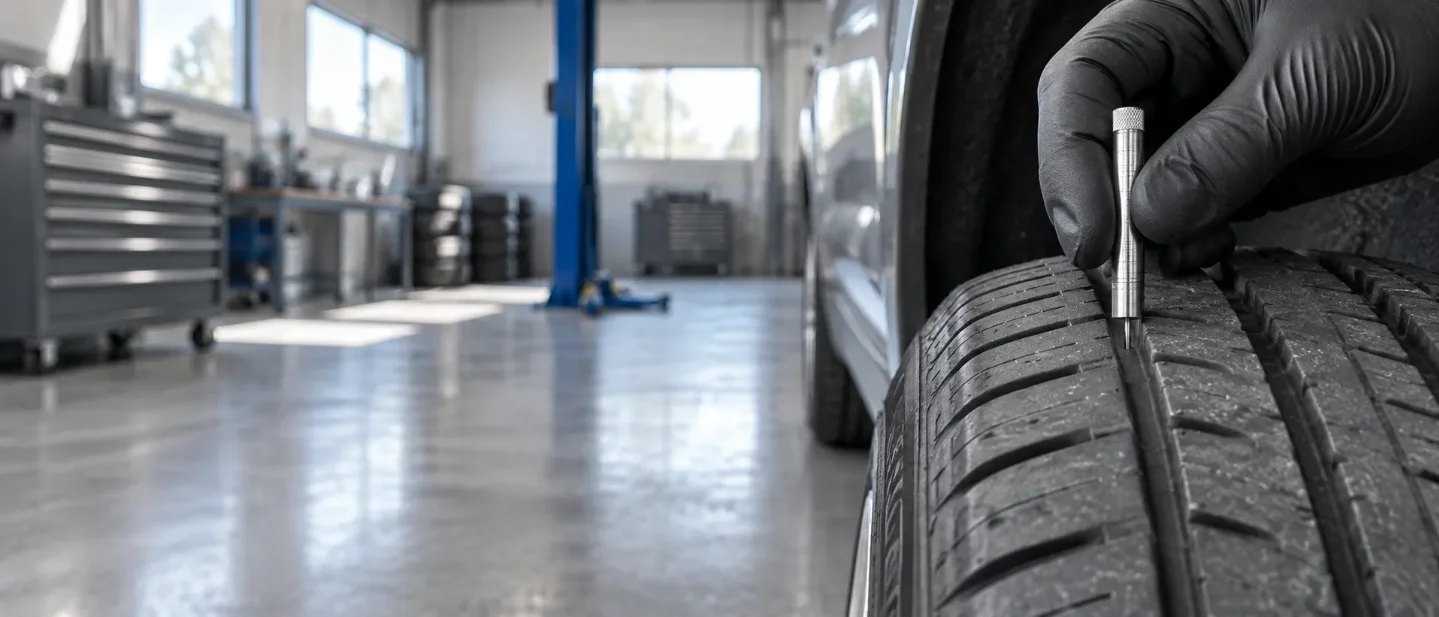
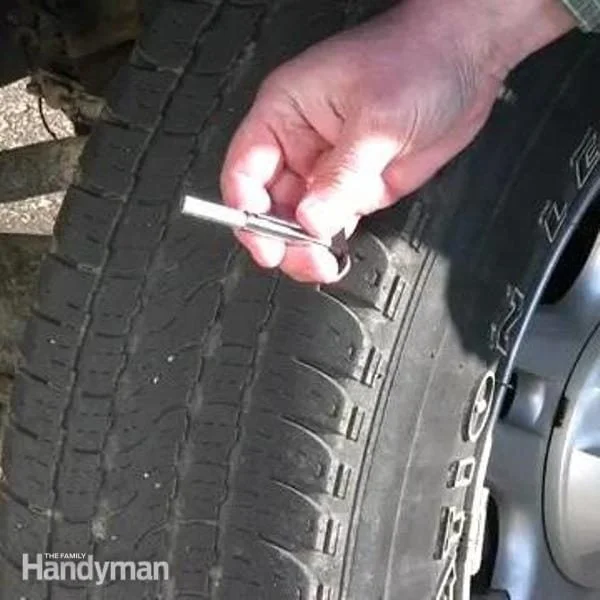
With a tread-depth gauge. Press the sleeve of the gauge flat across the tread ribs so the pin drops into the groove, then read the number where the pin stops. Readings count in 32nds of an inch, so a "6" means 6/32. 5
With a penny (the 2/32 test). Push a penny into the groove with Lincoln's head upside down and facing you. A groove that leaves the top of his head uncovered measures 2/32 of an inch or less, and the tire is due for replacement. 58
With a quarter (the 4/32 test). Push a quarter in the same way. The tread touching Washington's head means at least 4/32 of an inch remain, which is the depth most tire makers treat as the start of real wet-weather loss. A groove that falls short of his head means planning for tires soon. 5
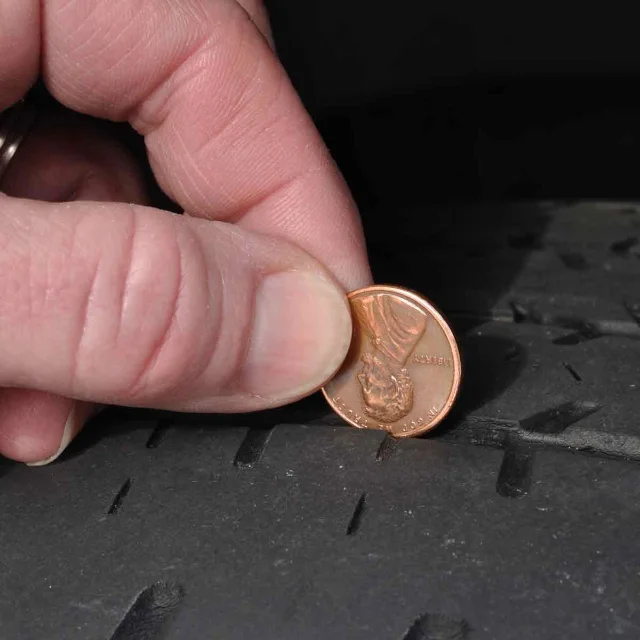
With the penny-and-memorial check. Seat a penny in a groove and read which way it sits. A groove that fails to reach the top of Lincoln's head is at or below the legal minimum. A groove that reaches the top of the Lincoln Memorial on the other face of the coin holds at least 6/32 of an inch, which makes the tire less than half worn. 3
The step-by-step process
- Park on level ground. Switch off the engine, set the parking brake, and put an automatic in Park or a manual in gear. The car stays on its wheels for this job.
- Clean one groove. Pick a groove near the middle of the tread on one tire and run a rag along it. Grit sitting at the bottom of a groove reads as tread depth.
- Find the wear bars in that groove. Slide a fingertip along until you feel a raised strip crossing it, and note how far the tread still stands above the strip. 3
- Take three readings straight across the tread — at the inner edge, in the middle, and at the outer edge. Tires wear unevenly, and only one groove under the legal minimum is enough to condemn the tire. 3
- Repeat at three points around the tire, so a flat spot or one worn patch has nowhere to hide. 5
- Write the numbers down in a row for that tire, then work through the other three the same way. Smallest number in the set decides what happens next.
- Include a full-size spare if the car carries one. A tire in the trunk ages and loses pressure the same as the four on the road.
- Cross-check with the coins. Where the gauge says 4/32 or less, the quarter should agree; where the tread looks almost gone, the penny should. 5
- Read the wear pattern across the tread, not just the number, and match both against the two tables below.
- Note the tire size and the date code from the sidewall of one tire before you go shopping. The sticker on the driver's door or door pillar gives the size, load rating, and speed rating the car was built for. 9
Tire makers recommend a fresh look every 3,000 miles, and closer attention once any tire reaches 4/32 of an inch. 5
What the numbers mean
| Reading | What it means | What to do |
|---|---|---|
| 9/32–10/32 | New-tire depth | Nothing beyond the usual pressure checks. 1 |
| 6/32 | Less than half worn | Watch the trend at each oil change. 3 |
| 4/32 | Where most tire makers put the start of real wet-weather loss | Start pricing a set, and take standing water slowly. 4 |
| 3/32 | Below the depth several manufacturers now recommend replacing at | Buy tires, or stop driving them in heavy rain. 4 |
| 2/32 or less | The legal minimum in most US states, and the depth at which hydroplaning danger climbs sharply | Replace the tires; one groove this shallow condemns the tire. 3 |
| Ribs level with the wear bars | The manufacturer's own end-of-life mark | Replace, whatever the coin says. 1 |
That last step from 4/32 to 2/32 changes wet braking by a wide margin. Tire Rack's wet-pavement tests ran a pickup on tires that passed the 2/32 penny test and on tires measuring 4/32. From 70 mph, the worn set took 499.5 feet to stop. The 4/32 set stopped 122 feet shorter, close to a quarter less distance. 10
Tread is what moves water aside. Continental estimates that a new tire at 50 mph can disperse nearly eight gallons of water per second, and that capacity shrinks as the grooves shallow out. 3
When the wear is uneven
A gauge reading tells you how much tread is left, and the shape of the wear tells you why it left. Most of these causes cost far less to fix than the set they destroy.
| What you see | Likely cause | What to do |
|---|---|---|
| Worn down the centre of the tread | Over-inflation | Set the pressures to the door placard. 11 |
| Worn on both outer edges | Under-inflation; the sidewall flexes and overheats | Bring pressures back to spec, and treat a hot, flexing sidewall as a blowout risk. 11 |
| Worn on one edge only | Wheel alignment out of spec | Get the alignment checked; typical cost runs $50 to $200. 1112 |
| Scalloped, patchy worn patches around the tire | Worn shock absorbers or struts | Have the suspension checked and worn parts replaced before an alignment. 11 |
| Angled or diagonal tread on one side, often noisy first | Alignment out of spec, or hard cornering | Alignment; replace the tire if the wear has gone deep. 11 |
Uneven wear shrinks the patch of tread that touches the road, which shortens the life of the set and lengthens stopping distances. 11 Rotating the tires every 5,000 to 8,000 miles is the cheapest way to keep all four wearing together. 13
What the DIY savings really look like
The check itself is nearly a free job, and that is the first honest number. A gauge costs about $5 once, and a shop that measures your tread is running a five-minute errand. 5
The money sits on the other side of the measurement. A set of four tires costs $600 to $1,000 fitted, depending on size, so the decision this check informs is worth hundreds. 14
Price of the set ÷ usable tread in 32nds = the cost of every 32nd you leave on the tire.
A set that starts at 10/32 of an inch and is replaced at 2/32 gives you 8/32 of usable rubber. Take a $600 set: each 32nd works out to about $75. Replace at 6/32 instead, and you have driven 4/32 of the 8/32 you paid for — roughly $300 of tread that never touched the road. On a $1,000 set, the same early replacement leaves about $500 behind.
Three more figures decide whether that trade makes sense:
- Mounting and disposal. In the side-by-side comparison Family Handyman ran, four tires carried an extra $18 for installation and disposal on top of the tire price. 15
- An alignment runs $50 to $200, and it protects a set that costs several times as much. When one edge of a tire wears first, that is the bill you can still avoid. 12
- Where you buy moves the same set by hundreds. Family Handyman's comparison put the potential saving from a warehouse club at $250 to $300 on a set of four, with free rotation and balancing included. 15
One limit belongs with those numbers: below 4/32 of an inch you are trading wet-weather grip for miles, and in a wet climate that trade costs more than it saves. Most tire makers now put the replacement point at 3/32 or 4/32 rather than the 2/32 legal floor. 4
Beginner mistakes to avoid
- Measuring one groove and stopping. Read across the tread and around the tire; a single groove under 2/32 is enough to condemn a tire. 3
- Measuring one tire. On a front-wheel-drive car the front tires wear faster, because they steer and brake as well as drive. All four get measured. 2
- Treating 2/32 of an inch as a target. It is the legal minimum, and wet performance has already fallen off well before you reach it. 4
- Reading the gauge in a deep groove. The shallowest groove holds the number that matters. 3
- Skipping the wear bars because a coin is quicker. The bars are the manufacturer's own end-of-life marker and take seconds to look at. 1
- Trusting a healthy tread reading on a tire with a bulge or a crack. Tread depth and sidewall condition are separate questions, and the sidewall is the one that fails at speed. 6
- Forgetting the date code. Rubber ages into a harder, less grippy material while the tread still looks acceptable, and ten years is the outside limit. 13
- Replacing a single tire on a worn set. Replace in pairs and keep the pair on the same axle, matching the size, load rating, and speed rating from the door sticker. 913
- Buying on price alone. Rank traction, tread wear, noise, and warranty first, then ask for the out-the-door price that includes mounting, balancing, and disposal. 9
Three verified tutorials
ChrisFix's 100 most recent uploads contain no video dedicated to checking tread depth, so this issue's list reaches for the closest verified match and says so. His tire content in that stretch is a 0:58 short on reading the date code before you buy. 16
- How to Check Your Tire Tread Depth with a Gauge or a Penny — 1A Auto: Repair Tips & Secrets Only Mechanics Know, 3:52. An exact match for this job: the gauge seated in a groove, the penny test, and what each reading means. 17
- How to check Tread Depth — Kal Tire, 1:02. One minute on the quarter test and gauge technique on a real tire. 18
- Check this CODE Before Buying New Tires! — ChrisFix, 0:58. Where the date code sits on the sidewall, and why a tire with plenty of tread can still be too old to trust. 16
Loading content card…
Next week: how to check your engine oil level — where the dipstick hides, how to read it on a cold engine, and how much one quart of oil actually fixes.
References
- 1What To Know About Car Tires
familyhandyman.com
- 2How Long Should a Set of Tires Last?
caranddriver.com
- 3Hydroplaning: What It Is and What to Do About It
caranddriver.com
- 4Best Tires to Use in the Rain
caranddriver.com
- 5How to Check Tire Tread
familyhandyman.com
- 610 Tire and Brake Problems All Drivers Need to Know
popularmechanics.com
- 7How to Reset Your Tire Pressure Indicator Light
familyhandyman.com
- 8Do You Need to Replace Your Tires?
caranddriver.com
- 9What to Know About Buying Tires
familyhandyman.com
- 10New Tire Tests Show the Quarter Is the New Penny
caranddriver.com
- 11What To Know About Uneven Tire Wear
familyhandyman.com
- 12Why Does My Steering Wheel Shake? Top Causes and Fixes
familyhandyman.com
- 13How Long Do Tires Last and Why?
familyhandyman.com
- 14Comparing the Benefits of All-Season and Snow Tires
familyhandyman.com
- 15Why Are Costco Tires So Cheap?
familyhandyman.com
- 16Check this CODE Before Buying New Tires!
youtube.com
- 17
- 18How to check Tread Depth
youtube.com
This story was produced automatically by a channel. One sentence is all it takes for Neodrop to keep producing for you.