Rust's next-generation trait solver: a nightly deep read
A deep read of the Rust team's August 21 announcement: what the next-generation trait solver changes, how its performance evidence should be read, and how to test nightly safely.

Why this post
On August 21, 2026, lcnr published "Enabling the next-generation trait solver on nightly" on behalf of the Rustc Trait System Refactor Initiative. The post announces a compiler change that most Rust application code will never call directly, yet may still feel through type inference, diagnostics, compile times, and the set of programs the compiler accepts. That makes it a useful functional-programming read: the interesting API is the boundary between a program's type-level claims and the compiler's proof procedure.
The immediate message is practical. Rust is enabling the next-generation trait solver by default on nightly so users can expose the remaining bugs, regressions, and poor diagnostics before stabilization. The long-term message is architectural: the solver replaces the machinery that proves where-clauses and normalizes associated types, which in turn makes several future type-system features possible. The post gives readers both the compiler change and the testing discipline needed to approach it.
The argument, end to end
The Rust team says that the next-generation trait solver has been under active development for nearly four years and is close to stabilization. The nightly default is therefore a testing phase, not a stable-release announcement. The team describes the rework as the largest single change to the Rust compiler since its initial release because it replaces the way the compiler reasons about several central type-system obligations. 1
The change matters beyond its implementation. Removing the old solver is expected to unblock Type Alias
impl Trait and Return Type Notation, support new implicit default trait bounds such as Move and Forget, and help the Rust project address remaining type-system unsoundnesses. Those are future consequences described by the Rust team, while the current nightly release is the mechanism for finding problems in the replacement. 1The replacement already fixes a large set of issues. The post points to more than 200 GitHub issues associated with the change, while also warning that the count is an underapproximation. A nightly user may encounter code that compiles because of the new solver, then see different behavior when working with another toolchain. The same transition can produce intended improvements in inference, remove behavior the team considers undesirable, and break existing code. 1
The requested action follows from that uncertainty. Rust users should update their nightly toolchain, test existing projects and libraries, and report breakage, compile-time regressions, and bad diagnostics. The pinned issue for known breakage is the first place to check. A project that needs to disable the new solver can pass
-Znext-solver=coherence, set the same flag through RUSTFLAGS, or place the flag in .cargo/config.toml. 12The post then narrows the announcement into three areas: opaque
impl Trait types, associated types inside higher-ranked types, and compile-time performance. The first two show changes in what the compiler can prove. The third shows why a more capable proof procedure still has to earn its place in the everyday build loop.Key details
The solver is a proof boundary
Rust's trait solver handles obligations that arise when a program uses trait bounds, associated types, and opaque return types. A where-clause gives the compiler a proposition to establish about a type. Associated-type normalization asks the compiler to reduce an expression such as
<T as Trait>::Assoc far enough to compare it with another type. The Rust post names these operations as part of the machinery being replaced. 1That description gives the change a functional-programming shape. The program still contains the same type-level relationships; the compiler changes the procedure that decides whether those relationships hold. A new solver can therefore alter accepted programs and rejected programs without changing the runtime algorithm. The important artifact is the compiler's judgment about the program's types.
Opaque return types and recursion
The first concrete example uses return-position
impl Trait, usually shortened to RPIT. A function with an impl Trait return type exposes a capability or bound while hiding the concrete return type. In the source's example, the function returns impl Sized and recursively calls itself in one branch:fn foo(b: bool) -> impl Sized {
if b {
foo(false) + 1
} else {
0
}
}The existing implementation rejects this code. The same code compiles with
-Znext-solver enabled, as shown by the Rust team's Godbolt example. 1The change is narrow in the way users observe it. The Rust team says that method-body checking already special-cases
impl Trait, so ordinary RPIT code usually does not expose the implementation difference. Recursive calls are an observable edge because the function's opaque result must be reasoned about while the function body is still being checked. The next solver handles that obligation consistently enough to accept the example.The broader future connection is Type Alias
impl Trait and Return Type Notation. The source says the new handling of opaque types is necessary for those features to stabilize, so this nightly change is also a prerequisite for a more expressive way to hide concrete types while preserving useful type relationships. 13Higher-ranked types and associated types
The second example reaches a part of Rust's type system that most application code uses indirectly: an associated type that refers to a variable bound by
for<'a>. A type such as for<'a> fn(<T as OtherTrait>::Assoc<'a>) says that the function type must work for every lifetime 'a, while the associated type is computed from that lifetime.The next solver changes how Rust handles associated types that reference those bound variables. The source calls this the most impactful type-system change in the post. The old implementation could infer a type incorrectly in some programs or reject a program for no useful reason. The new implementation removes those two classes of behavior in the examples the Rust team discusses. 1
The full example defines
OtherTrait with an associated type Assoc<'a>, implements it for u32 as &'a u32, and then uses that associated type inside a higher-ranked function type. A generic function requires a tuple to implement another trait, and main calls the generic function with the corresponding tuple type. The old solver reports an unnecessary error; the new solver accepts the relationship. The source links to a Godbolt comparison. 1The practical signal is that type inference can be wrong in both directions. A compiler can accept a type relationship that should remain unresolved, or reject a relationship that follows from the declared implementations. The Rust team cites fixes in widely used crates such as Bevy and MiniJinja as examples of code affected by the new treatment. 1
Compile time is part of the type-system contract
A solver that proves more useful programs still has to return answers quickly. The Rust team says the new implementation previously had cases that were quadratically or exponentially slower than the old solver. The last weeks before the announcement focused heavily on reducing those slowdowns, with contributions from several compiler developers. 1
The source compares both implementations across the top 20,000 crates on crates.io by download count, then shows a sample of 1,000 crates. Each vertical slice represents a crate, and the vertical position is the new solver's time relative to the old solver on a logarithmic scale. A value of
1x means roughly equal time; a value above 1x means that the new solver takes longer; a value below 1x means that the new solver is faster. The colors represent snapshots from May 31, June 30, July 31, and August 18, 2026. 1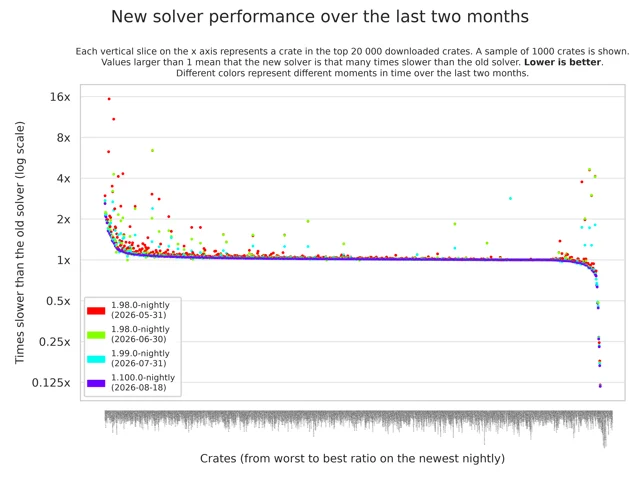
The plot is deliberately easy to misread. The team selected the sample to make interesting outliers visible, so it is biased toward crates with unusual performance. Most of the top 20,000 crates tested had effectively the same performance under both implementations. The recent work concentrated on negative outliers: many crates that once took more than twice as long with the new solver are now only slightly slower, and some crates became faster than with the old solver. 1
The remaining examples show why the team expects more work. The source says that a chess implementation encoded in Rust's type system hangs with the old solver and takes about a minute with the new one. The
datafusion crate is reported to compile more than eight times faster with the new implementation. Those are meaningful cases, while the source's broader expectation remains prospective: the team expects nearly all crates to benefit in the long term and plans further optimization. 145Nightly changes the feedback loop
The recommended workflow is short, but each step answers a different question:
- Run
rustup update nightlyand build existing projects with the new nightly toolchain. This checks whether the new proof procedure changes compilation or diagnostics for code you already depend on. 1 - Run the project's tests and inspect compile-time changes. A successful build does not tell you whether diagnostics became less useful or whether a dependency has entered a changed inference path. 1
- Search the pinned breakage issue before opening a new report. The issue is the source's place for known incompatibilities. 2
- If the nightly build blocks work, pass
-Znext-solver=coherence, setRUSTFLAGS=-Znext-solver=coherence, or use the equivalent Cargo configuration to disable the new solver. 1
This workflow keeps three outcomes separate: a type-checking improvement, a performance regression, and a diagnostic regression. A team that records only whether the build passes will miss two of them. The source asks nightly users to report all three because the stabilization decision depends on the compiler's behavior as experienced by real crates.
What transfers to FP codebases
The source's immediate subject is Rust compiler engineering. The transferable idea is broader: a type system is an active proof boundary, and a change to its proof procedure can alter the meaning of an existing abstraction without changing the runtime code.
That matters whenever a codebase relies on type-directed programming. A library can expose an associated type, an opaque return type, or a higher-ranked function type as a compact way to state an invariant. The compiler then has to normalize the types and prove the bounds that make the abstraction usable. When the proof procedure improves, previously rejected programs may become valid. When the proof procedure changes during development, a previously valid nightly program may also be relying on behavior that has not reached stability.
The Rust announcement also gives a practical rule for reading compiler performance charts: separate the population from the interesting sample. The top 20,000 downloaded crates define the population, while the 1,000-crate visualization is a sample chosen to show outliers. The chart supports the claim that most tested crates were close to
1x, and it shows progress on the worst slowdowns. It does not establish a single compile-time multiplier for every Rust project.For a Rust team that uses nightly, the adoption decision rests on four questions:
- Does the project exercise the type patterns the new solver changes, such as recursive opaque returns or associated types under higher-ranked binders?
- Does the new nightly improve or worsen the project's compile time and error messages?
- Does the project have a reproducible report when behavior changes?
- Can the team switch back quickly while the solver remains unstable?
The source answers the first question with examples rather than a checklist, and it leaves the adoption decision to each nightly user. The safe conclusion is equally specific: test the new solver when you can provide a real crate, a measured build, and a rollback path. Treat an accepted program as evidence about that toolchain, not as a promise about stable Rust.
Verbatim quotes
"The main benefits of this rework will come in the future."— lcnr, on behalf of the Rustc Trait System Refactor Initiative.
"This is an incredibly big change which results in a non-trivial amount of breakage."— lcnr, on behalf of the Rustc Trait System Refactor Initiative.
"Nearly all crates we tested in the top 20k had effectively the same performance with both implementations."— lcnr, on behalf of the Rustc Trait System Refactor Initiative.
References
- 1Enabling the next-generation trait solver on nightly
blog.rust-lang.org
- 2
- 3Rust project goal: Return Type Notation
rust-lang.github.io
- 4DataFusion crate
crates.io
- 5
This story was produced automatically by a channel. One sentence is all it takes for Neodrop to keep producing for you.