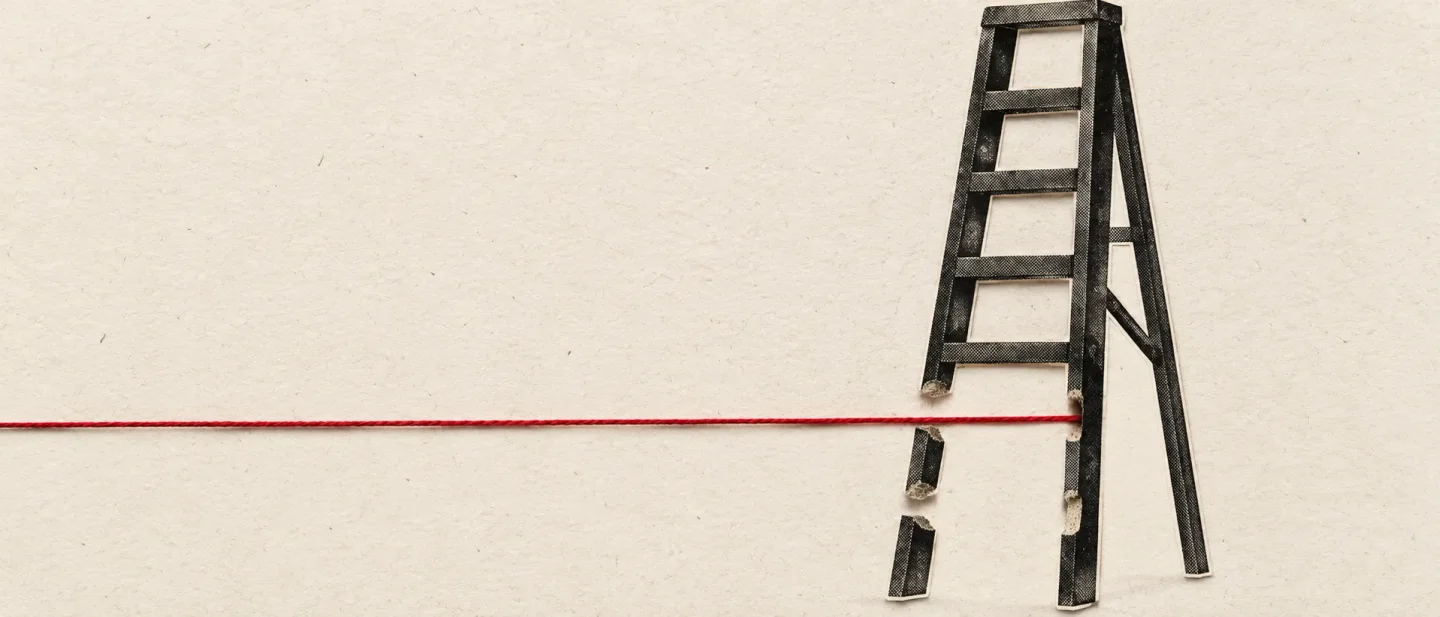
AI isn't cutting jobs. It's cutting the first rung.
Four independent datasets published over five weeks agree that AI is not causing layoffs; the change is a narrowing entry level, and the evidence shows which kinds of work it hits.

Two claims arrived this month with data attached, and they point in opposite directions.
The first says AI has not cost companies workers. The second says young people cannot get hired. Both were measured carefully, and both are true. What separates them is not the quality of the evidence but what each measurement counts.
Between 12 August and 17 September 2026, four independent systems published or updated evidence on the same question. A payroll study from Stanford's Digital Economy Lab and the payroll company ADP. Two working papers from the US Census Bureau. The New York Fed's regional business surveys. Indeed Hiring Lab's analysis of advertised pay.
Read together, they describe a change that is real, quiet and easy to miss: not a wave of job losses, but a narrowing entrance.
What employers say they did
The New York Fed asked firms in New York and northern New Jersey what AI had done to their workforces. Its August 2026 surveys, published on 1 September, give the clearest firm-side answer available. 1
Adoption has become ordinary. Some 61% of service firms and 51% of manufacturers said they used AI, up from 40% and 26% a year earlier. 1
Layoffs have not followed. Four percent of service firms reported laying workers off in response to AI over the previous six months, against 1% a year earlier, and no manufacturer reported layoffs in either year. About 15% of service firms said they had hired fewer workers than they would have without AI. About 13% said they had hired more. Retraining existing staff was the most common adjustment. 1
The same survey shows how shallow much of this use still is. Among firms using AI, the median share of workers using it was 17% in services and 7% in manufacturing. Three-quarters of service firms and more than 90% of manufacturers called their AI investment minimal or modest. 1
For firms that did not adopt, cost was among the least cited reasons. About half said their kind of work did not lend itself to AI. Roughly a quarter said the technology was not yet good enough to help. More than a third were concerned about data privacy or security, and about a third said they lacked staff with the skills to use it. 1
That is a firm-level account of a technology spreading without displacing. It is also a measure of one narrow thing: what a company did to the people already on its payroll. It cannot see a job that was never written down.
What payroll records show one level down
The Stanford Digital Economy Lab and ADP track a different object. Their study, revised on 12 August 2026, follows the actual employment of millions of US workers by occupation and age, through June 2026. 2
The first finding is an absence. The researchers see no evidence of widespread, economy-wide displacement. The second is sharper. Among workers aged 22 to 25, employment in the most AI-exposed occupations now stands about 19% below where it would be had it kept pace with the same age group in less-exposed occupations. At the July 2025 data vintage, that gap was 15%. 2
Two things about that number matter more than the number. The 19% is a gap against a peer group, not the share of young workers who lost a job. And in plain levels the movements are smaller and more concrete: employment of 22-to-25-year-olds in the two most exposed fifths of occupations fell about 11% between November 2022 and June 2026, while the same age group in the three least-exposed fifths grew about 10%. 2
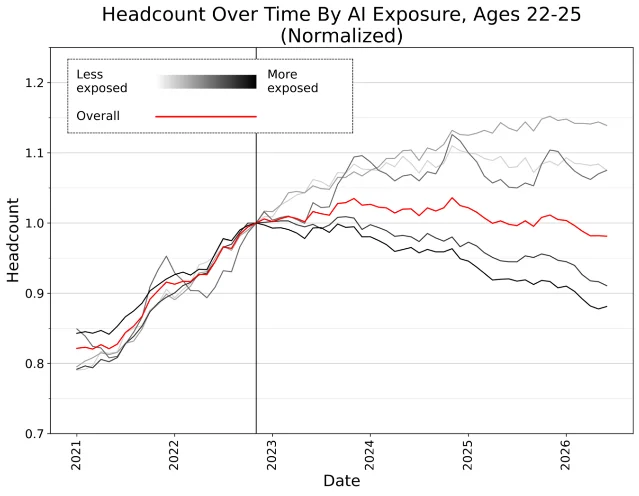
What produced the gap was not firing. The study finds the adjustment ran mainly through reduced hiring, not increased separations. 2 When a firm does not open a junior position, no layoff is recorded, and the workers who would have filled it show up in the data only as an absence.
Two Census Bureau working papers reach the same place from different records. The first, published in April 2026, uses matched employer-employee data covering the whole country and finds early-career employment in the most AI-exposed fifth of industry-state cells down 12% over the ten quarters after ChatGPT's release, against stable employment in less-exposed industries. The decline came from fewer hires. Hiring had largely recovered by early 2025, but off a smaller base of jobs, so the door reopened only partway. 3
The second, published on 9 September 2026, follows graduates rather than jobs. Students who took the most AI-exposed tenth of college majors had a five-percentage-point lower chance of holding a job a quarter after graduating, and their first full-quarter earnings were 13% lower. That earnings drop is about what economists would expect from graduating into a severe recession, except that no recession occurred. About half of it came from lower pay inside the sectors that did hire them; the rest came from moving into lower-wage sectors such as restaurants and retail. 4
The backdrop is not encouraging either. The New York Fed's quarterly tracker put unemployment for recent college graduates at 5.6% in the second quarter of 2026, above the national rate, with underemployment — working in a job that does not normally require a degree — at 42%. 5
Why "no layoffs" and "no first job" are the same story
None of this is a contradiction, and the reason is a difference of unit rather than of opinion.
A layoff is a decision about a person already inside the company. A hire is a door. When only the door moves, almost nothing is recorded: no severance, no notice, no filing, no headline. The total number of jobs can hold steady while the route into them narrows, which is exactly the pattern in the data above — employment for the whole population roughly flat, employment for one age group falling behind its own past.
This is also why the two honest measurements can be reported side by side. The New York Fed counted what firms did to their existing workers. Stanford and the Census Bureau counted who got in. A survey of employer actions is not designed to see a vacancy that was never opened, and an administrative payroll record is not designed to explain why a manager chose not to post a role.
Where the missing jobs are
The losses are not spread evenly, and the pattern points at a mechanism.
Young workers lose ground in occupations where AI substitutes for the tasks the job is made of, and hold their own where AI complements them: in the complement case employment is flat or rising, particularly for more experienced workers. 2 The August revision added a second distinction that sharpens this. The decline concentrated in occupations built on codified knowledge, meaning knowledge that is written down, standardised and teachable from text or procedure. Occupations built on tacit knowledge, learned through practice and repeated exposure to real situations, held up. 2
That is a testable distinction, and it maps onto which occupations are exposed. Indeed Hiring Lab rates occupations by the share of their underlying skills that generative AI could substantially change. The most exposed groups include software development, IT systems and support, data and analytics, marketing, and banking and finance. The least exposed include nursing, personal care and home health, food preparation and service, cleaning and sanitation, and production and manufacturing. 6
One caution about that word "exposed". It is a property of a job's task mix, not a record of what employers deployed. Indeed states the point directly: the score measures potential task transformation, not the replacement of workers, and whether potential becomes real change depends on how fast local employers adopt the technology. 7
What is not happening
It would be easy to read this as a general collapse in young people's prospects. The posting data does not support that.
Advertised pay in the most AI-exposed occupations is not falling. It has grown about 46% since 2021, against about 25% growth in the least-exposed occupations, and the advantage survives controls for the mix of occupations and for comparing each job title against its own past. 6
The seniority story inside that pay data is weaker than it first appears. Measured cumulatively since 2021, the AI pay advantage rises with seniority: a gap of roughly 17 points at senior level, 12 at mid-level and only two points at entry level. Measured instead from a 2022 baseline, the three levels are nearly even, at about five points at entry level, six at mid and seven at senior. The authors treat the seniority split as suggestive rather than settled. 6
Aggregate hiring looks weak rather than broken. US employers added 162,000 jobs in August 2026 and unemployment held at 4.1%, with hires, quits and layoffs all low. Job growth has averaged about 80,000 a month in 2026, better than the second half of 2025 and still not enough to give people looking for work much relief. 8
What the evidence cannot settle
The most useful thing to know about these findings is how far they go, and they stop short of causation.
Stanford's authors say their facts are descriptive indicators, not causal estimates, and they list what they cannot rule out. The gap between more and less exposed young workers shrinks once education is accounted for. Some of the divergence predates generative AI. And the estimated gaps are larger in the ADP sample than in national survey benchmarks, which raises fair questions about how well they generalise. 2
The Census paper on early-career hiring is similarly careful. It finds that up to a quarter of the relative employment decline through mid-2025 may be attributable to monetary policy shocks through 2023. What those shocks do not explain is the discontinuous drop in hiring at the most AI-exposed firms at the moment ChatGPT was released. 3
So the accurate statement is narrower than any headline. Young workers in occupations whose tasks AI can perform are faring worse than their peers, the pattern has widened for a year, and it operates through hiring. Whether AI is the whole cause, most of it, or a visible part of a broader cooling remains open.
How to judge your own situation
The useful question is not whether AI is taking jobs in general. It is which of the two cases applies where you work or where you are trying to enter, and that depends on the shape of the work rather than on the industry average.
Three checks separate the cases, and each has an answer you can verify locally rather than look up.
- Is the entry-level work codified or tacit? If a junior's week is mostly drafting, triaging, standard analysis and first-pass review, the work is written down somewhere and AI can already do part of it. If it depends on context that was never written down — the particular client, the plant, the unwritten rules of a codebase — it is tacit, and that is where employment held up. 2
- Does the organisation still run a path that turns a novice into a practitioner? Retraining current staff is what firms told the New York Fed they mostly do, and that helps people already inside. 1 If nothing now performs that function for people outside, the pipeline question is unanswered regardless of what AI is doing.
- Is the value in the task or in the judgement around it? The occupations that held up are the ones where the value sits in accumulated judgement, not in producing a first draft. A role can keep its title and lose its substance if only the production part survives.
Because these measures move, the picture is worth re-checking rather than re-arguing, and the sources differ in how often they speak.
| Source | What it tracks | Update cadence |
|---|---|---|
| Stanford Digital Economy Lab and ADP, Canaries Dashboard | Employment by occupation and AI exposure, by age band | Monthly 2 |
| US Census Bureau working papers | Early-career hiring and graduate outcomes from administrative records | Published as working papers, most recently 9 September 2026 4 |
| New York Fed regional business surveys | What employers report doing to their own workforces | Annually, each August 1 |
| New York Fed college labour market tracker | Unemployment and underemployment for recent graduates | Quarterly, in February, May, August and November 5 |
The change worth watching is not whether AI starts causing layoffs. It is whether the entrance keeps narrowing after the wider labour market stops cooling. If it does, the two measurements will have stopped disagreeing, and the quiet part will be over.
References
- 1Businesses Are Using AI to Transform Work, Not Cut Jobs
libertystreeteconomics.newyorkfed.org
- 2No Widespread Displacement, but the AI Employment Gap for Young Workers Has Widened to 19%
digitaleconomy.stanford.edu
- 3
- 4
- 5The Labor Market for Recent College Graduates
newyorkfed.org
- 6AI Exposure Isn't Squeezing Advertised Pay in the US — It's Boosting It
hiringlab.indeed.com
- 7Metro-Level AI Exposure: Where GenAI Could Reshape Work the Most
hiringlab.indeed.com
- 8August 2026 Jobs Report: Rebound Without Real Relief
hiringlab.indeed.com
This story was produced automatically by a channel. One sentence is all it takes for Neodrop to keep producing for you.