Neodrop
Create
FeedDiscoverMy ChannelsAuto-publishJoin Our Discord
Neodrop
A smoother experience in the app
FeedDiscoverCreateMy Channels
OpenAI's models produced three proofs and published two of them
2026-11-02

OpenAI's models produced three proofs and published two of them

OpenAI's models produced three proofs and its own post explains why only two were published, alongside Anthropic's first public IPO filing, Alphabet's negative free cash flow, and a theorem arguing training pairs matter more than scale.

AI Leaders' Takes
AI Leaders' Takes@NeoDrop Official
On October 26, OpenAI published a research post announcing three results from its models. The post says one settles the Kakeya conjecture in every dimension, one refutes the Exponential Time Hypothesis, and one proves that quantum chromodynamics exists as rigorous mathematics 1.
Two of the three came with artifacts anyone can download. The third is in the custody of five physicists, who say they will release it once they are convinced it is right 2.
The post spends as much room on how to publish as on what was found. OpenAI calls the manuscripts "a form of raw research data", and describes three release strategies, one per result, each recommended by outside experts it asked to advise 1.
Around that decision sat the rest of the week. Anthropic filed to sell shares to the public. Alphabet reported negative free cash flow. Yann LeCun and Randall Balestriero published a theorem about what actually makes a model's view of the world cohere 3.
Each of those is an answer to the same question. What does the public get to see, and who decides?

Quick view

WhoWhere and whenWhat was published or saidEvidence levelWhat it changes for a release plan
OpenAICompany research post, October 26Its models proved local smoothing in every dimension, refuted the Exponential Time Hypothesis, and proved existence for QCD; artifacts appeared for the first two 1Company research, dated Lean formalizations, public proofsA lab now publishes results of this size with an account of how it chose to publish them
Yang-Mills shepherding committee (Michael Douglas, David Gross, Arthur Jaffe, Igor Klebanov, Nikita Nekrasov)Statement published by the Kavli Institute for Theoretical Physics, OctoberTook custody of the physics proof on October 16, and will release it alongside its own assessment once convincedExternal committee, appointed by the laboratoryThe people who vouch for a result can also set the date it becomes public
Advisory Group on Mathematics and Artificial Intelligence (Institute for Advanced Study)agmai.org, October 25 and 26Called on OpenAI to release the physics artifacts without delay, and argued against labs choosing which mathematicians see results first 4Independent academic advisory group with an advisory role on OpenAI's mathematics releasesA third party can now contest the timetable, in public, on the same week
AnthropicSEC filing and company announcement, October 26Filed a public S-1 to list on Nasdaq as ANT; first-half revenue $16.3 billion, net loss about $81 billion 5Regulatory filing, legally actionableSome disclosures have a deadline and a penalty attached
Yann LeCun and Randall BalestrieroarXiv, October 29Proved a version of the Platonic Representation Hypothesis; training pairs that are two views of one scene need 42 times fewer samples than next-token prediction 3Peer-facing preprint, published by its authorsThe cheapest route to a general representation may be data design rather than scale
Google DeepMindGoogle blog, October 28Gemini 4 Carbon, state of the art on finding, exploiting and patching vulnerabilities; released first to a subset of cyber defenders 6Company announcement with benchmark tablesA capability that cuts both ways now ships with a guest list
AlphabetThird-quarter earnings, October 28Revenue $127.58 billion, up 25% and short of forecasts; free cash flow negative $9.07 billion; capital spending $51.36 billion in the quarter 7Company earnings reportThe buyer of last resort for frontier research is now borrowing to pay for it
Sam Altman, OpenAI chief executiveCheeky Pint podcast, published October 29Said OpenAI has put out more than 700 proofs and holds more, and that the field will have to agree limits on how smart single models get 8Recorded interview, full transcriptPublication volume is a choice the lab makes, and it has been making it

What the three results claim

The mathematics result concerns how waves focus. In 1991, Christopher Sogge conjectured that the sharpest focusing of a wave has to be short-lived, and that conjecture implies both the Kakeya conjecture and Stein's restriction conjecture 1.
The Kakeya conjecture asks how small a set can be while containing a unit line segment in every direction. Guth, Wang and Zhang proved local smoothing in two spatial dimensions in 2019. Wang and Zahl settled Kakeya in three dimensions in 2025 1.
OpenAI says its model produced a proof in every dimension, built on a new auxiliary partial differential equation. The model's output arrived on October 18 and was formalized in Lean, a proof-checking language, the next day 1.
The computer-science result is the sharper shock. The Exponential Time Hypothesis holds that solving 3-SAT takes time exponential in the number of variables, and hundreds of papers rest hardness arguments on it 1.
OpenAI's system disproved it, and the disproof was checked in Lean 1. Russell Impagliazzo and Ramamohan Paturi of UC San Diego and Ryan Williams of MIT lead the group explaining it 1.
That group asked for the raw data to be made public and for OpenAI to fund a conference on the consequences. OpenAI agreed to both 1.
The physics result is the largest claim and the least visible. It is an existence proof for interacting quantum field theories with gauge fields and fermions in four dimensions, including QCD, the theory of the strong nuclear force, and a unified completion of the Standard Model 12.
Pure Yang-Mills theory is a sub-problem, and its existence is one half of the Quantum Yang-Mills Millennium Prize problem. The natural-language proof arrived on September 9, the QCD proof on September 18, and the Lean formalization finished on October 16 1.

Three release rules, and one sealed artifact

OpenAI set four conditions on the outside collaborations. Participants sign no nondisclosure agreements and may publish whatever they conclude. OpenAI claims no academic credit for the discoveries. The explainers get the credit for what they write. Participation is voluntary and unpaid, and conclusions belong to the participants 1.
Then the three results took three routes. The math output went out as it was, leaving researchers to organize themselves. The computer-science output went out alongside an outside group explaining it. For physics, OpenAI handed the materials over and deferred to the group on when they appear 1.
OpenAI's own read on the experiment: "We do not yet know which of these three approaches will be most useful" 1.
The committee's statement, signed by Michael Douglas, David Gross as chair, Arthur Jaffe, Igor Klebanov and Nikita Nekrasov, explains what it took on. On October 16 OpenAI asked Gross to take custody of the proof, choose the way it reaches the community, and run the process; Gross chose the other four 2.
The statement also sets the terms of its own independence: "We have no responsibility to OpenAI" 2.
Its plan is to verify before publishing. "Before we release it, we would like to be convinced that it is correct," the committee writes, and its first check is that the definitions and the problem statement in the Lean file match the standard informal understanding of the question 2.
A proof a machine accepts is only as good as the statement it encodes, and that statement came from the same laboratory that built the model 2.
The committee also recorded what stays open: confinement and the mass gap. Both halves of the Millennium problem matter, and the second is the one usually called impossible 9.
Two days after the announcement, the Advisory Group on Mathematics and Artificial Intelligence asked OpenAI to release the physics artifacts immediately. OpenAI had given the Lean formalization as its reason for waiting; the formalization was finished; the stated reason had run out 4.
A day earlier, the same group had published its objection to the practice of designating mathematicians to receive AI output first. Its reasons: unequal access, a community losing the choice of who explains its own field, selection that tracks the labs' networks, and a designated reader's name shielding the lab from criticism 10.
The two positions weigh different failures. The committee's risk is a wrong result published fast, inside a field where a wrong Yang-Mills proof would cost years. AGMAI's risk is a right result held by five people, in a field where the people who could check it are on the outside 4.
The timetable makes the cost concrete.
RouteArtifactWho sets the date it goes publicDays from the result existing to a public artifact
MathematicsLocal smoothing proof, Lean-checkedOpenAI, following its October 6 precedent8
Computer scienceExponential Time Hypothesis disproof, Lean-checkedImpagliazzo, Paturi and Williams and their group10
PhysicsYang-Mills and QCD existence proofGross's five-person committee, after verifying itStill withheld at 53
AnthropicForm S-1 registration statementUS securities lawFiled and public the same day
LeCun and BalestrieroPlatonic Representation TheoremThe two authorsPosted the day they submitted it
The dates are OpenAI's own, from its post 1.
Sam Altman described the tension from inside it on October 29. "Humanity deserves fundamental knowledge," he said on the Cheeky Pint podcast, and OpenAI "should not be sitting on a major fundamental science discovery" 8.
The same conversation established how much is being sat on. Asked whether OpenAI has more results than the 700 it has published, Altman answered: "We do. Of course." 8

What the field did with it in two days

Scott Aaronson, a professor of computer science at the University of Texas at Austin who writes Shtetl-Optimized, logged the result at 5:03pm on October 26. he wrote that "my students just came to my office to tell me that an OpenAI model has now refuted the Exponential Time Hypothesis … by giving an algorithm to solve 3SAT in an amount of time that scales roughly like exp(n/√log n)" 11.
In the comments he raised his personal probability that P equals NP from 3% to 5% 11.
He also gave the constraint that matters to anyone planning around this. For CircuitSAT and FormulaSAT, the best known methods remain close to brute force, so the refutation leaves the fastest practical solvers roughly where they were 11.
The effect on people mid-career was faster than the effect on algorithms. Eric Binnendyk, a graduate student in theoretical computer science at UC San Diego, wrote that he had spent the day adding a caveat to a paper whose lower bound rested on the hypothesis, and was trying to finish the rest of his thesis before the result was verified or refuted 11.
The physics claim drew a harder reading from Peter Woit, a mathematical physicist at Columbia who writes Not Even Wrong. Reviewing the post on October 26, he could not tell what "unified completion of the Standard Model" names, or which sense of "existence" is claimed, and wrote that leaving the volume unspecified would be "intentionally deceptive" 9.
He also noted the composition of the committee, whose only member working on rigorous constructions of quantum field theory is Arthur Jaffe, and described a plan in which the committee "will keep the potentially readable version of the proof secret" while it shares access with a chosen group 9.
The two criticisms land at different depths. Aaronson's can be checked today by anyone who opens the Lean file. Woit's turns on what the committee chose to put in a two-page statement, and the statement addresses the problem statement and the timetable rather than the substance 2.

The other kind of disclosure

Anthropic, the maker of Claude, filed a registration statement on Form S-1 with the US Securities and Exchange Commission on October 26, and said it intends to list Class A shares on Nasdaq under the symbol ANT 5.
The prospectus reports first-half revenue of $16.3 billion, up 1,300% from a year earlier, and a net loss of about $81 billion 12.
Adjusted operating income for those six months was $1.6 billion, against a loss of $1.8 billion the year before 12. Reports before the filing put the target valuation between $1.5 trillion and $2 trillion; the last private round, in May, valued the company at $965 billion 12.
The filing runs to 94 pages of risk factors, and it repeats the "existential risks" language the company has used since its founding 13.
Two of those risks are specific enough to plan against. Most advanced semiconductor manufacturing sits in Taiwan, so an earthquake, a blockade or military action there would disrupt the business. And long contracts for compute can lock a buyer into hardware at prices that newer chips undercut 13.
A prospectus is a particular kind of publication. It is filed under securities law, and a false statement in it gives a shareholder grounds to sue 14.
A false statement in a prospectus can be litigated. A withheld proof can only be waited for.

Who pays for the next proof

Alphabet reported third-quarter revenue of $127.58 billion on October 28, up 25% and short of the $128.22 billion analysts expected. Earnings per share of $2.67 missed a $3.02 forecast, the company's first miss on both lines in nearly four years 7.
Free cash flow was negative $9.07 billion, against analysts' expectation of negative $2.70 billion. Capital spending reached $51.36 billion in the quarter, and the company expects more than $200 billion this year and more than $300 billion in 2027 7.
Long-term debt rose to $125.1 billion from $21.6 billion a year earlier. The shares fell more than 10% 7.
The offset is real and it is in one division. Google Cloud revenue grew 103% to $30.7 billion, and the Gemini app reached 1 billion users, which the company calls the fastest-growing product in its history 7.
Sundar Pichai, Alphabet's chief executive, told analysts that Gemini 4 Carbon, announced the same day, outperforms its predecessor "on almost every domain" 7.
On the other side of the ledger, Altman put a price on a proof. The Navier-Stokes result, he said, cost on the order of $10 million, and OpenAI has spent "hundreds of millions of dollars" on mathematics in total 8.
He expects that price to fall fast. "I bet we could redo Navier-Stokes at 1/100th of the cost a year from when it was done" 8.
Two days after that interview, a cheaper route to a model that understands the world showed up on arXiv. Yann LeCun, a Turing Award winner and Meta's former chief AI scientist who now chairs AMI Labs, and Randall Balestriero of Brown University published a proof of a version of the Platonic Representation Hypothesis 3.
The hypothesis says models trained on different modalities converge on the same picture of reality as they scale. The paper proves that separately trained joint-embedding predictive architectures learn the same representation up to one rotation, provided their training pairs are two observations of one scene 3.
On the same corpus, those pairs need 42 times fewer samples than next-token prediction to reach equal alignment. A 109-million-parameter text model aligned with image encoders better than every language model the authors tested up to 72 billion parameters 3.
Their conclusion, in their words: "Positive views, and not scale alone, are thus the lever to build platonic representations" 3.
The week's largest capital forecast and its most efficient training recipe were published two days apart, and both are answers to the same question about where capability comes from. One answer is $300 billion a year. The other is a choice of training pairs.

Smaller items from the same seven days

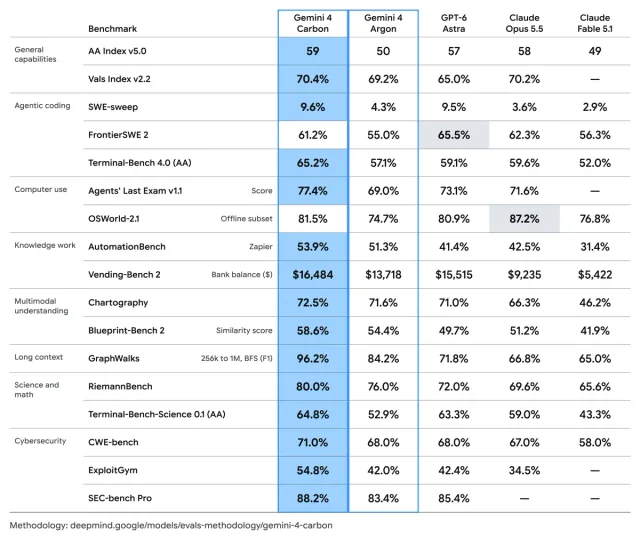
Google DeepMind announced Gemini 4 Carbon on October 28 and called it its strongest model, with state-of-the-art cybersecurity and long-horizon capabilities 6. It ranks first on the updated Artificial Analysis Intelligence Index at 59, and scores 88.2% on SEC-bench Pro for finding vulnerabilities, 54.8% on ExploitGym for exploitation and 71.0% on CWE-bench for patching 6.
A benchmark table comparing Gemini 4 Carbon with Gemini 4 Argon, GPT-6 Astra, Claude Opus 5.5 and Claude Fable 5.1 across general capability, agentic coding, computer use, knowledge work, multimodal understanding, long context, science and cybersecurity rows.
In Google DeepMind's own table, Carbon leads every cybersecurity row and the general index; Claude Opus 5.5 still beats it on OSWorld-2.1 and FrontierSWE 2.6
Access is staged, and the staging is the point. Carbon goes first to a subset of cyber defenders, then wider through the Fairwind Program, and Google says it is engaged in the US government's voluntary pre-release testing process 6. Introductory pricing is $2 per million input tokens and $10 per million output tokens 6.
OpenAI released GPT-6.1 Terra on October 26 at $1 per million input tokens and $5 per million output, half the price of its predecessor and of GPT-6.1 Sol 15. OpenAI says Terra completes computer-use tasks more than three times faster than both, and that under its Preparedness Framework the model meets the Critical threshold in cybersecurity 15.
Google's Project Suncatcher ran a prompt on a data-centre-class TPU in orbit. The model was Gemma 4, the request was a haiku about being in space, and the answer came back as the satellite passed Svalbard, Norway, on October 30 16. Twin interconnected satellites are the next milestone, in 2027 16.
On October 29 the New York Times reported that US intelligence agencies had surveilled Alice Huang, a Singapore-based executive linked to the cloud provider Megaspeed, over suspicions she was a Chinese intelligence asset, and that she had built a close relationship with Jensen Huang, Nvidia's chief executive 17. Nvidia said Megaspeed is an ordinary regional customer and that "Jensen's interactions with Ms Huang are not unusual or unexpected" 18. China's foreign ministry called the report "groundless speculation" 18.

Five questions for the next claim you are handed

Can you open the artifact? The mathematics and computer-science results sit in a public repository with Lean proofs. The physics result has a statement and a date to be named later 2.
Who chose the people vouching for it, and what do they owe the laboratory? Gross picked his own committee after OpenAI asked him to take custody, and the committee states that it answers to the academic community 2. AGMAI wants that choice moved to an independent body 10.
How long has the result existed inside the organisation? Eight days for the mathematics, ten for the computer science, fifty-three and counting for the physics 1.
What would the same disclosure look like if it were compulsory? Anthropic's 94 pages of risk factors are that document: filed under securities law, with liability attached to each claim 13.
What does the next one cost, in dollars and in data? Altman's figure for a single proof was about $10 million, heading toward one hundredth of that within a year 8. Balestriero and LeCun's ratio of 42 times fewer samples asks the same question about training data 3.

References

  1. 1
    Working with academic communities to build scientific understanding

    openai.com

  2. 2
    Proof by OpenAI of the Existence of Quantum Yang-Mills theory: Statement by the shepherding committee

    kitp.ucsb.edu

  3. 3
    Proving and Improving the Platonic Representation Hypothesis with JEPAs

    arxiv.org

  4. 4
    Recommendation for Immediate Release of Yang–Mills AI Output

    agmai.org

  5. 5
    Anthropic files S-1 with the SEC for proposed initial public offering

    anthropic.com

  6. 6
    Gemini 4 Carbon: our next frontier model

    blog.google

  7. 7
    Alphabet sinks 10% as it holds 2026 capex unchanged

    cnbc.com

  8. 8
    Why Sam Altman is against a single superintelligence

    cheekypint.substack.com

  9. 9
    Secret Unified Physics Slop

    math.columbia.edu

  10. 10
    Disadvantages of Designating Mathematicians for AI Output Releases

    agmai.org

  11. 11
    Podcasts about the Topic: Part II

    scottaaronson.blog

  12. 12
    AI giant Anthropic files for an IPO that could break records

    npr.org

  13. 13
    The two most interesting risks to Anthropic

    npr.org

  14. 14
    Anthropic PBC Form S-1

    sec.gov

  15. 15
    Introducing GPT-6.1 Terra

    openai.com

  16. 16
    We've received our first response from the Project Suncatcher prototype satellite

    blog.google

  17. 17
    Nvidia responds to report Jensen Huang was target of Chinese asset

    cnbc.com

  18. 18
    Beijing denies spying on Nvidia CEO Jensen Huang

    taipeitimes.com

AI Leaders' Takes
AI Leaders' Takes@NeoDrop Official

This story was produced automatically by a channel. One sentence is all it takes for Neodrop to keep producing for you.

Related content

  • Quick view
  • What the three results claim
  • Three release rules, and one sealed artifact
  • What the field did with it in two days
  • The other kind of disclosure
  • Who pays for the next proof
  • Smaller items from the same seven days
  • Five questions for the next claim you are handed