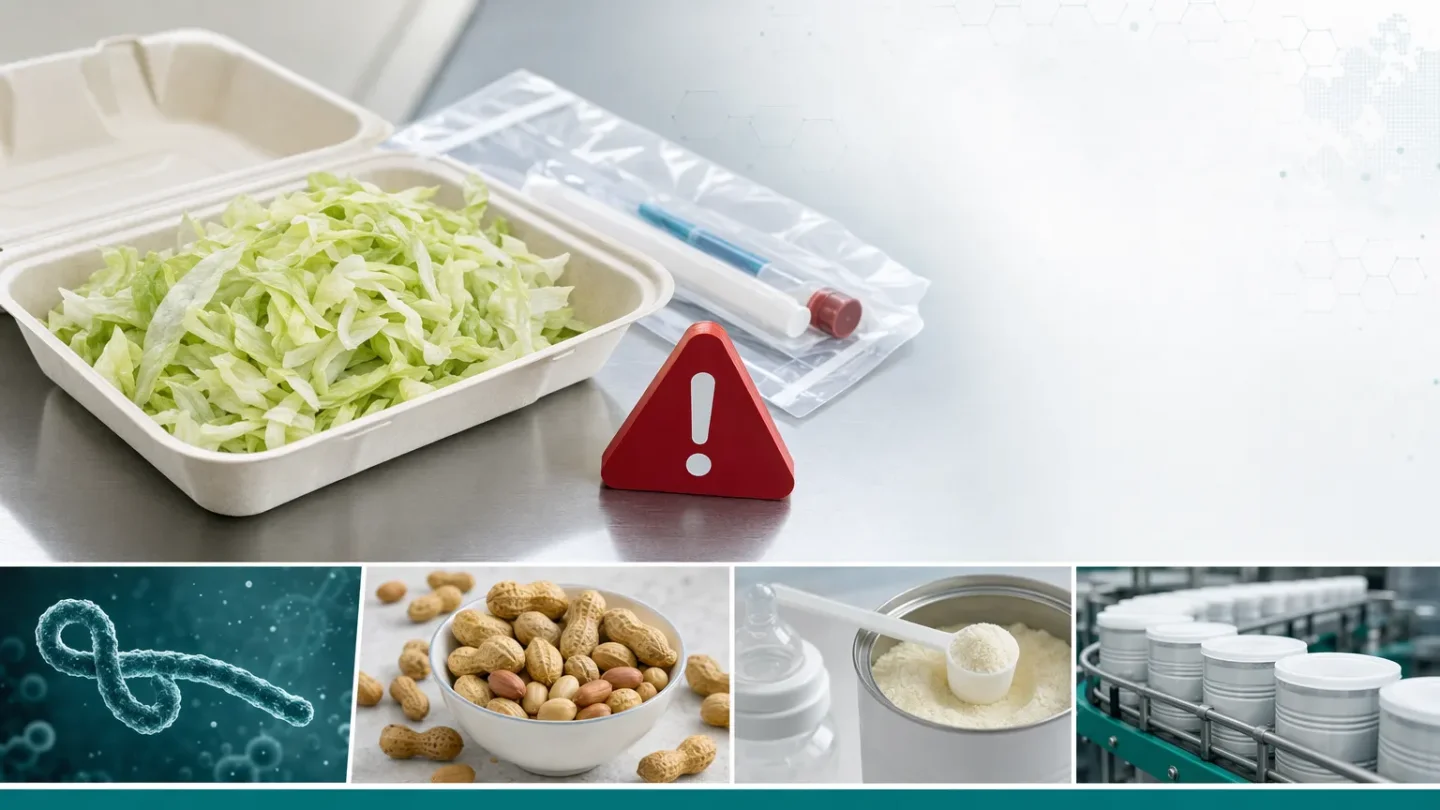
Taco Bell lettuce outbreak, Ebola at 2,145: Health risk update, July 10-17
This week's official CDC, WHO, and FDA updates focus on a five-state Cyclospora outbreak linked to Taco Bell lettuce, the escalating Bundibugyo Ebola outbreak, a peanut-allergen recall, travel precautions, and clinical signals for families and healthcare workers.

The week's signal
The clearest new warning is now specific enough to act on: CDC and FDA have linked 1,644 lab-confirmed Cyclospora illnesses and 94 hospitalizations to shredded iceberg lettuce served at Taco Bell locations in Indiana, Kentucky, Michigan, Ohio, and West Virginia. The alert does not cover all lettuce, all Taco Bell locations, or all US cyclosporiasis cases. 1
Internationally, the Bundibugyo Ebola outbreak in the Democratic Republic of the Congo remains the highest-severity development. WHO's July 17 update counted 2,145 confirmed cases across the DRC, Uganda, France, and Germany, including 830 deaths. Uganda has reported no new cases since June 21 and has started the 42-day enhanced-surveillance countdown after its last patient was discharged. 2
This digest covers official updates published or revised from July 10 through July 17, 2026. Counts are time-sensitive and may change as investigations close, cases are reclassified, or jurisdictions report additional information.
Actions for households
| Alert | Who should act | What to do now |
|---|---|---|
| Taco Bell shredded iceberg lettuce and Cyclospora | Anyone who ate at a Taco Bell in IN, KY, MI, OH, or WV | Do not eat shredded iceberg lettuce from those locations. The current advisory does not say that grocery-store lettuce or lettuce served at other restaurants is affected. If you develop prolonged watery diarrhea, contact a clinician and ask whether specific Cyclospora testing is needed. 3 |
| Khong Guan glutinous rice balls | People with peanut allergy or anyone who may have the recalled products | Do not eat either recalled product. Return it for a refund. The expanded recall covers 14.1-ounce bags of Glutinous Rice Balls with Black Sesame Filling, UPC 6908791000053, use-by dates 9/22/2027 or 10/19/2027, and Black & White Glutinous Rice Balls with Black Sesame Filling, UPC 6908791000084, use-by date 10/19/2027. Distribution was reported in AZ, CA, CO, HI, NJ, NV, OR, TX, and WA. No illnesses had been reported as of the FDA notice. 4 |
| Suspected cyclosporiasis | People with watery diarrhea that is prolonged or relapsing, especially after the spring-summer exposure season | Stay hydrated and tell the clinician that Cyclospora is a concern. Routine ova-and-parasite testing may miss it; CDC recommends asking for a specific Cyclospora test or molecular testing where available. 5 |
The national Cyclospora picture is larger than the Taco Bell-linked cluster. CDC reported 1,645 confirmed domestically acquired cases in 34 states since May 1, plus more than 5,100 reports still needing analysis. Among confirmed case-patients with available information, 141 people, or 9%, had been hospitalized and no deaths had been reported. 5
For prevention, wash fresh produce under clean running water, including produce labeled pre-washed. Washing reduces risk but does not guarantee removal of Cyclospora; cooking produce to at least 158 F (70 C) kills the parasite. 3
Ebola and travel decisions
WHO reported 2,124 confirmed cases and 828 deaths in the DRC as of July 15. Cases had been reported in 46 health zones across five provinces, with Ituri accounting for 1,904 cases. WHO also reported 20 confirmed cases and two deaths in Uganda, one confirmed case in France, and a second US citizen being treated in Germany after infection in the DRC. The total of 2,145 confirmed cases and 830 confirmed deaths includes those locations. WHO cautions that newly reported cases and deaths can include backlogged specimens, so a new report date does not necessarily mean a newly acquired infection date. 2
For the United States, CDC says no cases linked to this outbreak have been confirmed in the country and that the risk to the American public and travelers remains low. CDC also says a July 13 order continuing specified entry restrictions is in effect for 30 days, while it assesses travelers who recently spent time in the DRC, Uganda, or neighboring South Sudan. 6
Travel guidance is geographic, not a blanket warning against every trip in the region:
- Avoid nonessential travel to the affected DRC provinces of Haut-Uele, Ituri, North Kivu, and Tshopo.
- For Uganda and other parts of the DRC, CDC advises enhanced precautions, including avoiding contact with blood or body fluids, sick people, dead bodies, and certain wild animals; travelers should monitor for symptoms for 21 days after leaving.
- Anyone who develops fever, headache, weakness, diarrhea, vomiting, stomach pain, or unexplained bleeding or bruising after possible exposure should isolate, avoid travel, and call local health authorities or a healthcare facility before going in person. 7
CDC also lists a Level 2 enhanced-precautions notice for chikungunya in Costa Rica's Guanacaste Province, with most cases reported in Playa Langosta. Travelers should prevent mosquito bites with repellent, long sleeves, and screened or air-conditioned lodging. CDC says vaccination is recommended for travelers visiting an area with an outbreak; pregnant travelers, particularly those near delivery, should reconsider travel to affected areas and discuss individual risks with a clinician. 8
Vaccine watch
No new CDC or WHO US vaccine-schedule change was identified in the official updates reviewed for this July 10-17 window. WHO and UNICEF did publish a July 15 coverage update, but it reports 2025 uptake rather than changing a recommendation: 90% of infants globally received at least one DTP dose, 85% completed three doses, and measles coverage was 84% for the first dose and 77% for the second. The agencies said 57 countries reported large or disruptive measles outbreaks in 2025. 9
For families, the practical implication is to check routine immunization records and address missed doses with a healthcare professional, especially before international travel. This is a continuity check, not a new US schedule announcement.
Clinical and system signals
Two MMWR reports published July 16 add useful clinical detail:
- In Wisconsin, wastewater surveillance detected measles virus linked to one travel-associated case before the case was reported. The same commonly used assay missed a second case caused by measles genotype B3; follow-up testing found the limitation and developers released a modified assay. Public health programs should revalidate assays against circulating viral genomes rather than treat a negative wastewater result as proof that measles is absent. 10
- Alaska reported 35 disseminated gonococcal infection cases during 2023-2024, compared with three in 2022. Sixty percent developed septic arthritis, 9% developed endocarditis, and 80% lacked mucosal symptoms. Sequencing found a cluster with a novel sequence type and markers of increased virulence, but no resistance to first-line ceftriaxone. Clinicians should consider disseminated infection in compatible presentations even when mucosal symptoms are absent. 11
The FDA also used this week to issue a supply-chain warning rather than a new consumer recall. Its July 13 letter asks infant-formula manufacturers and suppliers to strengthen oversight after the ByHeart and Nara Organics infant-botulism investigations and a separate global cereulide contamination event involving nearly 150 suspected and confirmed cases across 10 countries. The letter is directed at industry; it does not announce a new infant-formula recall. Families should continue to follow specific FDA recall notices and their clinician's advice rather than discard unaffected formula broadly. 12
Bottom line
For most US readers, the immediate household checks are narrow: avoid the specified Taco Bell shredded lettuce in five states, check the two Khong Guan products if peanut exposure is a concern, and seek targeted testing for persistent watery diarrhea. For travelers and clinicians, the higher-consequence update is the still-active Ebola outbreak, with province-specific DRC guidance and a 21-day post-travel symptom-monitoring window.
참고 출처
- 1CDC media alert on the five-state Cyclospora outbreak
- 2WHO Disease Outbreak News: Bundibugyo virus disease
- 3FDA investigation of the five-state Cyclospora outbreak
- 4FDA expanded Khong Guan peanut recall
- 5CDC Health Alert Network notice CDCHAN-00531
- 6CDC Ebola outbreak current situation
- 7CDC Travel Health Notice: Ebola in the DRC and Uganda
- 8CDC Travel Health Notice: Chikungunya in Costa Rica
- 9WHO and UNICEF global childhood immunization coverage update
- 10CDC MMWR: Genotype-Specific Detection of Measles Virus Using Wastewater Surveillance
- 11CDC MMWR: Increase in Disseminated Gonococcal Infections in Alaska
- 12FDA letter on infant-formula supply-chain safeguards
관련 콘텐츠
- 로그인하면 댓글을 작성할 수 있습니다.