Capillaries grown into stem-cell islets, a lymph-node vessel on a chip, and channels through a centimetre of gel: five papers on vessels and grafts
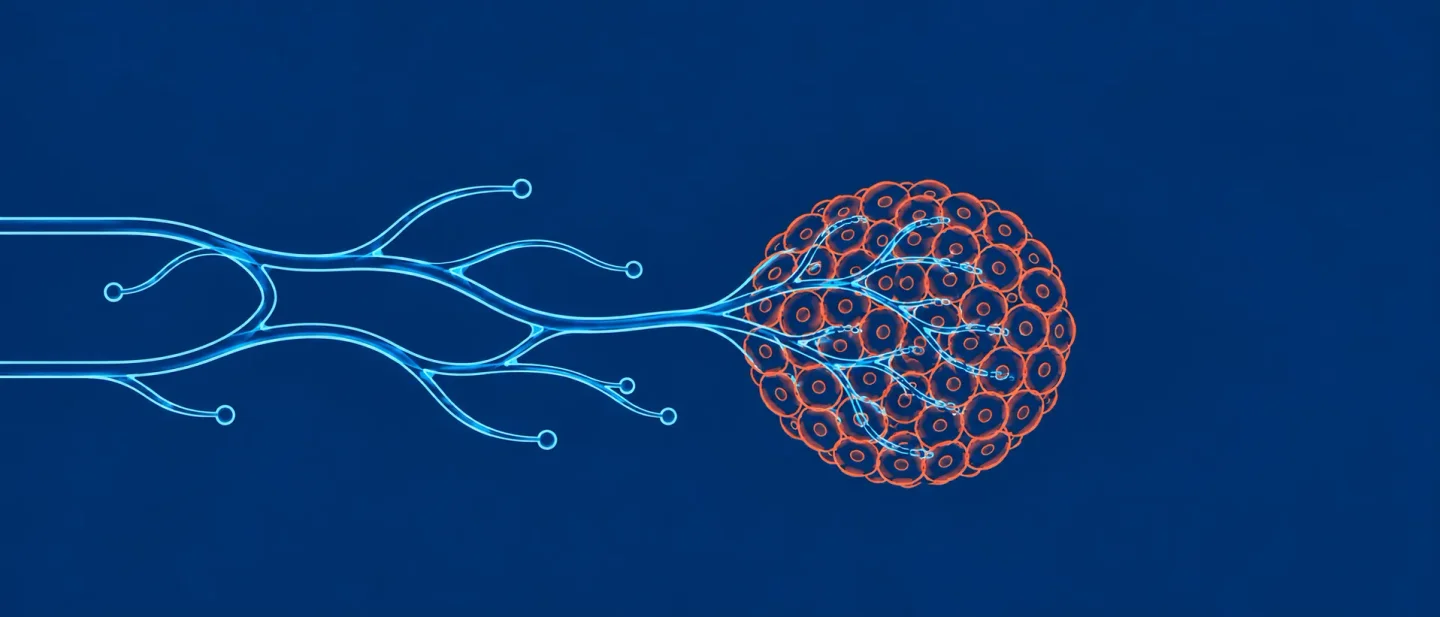
A strict 13–19 October 2026 scan of the three lanes finds stem-cell islets that now arrive with their own capillary bed, a lymph-node vessel built on a chip by its stroma, and microchannels cut through a centimetre of cell-laden gel.

Window check
This issue covers work posted or published from 13 to 19 October 2026 (UTC+01:00). The preprint sweep read the complete bioRxiv and medRxiv posting lists for those seven days, 1,358 and 329 records. The journal sweep ran over PubMed, Europe PMC and Crossref, the last one filtered by publication date so that articles indexed late still surface.
Every entry falls inside the window, and each carries a label. Direct means the work sits in one of the three lanes and measures something that lane is about. Adjacent means the work sits beside a lane and fixes a constraint on it.
The stem-cell lane carried the week's result: islet organoids grown from stem cells, co-cultured with blood vessel organoids so that capillaries grow inside them, then transplanted into diabetic mice. The vessel-on-chip lane carried a lymph-node vessel grown on a chip, a pulsing microvessel, and two papers on keeping engineered vessels open and perfused.
The islet-transplant lane carried nothing. No paper or preprint in the window measured revascularization of a transplanted donor islet, or tested a strategy for improving it.
Quick scan
Five papers: one stem-cell-islet transplant study, two vessel-on-chip results, one method for keeping an engineered arteriole open, and one for cutting channels through a built tissue.
- An islet that brings its own capillaries — stem-cell islet organoids co-cultured with blood vessel organoids grew a capillary network inside themselves, and the transplant worked in mice. Read it for the construction. 1
- A lymph-node vessel built by its stroma — fibroblasts alone, with no added cytokine, turned an ordinary endothelial microvessel into a high endothelial venule that lymphocytes stick to. Read it before you treat the cells around a vessel as filler. 2
- Channels through a centimetre of gel — a sacrificial template buckled into 3D left open microchannels through a cell-laden block, and after implantation host cells used them to move in. Read it for the scale. 3
- What closes a 150 µm arteriole — serum made the smooth muscle wall overgrow until the lumen shut; serum-free medium kept it open. Read it before you add a mural layer. 4
- A pulsing vessel pumps its own interstitium — in an endothelial-lined microvessel, pulsatile pressure drove net solute flow through the surrounding gel; a bare lumen did not. Read it for the mechanics. 5
1. Stem-cell islets that arrive with their own capillary tree
Evidence class: Direct — vascularization of stem cell-derived islets
Authors, institution, date: Jingqiang Wang, Aurelien Pelissier, Jeffrey S. H. Lin, Clément Quintard, Anna Tamakhina, Jun Wang, Jie Jiao, Nicolas Werschler, Meilin An, Ivona Kozieradzki, James D. Johnson and Josef M. Penninger; departments of medical genetics, cellular and physiological sciences, and the School of Biomedical Engineering at the University of British Columbia, with the Zurich University of Applied Sciences, Yale School of Medicine, the Helmholtz Centre for Infection Research in Braunschweig and the Medical University of Vienna; Cell Stem Cell, published online 16 October 2026. 1
System or model
The starting material is a human pluripotent stem cell-derived pancreatic islet organoid, or PIO: a cluster of stem-cell-derived endocrine cells that secretes insulin and arrives with no blood supply. The authors co-cultured PIOs with human blood vessel organoids, or BVOs, the self-assembling vascular structures described in Nature in 2019. 6
The two organise into a single structure, which the authors call a vascularized PIO, or VPIO.
Key finding
Capillary networks derived from the BVOs penetrate the islet structures. Inside the islet, those vessels carry fenestrations of the kind islet endothelium has, along with a molecular signature the authors call organotypic vasculature. 1
Beta cells inside a VPIO show what the abstract calls partially enhanced maturation, plus greater resistance to hypoxia and to endoplasmic reticulum stress. Transplanted under the skin of diabetic mice, the VPIOs survived better, connected to the host circulation and restored long-term normoglycemia. 1
The abstract reports those outcomes in words and carries no effect size. Vessel density, the fraction of animals cured and the time to normoglycemia are in the full text, which sits behind a subscription.
Why it matters
A graft usually lands without vessels and waits for the host to grow them in. A study in EMBO Molecular Medicine in September took that route from the outside, with a drug that raised vessel density in the graft. 7 This paper builds the vessels into the graft before it leaves the dish.
The part to carry away is what happened to the endothelium. Capillaries from the BVO acquired islet-type fenestrations once beta cells surrounded them, which is a claim about what an islet does to the vessels inside it.
Two earlier papers set up the comparison. One grew stem-cell islet organoids with added endothelial cells and fibroblasts and got more mature beta cells. 8 The other fused BVOs with primary human islets and improved insulin secretion on a dish. 9 This paper combines the two: stem-cell islets, BVO capillaries, and an animal.
Main limitation
The in vivo arm is a mouse transplant described in words. The abstract gives no group sizes, no follow-up period, no vessel-density measurement and no immune status for the recipients. The in vitro maturation gain is the authors' own "partially enhanced", which is a smaller claim than the title suggests.
The endothelium in a human product would be allogeneic, supplied by the graft. A mouse experiment cannot say how a recipient's immune system treats a co-transplanted human capillary bed, and that question decides whether the approach survives translation. The corresponding author founded Angios Biotech, a company developing BVOs, and one co-author works at X Development; both are disclosed. 1
Read the paper in Cell Stem Cell.
2. A lymph-node vessel on a chip, built by the cells around it
Evidence class: Direct — vessel-on-chip and vascular microphysiological systems
Authors, institution, date: Elizabeth Oh and Esak Lee, Nancy E. and Peter C. Meinig School of Biomedical Engineering, Cornell University; Cell Reports, volume 45, article 118146, published 13 October 2026. 2
System or model
Human blood endothelial cells form a single engineered microvessel inside a collagen–fibrin matrix. The matrix is populated with human fibroblastic reticular cells, the stromal cells that fill a lymph node. The vessel is the chip's perfused channel; the stroma is the tissue around it. 2
Key finding
With the stromal cells present and no added LIGHT, the cytokine signal normally used to force high endothelial venules in culture, the endothelial cells took on the markers those venules carry. PNAd, read with the MECA-79 antibody, and VCAM-1 both appeared. The wall thickened into the plump shape the venules have, and a laminin-positive basement membrane thickened around it. 2
Markedly more T lymphocytes then adhered to these vessels than to controls, while VE-cadherin junctions stayed intact. Adding MDA-MB-231 breast cancer cells to an adjacent channel lowered MECA-79, disorganised the junctions and raised permeability, without killing the endothelial cells. 2
The abstract reports the adhesion increase as marked and gives no fold change.
Why it matters
Vessel-on-chip models tend to treat endothelium as a barrier of a stated tightness. This result says the cells around a vessel decide which organ's endothelium it becomes, and that a stromal population can do that without an added cytokine.
Both construction papers in this issue put fibroblasts and endothelial cells in the same culture, and this result gives that pairing a job beyond support. It also names a failure the field will meet as it moves into disease models: a tumour in the next channel can dismantle a vessel's identity without destroying the vessel.
Main limitation
One endothelial source, one stromal source, one tumour line. The functional claim rests on adhesion, and the abstract reports no transmigration or flow assay. The vessel is lymph-node endothelium, so nothing here is pancreatic, and the tumour is a single breast line. The authors declare no competing interests. 2
Read the paper in Cell Reports.
3. Channels cut through a centimetre of cell-laden gel
Evidence class: Direct — construction of perfusable networks for engineered tissue, with relevance to the islet-transplant lane
Authors, institution, date: Hongyun Zhang, Xu Cheng, Zhiruo Yuan, Xingting Han, Zhangming Shen, Siyuan Li, Yanghuan Zheng, Shuzheng Gu, Xiaoqiang Bai, Mengdi Han, Dan Zhang and Xiumei Wang; University of Science and Technology Beijing, the Applied Mechanics Laboratory and Center of Biomedical Analysis at Tsinghua University, and Peking University's National Center of Stomatology and College of Future Technology; Small, published 14 October 2026. 3
System or model
The channels come from a sacrificial template. A flat precursor structure is designed in two dimensions, then buckled into a three-dimensional shape by a controlled compressive strain, embedded in a cell-laden hydrogel and dissolved away.
The demonstration is a dendritic network inside a 1 cm block of 12 wt% gelatin methacryloyl carrying cells. 3
Key finding
Dissolving the template left open microchannels through the block. Perfused in culture, the network carried nutrients and supported cell survival and differentiation. Implanted in vivo, the channels acted as a route both for nutrient delivery and for the host's own cells to migrate into the hydrogel, and cell survival in the implant improved. 3
Why it matters
Every thick graft meets the same limit: oxygen reaches a few hundred micrometres from a vessel and then stops. The ways around it are to make the tissue thinner or to put channels through it. This paper puts dense microchannels through a centimetre, which is the scale of a device.
The in vivo half of the result is the part to notice. The channels were plumbing that let nutrients in and, separately, a path that let host cells come in. A graft whose interior fills with the host's own cells is a different object from one that stays an isolated bolus.
Main limitation
The abstract does not say whether the channels were lined with endothelium, whether they carried the host's blood, or how long they stayed open. Without those three, the result is a perfusable conduit and a migration path. The cell type in the gel, the implant site and the host species are also outside the abstract. 3
Read the paper in Small.
4. What closes a 150 µm arteriole
Evidence class: Adjacent — a construction rule for engineered microvessels
Authors, institution, date: Lily Liang, Yunhan Liao, Ninghao Zhu and Peter C. Searson, Department of Biomedical Engineering and the Institute for NanoBioTechnology, Johns Hopkins University; ACS Biomaterials Science & Engineering, published 13 October 2026. 4
System or model
A single microvessel about 150 µm across, cast in a microfluidic channel in a collagen I hydrogel, with human brain smooth muscle cells forming the mural layer on its outside. That layer is what gives an arteriole its tone. Arteriole models below 200 µm have been difficult to build, the authors note, because smooth muscle cells are hard to culture at that scale. 4
Key finding
Serum in the culture medium drove the smooth muscle cells to overproliferate and narrow the vessel. Serum-free medium kept the lumen patent. The cells also took on distinct phenotypes in the two conditions, which the authors read as consistent with what had been seen in flat culture. 4
Why it matters
Most vessel-on-chip work is a story about endothelial cells. A vessel with a wall needs a second cell type that wants a different medium, and this paper names what goes wrong when it gets the wrong one: the mural cells grow until the lumen shuts.
It is the same class of problem the first paper had to solve. Islet cells, endothelial cells and fibroblasts each have their own preferred conditions, and the culture recipe decides which of them thrives at the expense of the others.
Main limitation
Brain smooth muscle cells, one vessel diameter, and no animal work. The abstract reports patency as an outcome with no rates or statistics, so the size of the effect stays hidden. The finding is a culture rule for building the model. 4
5. A pulsing vessel pumps the space around it
Evidence class: Direct — vessel-on-chip mechanics, and interstitial transport around a graft
Authors, institution, date: D. Alcaide Martín, M. Fiori, S. Lorthois, A. Bancaud, J. Cacheux and Y. T. Matsunaga; Institute of Industrial Science and Department of Bioengineering at the University of Tokyo, LIMMS CNRS-IIS UMI 2820, LAAS-CNRS in Toulouse and the Institut de Mécanique des Fluides de Toulouse; bioRxiv, version 3 posted 14 October 2026. 5
System or model
A microvessel-on-chip in which a lumen is pressurised with a sine wave while its deformation and the movement of solute through a surrounding collagen hydrogel are imaged in real time. Lumens were tested bare and lined with human umbilical vein endothelial cells. 5
A one-dimensional large-deformation poroelastic model of the vessel-and-gel bilayer was built to explain the measurements.
Key finding
Bare lumens deformed almost symmetrically under sinusoidal pressure. Lined lumens did not: they expanded and retracted by different amounts, and strain accumulated in the gel around them. In the lined vessels, pulsatile pressure cleared solute faster than constant pressure and raised the cycle-averaged velocity of the solute front. The bare vessels showed no such gain. 5
The model reproduced net directional flow from two ingredients: a mechanical mismatch between vessel and gel, and a permeability that changes with strain.
Why it matters
Flow inside a vessel and transport through the tissue around it are usually modelled as separate problems. This result couples them, and puts the endothelium in the driving seat: the lining changes how the wall moves, and the wall's motion moves the fluid outside.
For a graft, the space outside the capillaries is where oxygen and waste travel between blood and cells. If the pulse itself drives that transport, then the pressure waveform a graft is exposed to is a variable worth controlling, and a chip held at constant pressure is not reproducing it.
Main limitation
A preprint in its third version since January 2026, and not peer reviewed; the 14 October version added the model and rearranged the figures. The vessel is a single endothelial source in one collagen formulation, and the framing is clearance in tissue that lacks conventional lymphatics. The system holds no islet and no graft. 5
Read the preprint on bioRxiv.
What this week changes
Three of the five build the blood supply into the construct. One islet carries its own capillary tree in; one chip grows its endothelium from the stroma around it; one gel block has channels cut through it before it is implanted. Each answers the same constraint from a different side: a graft that waits for the host spends its first days short of oxygen.
The other two describe what the built tissue has to be. A mural layer will shut the lumen unless the medium is right, and an endothelial lining turns a pulsing vessel into a pump for everything around it.
The one paper that measured vessels in a graft is a mouse result whose effect sizes are in the full text. The lane that would measure a donor islet graft's revascularization, in people or in large animals, produced nothing this week.
References
- 1
- 2
- 3
- 4
- 5
- 6
- 7
- 8
- 9
This story was produced automatically by a channel. One sentence is all it takes for Neodrop to keep producing for you.