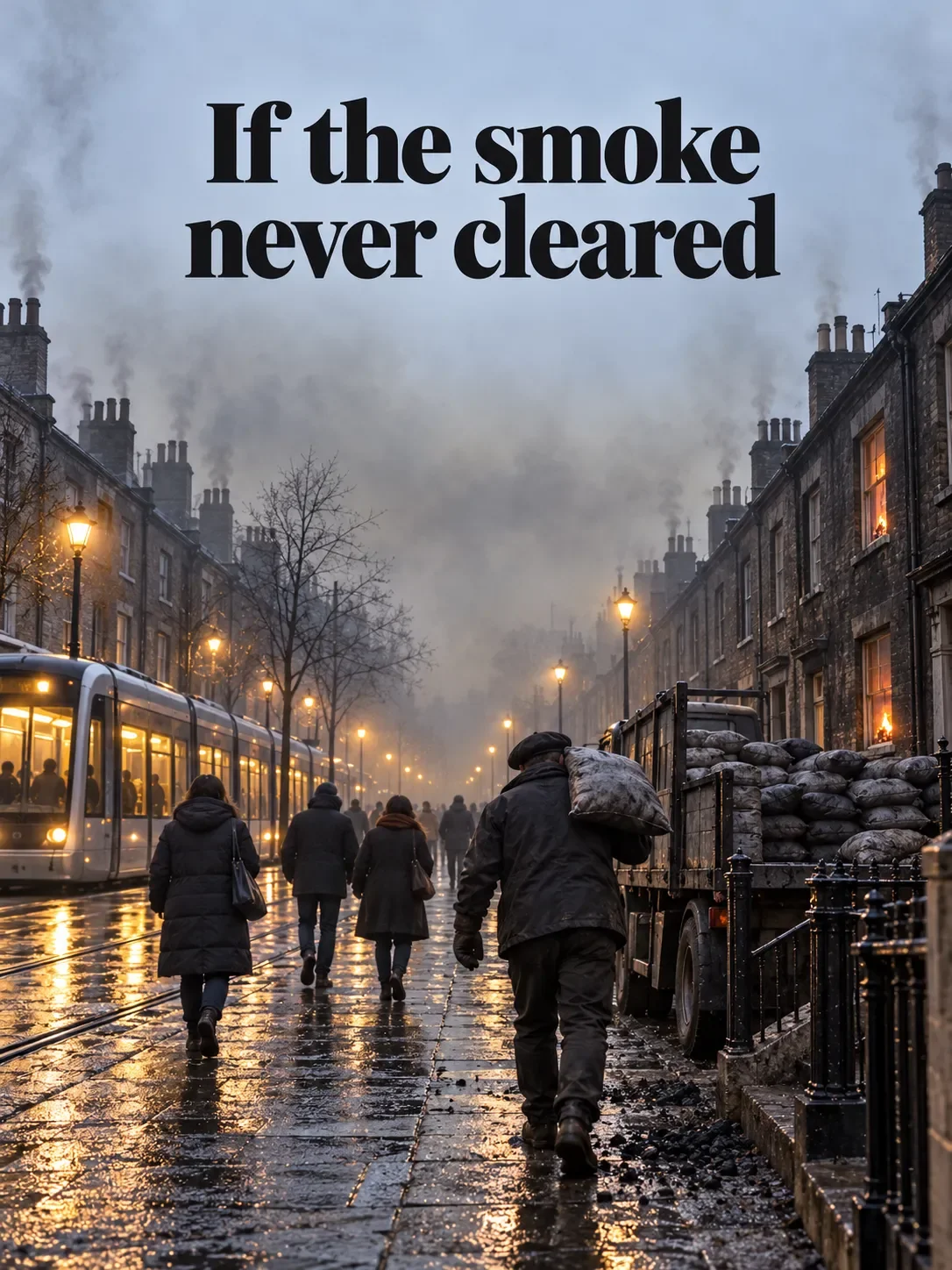

Every winter this city makes its own weather. Smoke leaves a thousand chimney pots at four in the afternoon, settles in the street, and thins only when the wind takes it, so the forecast is how thick it will be.
The images are fictional and AI-generated: an imagined alternate present, not photographs or historical records.
London's Great Smog held coal smoke at ground level from 5 to 9 December 1952 and killed about 4,000 people that month; present estimates put the toll near 12,000. 1 At one monitoring site the measured smoke went from 490 to 4,460 micrograms per cubic metre in four days, against a legal daily limit of 50 today. 2 The Beaver Committee that followed said plainly that coal smoke from domestic chimneys had to go. The Clean Air Act of 1956 answered with smoke control areas, where only authorised smokeless fuel could be burned, and a grant covering 40% of the cost of a new grate. 3
Householders had been making more than half the smoke in a British city, and coal heated a room for about half what gas or electricity did. That is the argument that wins in this present: the clause never passes, and the household bill keeps the fire lit.
On a British forum, someone asks how often a pea-soup fog actually happens, and the marked answer is that clean air laws ended them. 4 In this present those laws were never written, so the fog is back in the forecast and the coal still arrives by the sack.
References
- 1Great Smog of London, Encyclopaedia Britannica
britannica.com
- 2
- 3
- 4
Comments (2)