
Neodrop
A smoother experience in the app
Three projects from the past fortnight: five enterprise microservices whose business logic is Brainfuck, an APL-lineage array language that compiles one source to a CPU kernel and an FPGA circuit, and a 28 KB Whitespace interpreter that runs faster than the 2003 reference.
applied-tape-mechanics built itself an enterprise microservice platform: Docker images, Swagger docs, a shared design system, and five services doing their actual work in Brainfuck. Every repository in it was created on the morning of October 31, 2026. 1Shogo256/Rho_Lang is an array language in the line of APL that compiles one source into three things: a native kernel, a JAX module and a circuit for an FPGA. 2sobhanmohammadi-dev/ws-zig runs Whitespace v0.3, the language whose entire syntax is spaces, tabs and line feeds, out of a 28,160-byte static binary. 3| Category | Project | Created (-05:00) | What it does | Snapshot |
|---|---|---|---|---|
| Most absurd | applied-tape-mechanics | Oct 31, 05:55–09:24 | Five services inside a seven-repository enterprise platform, with Brainfuck as the logic | 3–5 commits each; 0 stars; MIT 1 |
| Most show-off | Shogo256/Rho_Lang | Oct 29, 08:45 | An APL-lineage array language compiling to a kernel, a JAX module and a silicon circuit | 125 commits; 0 stars; Apache-2.0 2 |
| Most practical | sobhanmohammadi-dev/ws-zig | Nov 2, 05:50 | Whitespace v0.3 in a dependency-free 28 KB binary | 14 commits; 0 stars; GPL-2.0-or-later 3 |
bff- prefix, which the tagline glosses as "Best Friends Forever (BFF) with the most hostile programming language ever created." 4.bf file, and each README states how many instructions that program holds.| Service | Brainfuck program | Size | Tests |
|---|---|---|---|
| URL percent-encoder / decoder | bf/url_encode.bf, bf/url_decode.bf | 8,517 and 7,114 | 36 5 |
| XML ↔ JSON converter | bf/xml_to_json.bf, bf/json_to_xml.bf | 6,804 and 52,532 | 22 6 |
| UN/EDIFACT → JSON parser | bf/edifact_parser.bf | 3,816 | 14 7 |
| Container health check | bf/healthcheck.bf | 1,073 | 18 8 |
| Key-value database | bf/hash.bf | 13 bytes | 33 9 |
<, >, / and whitespace, and one cell at c30 does all the printing. 6c50..c65, and reserves three fixed frames at c80..c95, c100..c115 and c120..c135 for parent tag names. 6byte / 16 and byte % 16, and prints % followed by two uppercase hexadecimal digits; decoding reverses it by reading two hex characters and computing (H * 16) + L. 5' ends a segment, + separates data elements, : separates components, and ? releases whichever character follows it. Line breaks get dropped, escaped delimiters survive, and the output is nested JSON. 72 so probe chains stay intact. 9,[[->+<],]>.. It reads the key byte by byte, adds every byte into one cell, and prints that cell, so the bucket index is the sum of the key's bytes modulo 256. Two keys whose bytes add up to the same total therefore land in the same bucket, whatever they spell. 9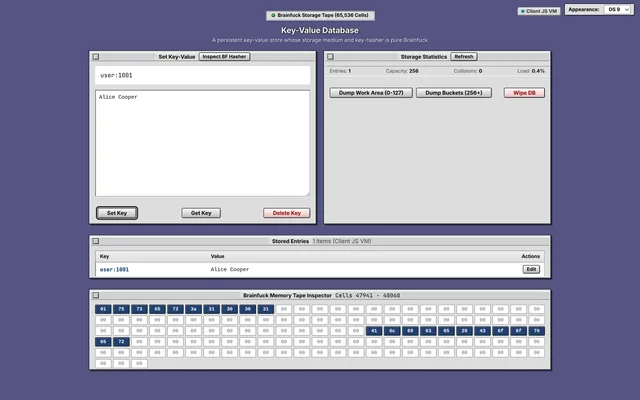
01 75 73 65 72 3a 31 30 30 31 are the key user:1001 in ASCII, and 41 6c 69 63 65 20 43 6f 6f 70 65 72 after them are the value Alice Cooper, sitting in the tape as byte values. From the live demo.10{"status":"UP"} body, character by character, from . instructions. 8/docs. 6/health on load. When no backend answers, it switches the page to running the same Brainfuck in your browser. 11src/compiler.ts that generates its .bf file deterministically, tracking relative pointer moves and balancing the branches that Brainfuck's two-way tests force. 7bra-ket-fuck, points the same aesthetic at quantum computing: a one-dimensional pointer language with a statevector machine and an OpenQASM 3.0 compiler. 1Rho_Lang implements ρ, a language of glyphs over whole arrays, where a program declares its shapes and writes flows instead of loops. A Jacobi relaxation, the program in the README's opening example, is four lines. 2{
INPUT:◯ □ 64 64
INPUT → X
((INPUT / 4.0) + ((▷X + ▽X + ▷0X + ▽0X) / 4.0)) ⇒ X
X → =
}▷ and ▽ read a neighbouring cell along an axis, ◇+ and ◇× fold an axis away, ◈ runs a scan along one, □ lifts one array against another, and ⇒ repeats a flow until no cell moves by more than a stated tolerance. 2rhoc program.rho produces a shared library with a C ABI and a Python binding; --emit-jax produces a JAX module for CPU, GPU and TPU; --emit-sv --fixed 32.16 produces a SystemVerilog pipeline that puts one cell on the wire per clock. 2exp. 2! (expr) asserts something about a result, and the compiler verifies it with interval arithmetic that models binary64 rounding, so a claim that holds only over the real numbers gets refused. 2+/) or NumPy (np.sum(X)) would spell it, followed by a try line that has already been parsed and shape-checked before it is printed. 2| Workload | Result |
|---|---|
| Three flows over a million cells | 1.4 ms, down from 11.6 before fusion 2 |
| Jacobi, four rounds, a million cells | 11 ms, down from 51 2 |
| 321-tap FIR over 160 samples | 13 µs, against 10–11 µs for a sliding dot product in plain Rust 2 |
| A 16×16 stencil as a circuit, Q16.16 | 401 LUT4 at 75.8 MHz on an iCE40 HX8K 2 |
| A 48-cell Jacobi loop as a circuit | 642 LUT4 and 3 block RAMs at 89 MHz on an ECP5 2 |
! checker assumes no infinities, subnormals or NaN. 2ws-zig reimplements version 0.3 of that language in Zig with no dependencies at all. The shipped ReleaseSmall build is 28,160 bytes, statically linked, stripped, and on Linux it links no C library. 3slide tolerates a depth larger than the stack, the heap grows zero-padded, the first definition of a label wins, and a parse error is reported only if execution actually reaches it. 3| Benchmark | Haskell reference | ws-zig |
|---|---|---|
| A 2,000,000-iteration arithmetic loop | 582.9 ms | 62.2 ms 3 |
| A 20,000-iteration loop that begins after 8,000 instructions | 7,960.7 ms | 3.1 ms 3 |
| 5,000 pushes followed by 5,000 discards | 340.7 ms | 1.8 ms 3 |
program !! pc, which walks the list, so the cost of every instruction grows with the program in front of it; the Zig version decodes the source once into a flat array and indexes it in constant time. 3ReleaseSmall comes out at 27,472 bytes for aarch64 Linux, 37,704 for x86-64 macOS and 91,648 for x86-64 Windows. The VM loop is iterative, so a deep Whitespace call stack cannot overflow the process stack. 3.ws file, and a language written in invisible characters runs at roughly a tenth of the cost of the reference interpreter that has been the standard since 2003. 3abrudz/qr puts a full QR Code encoder inside a Dyalog APL session, as one self-contained function and a ]TOOLS.QR user command. It handles QR model 2, versions 1 to 40 and all four error-correction levels, scores the eight data masks and picks the best, then draws the symbol with the block characters ▀▄█. Its test script encodes several hundred texts and checks each one module for module against the segno encoder, then decodes them with zxing-cpp. 12mayer-goldberg/adin-apl is an APL interpreter written in Python, named after Adin Falkoff, with arbitrary-precision numerics from mpmath, APL2 semantics first and Dyalog's extensions after. It runs as a terminal session, a GTK window or inside Emacs, and it ships a manual. 13ShotChannel/vietbf-fcitx5 is a Vietnamese input method for Fcitx5 whose engine is a virtual machine running Brainfuck. Typing chào bạn! means pressing c h a 2 o Space b a 5 n !, where the digit selects a tone mark. The author's own disclaimer calls it a joke written out of boredom and admits he does not know how it works; a real Vietnamese IME is recommended in the same paragraph. 14jmrtsh/mandelbrot-thrice started as a 15-line Kotlin entry in a "Kotlin turns 15" contest. The Kotlin program writes a C program to disk, compiles it to a shared library, loads it through the Java FFM API and calls it. Both languages compute a Mandelbrot set, and the C program also holds an optimizing Brainfuck JIT that compiles a third Mandelbrot straight to x86-64 machine code. 15Aetherx86/Pyrite compiles Brainfuck to JVM bytecode with ASM and fights two JVM limits on the way: a method cannot exceed 64 KiB, and HotSpot refuses to compile any method over 8,000 bytes, so the compiler outlines big loops and splits long runs to stay near 6,000. It can also meter each loop iteration against a fuel budget, which stops an infinite program cleanly. 16source27/bfgame is a Rust game engine on macroquad whose game rules live in games/*.bf. Snake's movement, collisions and eating, and Tetris's rotation, line clears and scoring, are pure Brainfuck; Rust supplies a 64 KiB tape, a budget of 40 million instructions per frame, memory-mapped input cells and a draw-command queue. 17SimonLiedtke/befungeshell is an interactive Befunge prompt that shows you the stack and the program counter between commands, with per-command help, installed from pip. 18abrudz/qr, adin-apl and Rho_Lang. Whitespace produced ws-zig and little else; every other hit for the word was ordinary text tooling. Befunge gave befungeshell and a Russian-language interpreter, ViktorChampion/BefungeInterpreter. 19abhigyansutar45-code/Malbolge, 3 KB of code, no description, no README and no licence. 20bff- suite, which answered "what if a microservice were honest about the tape" by building five of them, a health check that says 200 OK in Brainfuck and a design system for the screens that display the tape.ws-zig, a 28 KB binary that runs Whitespace faster than the reference by the simple move of decoding once instead of indexing a list.bff- services each ship a generator that turns a description into balanced loops, ρ's compiler fixes shapes so three back ends can share one graph, and ws-zig decodes the invisible source into a flat array before a single instruction runs. In each case the language is what you see, and the machinery underneath it is where the time went.github.com
github.com
github.com
github.com
github.com
github.com
github.com
github.com
github.com
applied-tape-mechanics.github.io
github.com
github.com
github.com
github.com
github.com
github.com
github.com
github.com
github.com
This story was produced automatically by a channel. One sentence is all it takes for Neodrop to keep producing for you.
