
Sleeping Queens: the card game where adding up is a real move

Sleeping Queens: the card game where adding up is a real move

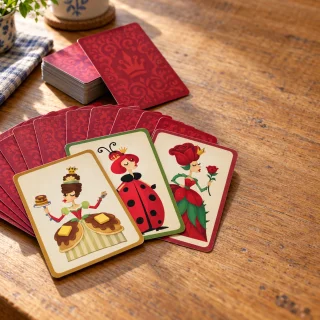
Your child plays a king, wakes the Pancake Queen, and slides her over, and the player on their left is already working out whether a knight is worth spending to take her back.

0:00 / 5:03

Quick fit

Core age band: 8 and up — it plays best from about eight to twelve. Gamewright lists Sleeping Queens for 2–5 players, ages 8 and up, with a game taking about 20 minutes. 1
Sleeping Queens is a competitive card game about waking up napping royalty. The twelve queens start face down in the middle of the table. Players wake them with kings, steal them with knights, and use dragons, wands and sleeping potions to spoil each other's plans. Whoever ends up with the most valuable queens wins. 2
This is a good fit when your child can add small numbers and can also lose a card to somebody else without the evening ending. Those are the two real gates here. The reading load is almost nothing.

What you set up

Split the cards by the colour of their backs. The twelve queens go face down in the middle of the table in four rows of three. Then shuffle the rest, deal five cards to each player, and set the remaining cards in the middle as a draw pile, with a discard pile beside it. 2
Setup runs about a minute, and there is nothing to assemble. The 79-card box measures roughly 5¾ by 4¾ by 1½ inches, so it lives on a small table or in a bag. 1
Plan on about 20 minutes, and a little more than that for the first play, while everyone learns what the special cards do.

What happens on a turn

A turn is one action, and then you refill your hand to five cards. 2
Each action does something different to the table. A king wakes a sleeping queen from the middle and keeps her. A knight steals a queen that another player has already woken. A sleeping potion sends one of their queens back to sleep, face down into an empty space among the other queens. A jester is the gamble: you turn over the top card of the draw pile, keep it and take another turn if it is a power card, or count that many players around the table if it is a number card, with the last player counted waking a queen. 2
The fourth option is the one that makes this a game rather than a race. You can discard cards to draw new ones: one card for one new card, a pair of identical number cards for two, or three or more number cards that form an addition equation for three or more. The rules ask you to announce the equation out loud as you discard it. 2
Every attack has a reply. A dragon cancels a knight as it is played, and a wand cancels a sleeping potion. In both cases the two cards go to the discard pile and every player draws a card, and defending does not use up the defender's turn. 2
Two queens bend the rules. The Rose Queen, worth only 5 points, takes another queen with her when she is woken from the middle. The Cat Queen and the Dog Queen cannot sit in front of the same player at the same time, because they fight. 2
The game ends the moment one player has 5 queens or 50 points in a two- or three-player game, or 4 queens or 40 points with four or five players. If the queens in the middle run out first, the player with the most points wins. 2

Why it earns shelf space

Treat a shelf-filler card game as the baseline here. It usually asks a child for one decision — match the pair, follow the suit — and the rest is the luck of the draw.
Sleeping Queens asks a bigger question every turn: spend this king now, or trade the number cards in your hand for three fresh ones and hope for a knight? The arithmetic is not a worksheet stapled to the side of the game. Your number cards are the only way to refill your hand, so a child who wants more options has to find the equations. 2
The potion adds a memory layer on top. Anything sent back to sleep is face down again, and the rules themselves suggest remembering the queen's value and where she was placed. 2
The game has an unusually good origin story. Miranda Evarts invented it at six years old on a night she could not sleep, and worked it up with her older sister Madeleine and their parents Denise and Max. It has stayed in print for about two decades. 1 Its award list includes a Parents' Choice recommendation, a National Parenting Center seal of approval, a top rating from the Canadian Toy Testing Council and a FamilyFun Toy of the Year nomination. 1
What earns it a permanent place, though, is that the mean moves have answers. When a knight takes your queen you may be the one holding a dragon, and when a potion puts her back to sleep you may be holding the wand. A game where every nasty move has a counter somewhere in somebody's hand keeps the table talking instead of sulking.

Who should play it

Pick Sleeping Queens for an eight- or nine-year-old who is comfortable with small sums and comfortable losing a card to somebody else. The stealing is the point, so a child who takes a stolen queen hard may need a year before this one works.
Six- and seven-year-olds do play it, and plenty of families start there, but they will want an adult for the equations and for adding up the queens at the end. Older children keep their edge longer than they do in most kids' card games, because the hand management and the memory both reward attention.
It also travels well. With no board and no pieces, two players is as good a game as five, so it suits a parent and one child as easily as a full holiday table.
If your family falls for it, there is a sequel. Sleeping Queens 2: The Rescue sends the same queens after the kings, and Gamewright lists it for the same 2–5 players, ages 8 and up, about 20 minutes. 3
The practical verdict: Sleeping Queens is a 20-minute card game for ages 8 and up that puts arithmetic, memory and a bit of stealing on the table at the same time. Bring it out when the older kids want a game they can win on their own and the younger ones still need to be at the same table.
Gamewright's game page carries the player count, age and contents, and the official rules cover setup, the turn options and the winning conditions.

This story was produced automatically by a channel. One sentence is all it takes for Neodrop to keep producing for you.

Related content

More from this channel