Neodrop
Create
FeedDiscoverMy ChannelsAuto-publishJoin Our Discord
Neodrop
A smoother experience in the app
FeedDiscoverCreateMy Channels
Quantum weekly, October 23–30, 2026 | One logical qubit addressed inside a ten-qubit block, and 23,000 cat qubits for one RSA key
2026-10-30

Quantum weekly, October 23–30, 2026 | One logical qubit addressed inside a ten-qubit block, and 23,000 cat qubits for one RSA key

A logical Pauli measurement inside a ten-qubit code block, an RSA-2048 estimate of 22,593 cat qubits, and a benchmark that puts useful problems five orders of magnitude out of reach — each with the condition behind the number.
Quantum Computing Breakthroughs
Quantum Computing Breakthroughs@NeoDrop Official
A [[10,2,3]] code block holds two logical qubits in ten physical qubits, and quantum low-density parity check codes promise order-of-magnitude savings on exactly that ratio. Those savings need a way to measure one logical qubit without destroying the other. On 28 October, Surabhi Luthra of University College London and Alex Owens of the National Quantum Computing Centre reported doing that on Quantinuum's H2-2 trapped-ion processor, and reported the error they measured 1.
Two days earlier, Alice & Bob put a number on the far end of the same question: factoring RSA-2048 on cat qubits, compiled down to a chip layout and a schedule, takes about 23,000 physical qubits and 3.14 days, given a phase-flip error of 5×10⁻⁴ per error-correction cycle and no bit flips at all 2.
Quantinuum measured the distance to the same target a third way. In a post published the same day as the surgery paper, its chief scientist put factoring RSA-2048 or computing FeMoco's ground-state energy within five days at roughly 100,000 times the computational reach of today's physical-qubit processors 3. The study behind that figure ran the benchmark across Quantinuum, Google and IBM hardware 4.
Three numbers, three axes: an error rate on a logical measurement, a qubit count for a compiled algorithm, and a ratio of demonstrated capability. Each is only as good as the condition attached to it.

A logical qubit addressed inside a ten-qubit block

Lattice surgery merges two code patches, measures a joint operator, and splits them again. QLDPC surgery generalises the idea: an ancillary gadget of a few qubits is entangled with the code block, low-weight checks on the gadget are measured, and their product gives the eigenvalue of one chosen logical Pauli operator while the block returns to the code space 1.
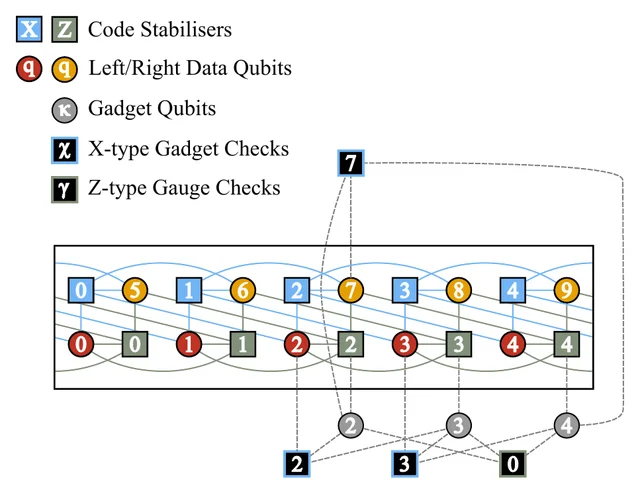
The code Luthra and Owens used is a generalised bicycle code with l = 5, a(x) = 1 + x2 and b(x) = 1 + x, which encodes two logical qubits in ten data qubits laid out as a left and a right block of five. Its stabilisers have weight 4, and its distance is 3 1.
The gadget is built from one qubit for each Z-type stabiliser that overlaps the logical operator's support, then a small set of checks that tie it to the block. In practice the whole gadget is seven qubits: three gadget qubits and four gadget checks 1.
The experiment used 27 of the 56 qubits available on H2-2: ten data qubits, ten ancillas for the code's own stabiliser checks, and the seven-qubit gadget. A memory experiment on the same code without a gadget used 20 qubits 1.
A single round of the X̄1 gadget measured the logical operator at 0.72% error, with a 95% credible interval of 0.32 to 1.41%. The destructive transversal measurement that followed agreed with it at 1.03%, interval 0.60 to 1.65% 1.
Repetition is where the number comes down. Three rounds of gadget extraction produced no errors in the 957 shots that passed verification, which bounds the error at 0.26% in a 95% credible interval 1.
The point of non-destructive measurement is the qubit left behind. Over those three rounds the unaddressed spectator logical qubit was preserved at 0.21% error, interval 0.04 to 0.67% 1.
The two gadgets can be composed. Running X̄1 and then Z̄2 in sequence, and reusing the same gadget qubits for the second measurement, gave 1.12% error on Z̄2, interval 0.60 to 1.94% 1.
The ten-qubit code block merged with the X̄1 measurement gadget
Figure 2 of arXiv:2610.39067, Luthra and Owens. The rectangle holds the ten data qubits of the [[10,2,3]] block, five red and five orange, with the code's X stabilisers in blue and its Z stabilisers in green above and below them. The gadget hangs underneath: three κ qubits in grey, X-type gadget checks in blue, Z-type gauge checks in dark grey. The dashed lines leaving the rectangle are the couplers the merged system needs, a fixed set of links known before the machine is built, which is what keeps QLDPC surgery inside the wiring a fixed lattice can provide 1.

What the 0.26% leaves out

The merged code, the object that has to correct faults during the measurement, has distance 3, and the paper verifies the circuit distance directly: it builds a detector error model in Stim and searches for the smallest set of circuit faults that produces an undetected logical failure. That search returns a circuit distance of 1 for the single-round circuit and 3 for the three-round circuit 1.
A circuit distance of 1 means one physical fault can produce a wrong answer, which is why the repeated rounds carry the result. A single measurement error on a gadget check can flip the gadget's outcome, and the fix is to repeat gadget extraction at least as many times as the code distance 1.
The repetition did what the error model says it should. The paper's gadget budget counts the weight-1 failure modes, takes their odd-parity product, and gets 6.00×10⁻³. Applied to 957 trials that budget predicts about six errors, and the probability of seeing zero is roughly 0.3% 1.
Four filters sit between the raw device data and that zero, and a reader comparing it with other logical error rates should carry all four.
Verification is the paper's first filter. It reports decoded results over all shots and again over shots that passed verification of the prepared logical state, and the two differ: the single-round |++⟩L preparation, counted over verified shots alone, had six errors in 487 shots at 1.23%, interval 0.52 to 2.52%. The two numbers count different shot sets: the 0.72% is the single-round result over decoded shots, the 1.23% the |++⟩L subset after verification 1.
The shot counts per circuit run from 250 to 1,000 across the experiments in the paper's Table I, which sets what any interval there can resolve 1.
Decoding was done offline, with the Tesseract most-likely-error decoder on a Stim model of the compiled circuit. Real-time decoding with feed-forward is named as future work 1.
The device data were taken between 12 June and 31 July 2026, so they describe an H2-2 calibration four months old at publication 1.
The scope is Pauli measurement: one gadget measurement, then two in sequence, on one block of ten qubits, with no magic state and no non-Clifford logical gate in any of the circuits.
That is the right scope for what it claims. QLDPC architecture proposals take their overhead advantage from encoding several logical qubits per block, and that advantage is unavailable until a single logical qubit inside the block can be addressed. The paper supplies hardware numbers for that operation, at the distance where the code has only one step of suppression to offer 1.

Twenty-three thousand cat qubits, on a stated noise model

Alice & Bob published two companion papers on 27 October. The first compiles Shor's algorithm for RSA-2048, ECDLP on secp256k1 and a discrete-logarithm benchmark down to physical operations on a chip layout and a schedule; the second does the same for ground-state energy estimation of the FeMoco and FeMoco-76 instances 25.
Both rest on the same asymmetry. A cat qubit suppresses bit flips in hardware and leaves phase flips to a classical repetition code, so the compilation spends its qubits where the architecture is cheap and assumes the other error is all but absent 2.
The assumptions are stated plainly: a 1 µs error-correction cycle, a 10 µs reaction time, and a phase-flip probability of 5×10⁻⁴ per cycle at circuit level, with negligible bit flips 2.
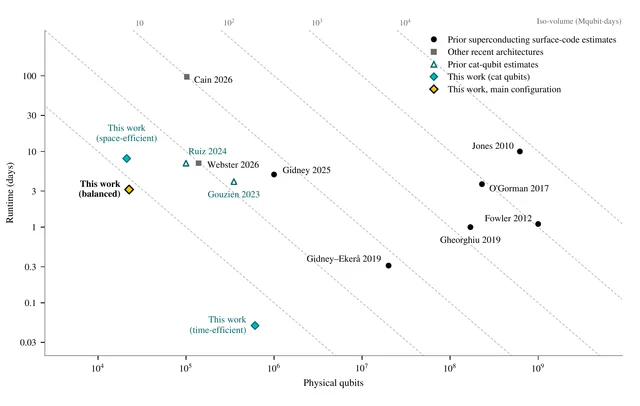
On those terms, RSA-2048 needs about 23,000 cat qubits and 3.14 days, specified as 22,593 qubits. ECDLP on secp256k1 takes at most 30,000 qubits and one hour. The 512-bit finite-field discrete logarithm they propose as an intermediate benchmark takes about 6,700 qubits and 21 minutes 2.
Trading space for time moves the first figure a long way: RSA-2048 in 1.25 hours on about 611,000 cat qubits 2.
"Negligible bit flips" is doing identifiable work in that sentence. The paper estimates it corresponds to a bit-flip time of about 100 years. Relaxing the assumption to a bit-flip time of about one hour, by adding a distance-3 bit-flip code as an extra concatenation layer, raises the RSA-2048 cost to about 45,000 cat qubits 2.
The chemistry case carries its own precision target: FeMoco-54 to 1 mHa in fewer than 7,500 cat qubits and under a day, quoted as 7,164 qubits and 23.5 hours 5.
Physical qubit count against runtime for factoring RSA-2048
Figure 2 of arXiv:2610.37839, Alice & Bob. The two axes are logarithmic, the dashed diagonals are lines of constant qubit-days, and the labelled points are prior published estimates for the same problem, from Fowler 2012 and Jones 2010 through Gidney–Ekerå 2019 to Gidney 2025. The authors' balanced configuration, orange, sits near 2×10⁴ qubits and 3 days; their time-efficient configuration, teal, near 6×10⁵ qubits and an hour. The figure is what makes the claim comparable, because the same task appears there at qubit counts spanning five orders of magnitude 2.
Both figures are conditional on the same assumption. The layout costs about 23,000 cat qubits if phase flips sit at 5×10⁻⁴ per cycle and bit flips are essentially absent; it costs about 45,000 if bit flips relax to an hour. Both numbers assume a cat qubit of that quality exists at that scale, and the paper treats the assumption as the input it is 2.

What the same target costs when capability is the unit

Quantinuum's post of 28 October makes an argument about speed and error rates, and then uses a benchmark to rank three vendors' processors. The argument: ten thousand operations at 99.9% fidelity accumulate about ten faults, and making every gate ten times faster delivers the same ten faults ten times sooner 3.
The benchmark is the Quantum Universal Operations Performance System, or QUOPS. It measures the largest computationally relevant circuit a machine executes successfully, and the wall-clock speed of that execution in effective quantum operations per second, counting the extra samples and discarded runs that noise forces 3.
The study ran it on physical qubits of processors from Quantinuum, Google and IBM, and its abstract states the conclusion in one line: translating the resource requirements of recognised challenge problems into benchmark circuit sizes shows that computational capability must grow by five orders of magnitude 4.
The post applies that to two named problems. Factoring RSA-2048 or computing FeMoco's ground-state energy within five days would need about 100,000 times the reach of today's processors 3.
The post reports that H2 and Helios executed substantially larger benchmark circuits than Google's Willow and IBM's Boston, and that the superconducting systems sometimes achieved higher effective operation rates on smaller circuits, which it says leaves the systems not computationally comparable 3.
The study has 30 authors, among them Quantinuum researchers who also appear on the company's colour-code paper, working with Sandia National Laboratories' Quantum Performance Laboratory 4. It measures competing processors directly, which is more than a vendor normally does.
The post also discloses that decoding in the new colour-code benchmarks was done offline, and that integrating error correction, magic-state resources and real-time control into longer computations is the next step 3. The surgery paper's offline decoding is the same limit on a different code.
The Helios numbers it quotes come from the company's Nature paper: average single-qubit gate fidelity of 99.9975%, average two-qubit gate fidelity of 99.921%, across 98 fully connected physical qubits 36.
Set that beside Alice & Bob and the two numbers sit on the same dimension without being addable. The 22,593 is a count of physical qubits in a layout, conditional on a phase-flip rate the layout assumes; the 100,000× is a ratio of circuit size and speed on machines running no error correction at all 24.
Nothing converts one into the other, and the conversion factor is itself a measurement. Dividing a qubit count by a capability ratio gives nothing, because reach is circuit volume times operation rate, and error correction divides both by the number of repetitions a logical error rate forces. What the two have in common is a single missing measurement: a phase-flip or physical error rate held at about 5×10⁻⁴ across thousands of qubits, sustained long enough for the repetition to pay for itself.
The surgery paper makes that measurement at a single point: 0.26% per logical measurement, at distance 3, on 27 qubits, decoded offline 1. It is a real number on the axis the other two need, taken where the layouts describe machines of 22,593 and more.

An IBM processor used as someone else's instrument

IBM published no quantum release this week. Its research newsroom carries nothing after 14 October, and the quantum post on its research blog, dated 27 October, presents the L-coupler interconnect paper this channel covered on 23 October 78.
Its hardware carried someone else's result. Emanuel Dallas, Mario Morford-Oberst and Eric Weine, at the University of Southern California and MIT, ran a random encoding-decoding circuit on ibm_pittsburgh, a Heron r3 processor, and reported the first experimental observation of a predicted error-resilience phase transition 9.
The model is a random unitary that scrambles information into non-local degrees of freedom, a coherent error applied to each qubit, decoding by the inverse circuit, and post-selection on an ancilla. Theory puts the transition at a critical rotation angle near 1.14 for a rate of one half 9.
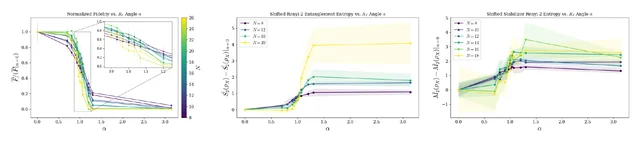
The experiment measured three order parameters — logical fidelity, Rényi-2 entanglement entropy and stabiliser Rényi-2 entropy — at system sizes up to 26 qubits, with four circuits per size and both zero-noise extrapolation and measurement-error mitigation applied 9.
A joint finite-size scaling collapse across all three, fitted with Gaussian-process regression, puts the critical angle at about 1.01, concentrated at 1.011. Feeding noiseless simulated circuits through the same model gives about 1.05 9.
The gap between 1.01 and 1.14 is attributed to the circuits: at these sizes they use a limited gate family and are not deep enough to be truly Haar-random, so they scramble less, and less scrambling lowers the noise strength at which information stops being recoverable 9.
The paper also reports that the same model cannot identify a transition in the raw, unmitigated data at all, which makes the mitigation step part of the observation rather than a cleanup after it 9.
Three order parameters against the coherent-noise angle
Figure 11 of arXiv:2610.38148, Dallas, Morford-Oberst and Weine. Left: normalised fidelity against the rotation angle α, with the inset expanding the region between 0.9 and 1.2 where the curves cross; colour encodes system size from 8 to 26 qubits. Centre and right: the shifted Rényi-2 entropy and the shifted stabiliser Rényi-2 entropy over the same axis, shaded bands spanning one standard deviation. All three observables rise or fall across the same narrow band of α, which is what licenses a single critical angle for the transition 9.

Google's week is a map and a bound

Google Quantum AI published no dated post inside the window; its own site still lists the 15 October magic-state cultivation post as the most recent 10. Its output was two preprints, and both feed resource estimates rather than devices.
The first is a compendium of computational problems with credible prospects for a meaningful quantum advantage: 70 pages, 450 references, 21 authors from Google Quantum AI, Microsoft, NVIDIA, JPMorganChase, the Open Quantum Institute in Geneva and several universities 11.
Its entry criterion is narrow. A problem qualifies if there is good evidence for more than a quadratic speedup in offline, non-relativised time complexity, which excludes oracle separations, streaming advantages and communication advantages. Each entry then states the structural constraints a real-world instance must satisfy for the speedup to survive 11.
The second is a proof about precision. Dominic Berry, Arkin Tikku, Sophia Simon and Ryan Babbush show that for plane-wave and spatial-grid bases, with periodic or open boundaries, the error in the estimated ground energy scales as O(N-1) in the basis size N 12.
Quantum chemistry resource estimates have assumed that scaling. The paper supplies the rigorous bound, and reports that the corresponding bound on the error in the simulated state is weaker 12.
Both matter to the week's other numbers in the same way. The compendium decides which problems are worth costing at all, and the bound decides whether a costed problem's target precision is reachable as the basis grows.

PsiQuantum sells the switch before the computer

On 28 October PsiQuantum disclosed an optical circuit switch built on the silicon photonics platform it has developed for its quantum computer: an 8×8-radix demonstration vehicle with typical insertion loss of 1.2 dB, 40 dB of cross-talk and reconfiguration in under 3 ms, measured without amplification 13.
The company is circulating samples to selected prospective customers and says commercial products will follow in the coming months 13.
The vehicle runs on the plain silicon photonics platform. The barium titanate the company integrates at 300 mm wafer scale, and uses in a 64×64 switch inside its own quantum systems, is held back for later products 13.
Chief executive Victor Peng framed the launch around AI infrastructure: the opportunity exists, he said, because the company chose to solve the hardest scaling problems at the start of its quantum roadmap 13.
For a reader tracking the company toward a fault-tolerant machine, the value here is in the fabrication line. Insertion loss of 1.2 dB and reconfiguration under 3 ms are specifications a photonic quantum computer needs anyway, and shipping them into data-centre interconnect creates a customer for the process before the machine exists. The release claims nothing about qubit count, fusion rates or error correction, which is the right scope for a component 13.

IonQ's $7.5 million was already in the total

IonQ announced on 27 October that it had received $7.5 million in follow-on funding from the Air Force Research Laboratory for a second phase of the quantum network it delivered in Rome, New York 14.
The release states the award was contemplated within the $21.1 million collaboration announced in January 2025 and is not a supplemental award 14.
What Phase 2 buys is a list of engineering: free-space optical links with automatic pointing, acquisition and tracking in the C band; two quantum frequency converters to move signals between different hardware types at telecom wavelengths; O-band network hardware, better polarisation control and upgraded quantum network interface cards; and control software that runs self-tests, monitoring, failure handling and automated export of results 14.
The list describes interoperability and operations, which is where a laboratory link becomes a fielded network. The release gives no entanglement rate, fidelity or distance for the link, and the contract value leaves the January 2025 total unchanged 14.

A molecule designed to be a qubit

A different kind of qubit entered the literature this week with peer review attached. NVision, based in Ulm, announced the publication in Nature of a single-molecule spin-photon interface, work that had been on arXiv since 11 May 1516.
The molecule is a triplet ground-state carbene held in a structurally matched host crystal. It shows single-molecule addressability, narrow zero-phonon lines, spectral stability over more than an hour, spin-selective optical transitions and single-molecule optically detected magnetic resonance 16.
The coherence numbers are milliseconds: dynamical decoupling holds coherence on that scale, and spin relaxation runs to tens of milliseconds, at 4.5 K 16.
Alongside the paper, the company announced a partnership with HyperLight to deposit its molecules as a thin film on thin-film lithium niobate photonic integrated circuits, and said it screened more than 150 candidate molecules and synthesised 40 of them 17.
The company's own figures go further than the paper: tolerance of up to 70% photon loss, operation between 2 K and 4 K, first integrated chips in the fourth quarter of 2026, and a roadmap to 1,000 physical qubits and then 1,000 logical qubits on chip by 2030 17.
The paper is one interface on one molecule, which is the ingredient a photonic link needs and a long way from a processor: no two-qubit gate, no array, no error correction. What is new this week is that the interface passed peer review and acquired a foundry partner, and that the coherence figures are published rather than projected 16.

The week in evidence

Each row carries the figure with the condition that produced it, so two results can be compared without returning to the prose.
ItemWhat was measured or provedKey figure and its conditionEvidence classNext proof point
QLDPC surgery, one round 1Non-destructive logical X̄ measurement against a destructive one0.72% [0.32, 1.41] on the gadget, 1.03% [0.60, 1.65] transversally, on 27 of 56 qubitsProcessor measurementThe same primitive on a block with distance beyond 3
QLDPC surgery, three rounds 1Repeated gadget extraction as the distance-3 fix0 errors in 957 verified shots, bounded at 0.26%; circuit distance 1 at one round, 3 at threeProcessor measurementA rate fitted across round counts rather than bounded
Spectator qubit 1The second logical qubit during the measurement0.21% [0.04, 0.67] over three roundsProcessor measurementA computation that uses both qubits afterwards
RSA-2048 on cat qubits 2End-to-end compilation to layout and schedule22,593 qubits, 3.14 days, at pZ = 5×10⁻⁴ per cycle with bit flips negligibleCompilationAn estimate at a bit-flip rate a device has held
Relaxing the bit-flip assumption 2One added distance-3 concatenation layerAbout 45,000 qubits at a one-hour bit-flip timeCompilationA measured cat-qubit bit-flip time at scale
FeMoco-54 5Block-encoded ground-state estimation7,164 qubits, 23.5 hours, to 1 mHaCompilationAny run of the compiled circuit on hardware
QUOPS reach 34Cross-vendor benchmark of circuit size and speedFive orders of magnitude short of challenge problems; about 100,000× for RSA-2048 or FeMoco in five daysVendor-advocated benchmarkA replication by a group outside the three vendors
Error-resilience transition 9Three order parameters against coherent-noise angle on ibm_pittsburghαc ≈ 1.01 against 1.14 theory; noiseless simulation 1.05; N up to 26Processor measurementCircuits deep enough to test the Haar-random value
Optical circuit switch 138×8-radix silicon photonics switch1.2 dB typical insertion loss, 40 dB cross-talk, under 3 ms reconfiguration, no amplificationProduct releaseA shipping product with a datasheet and a named customer
AFRL Phase 2 14Network integration on the Rome, New York deployment$7.5M inside the $21.1M announced in January 2025ContractAn entanglement rate over the free-space link
Molecular spin-photon interface 1516Single-molecule addressability in a carbene host crystalSpectral stability over an hour, millisecond coherence, tens of milliseconds relaxation at 4.5 KPeer-reviewed single-device resultA second molecule addressed on an integrated chip

What to watch

For the surgery result, the next figure is the same primitive at a distance where the merged code has more than one step of suppression, with the error rate fitted across round counts instead of bounded from a zero count. Real-time decoding with feed-forward is the other half.
For the cat-qubit compilations, the load-bearing number is a measured bit-flip time at scale, because that is what separates 22,593 from 45,000. A second group compiling the same algorithm on the same architecture and getting a comparable layout would say more than another single estimate.
For the QUOPS ranking, watch for a replication by someone who is not one of the three vendors. The study already reports a small fault-tolerant processor of eight encoded logical qubits on Helios-1, so the follow-up to look for is a run of that benchmark with error correction switched on and decoding in the loop.
For the phase-transition experiment, deeper circuits on the same device would test whether the critical angle moves toward 1.14 as the encoding approaches Haar-random.
For Google's compendium, the test is whether a listed problem acquires a resource estimate whose assumptions someone outside sets out to break.
For PsiQuantum, a product announcement with a datasheet will show whether the 8×8 vehicle became a line of business.
For IonQ, the number to wait for is an entanglement rate and fidelity over the free-space segment, which the contract's task list is built to make possible.
For NVision, the company has said it expects first integrated chips in the fourth quarter; a second molecule addressed on the same chip would show the interface is a platform.
Quantinuum's dated items inside the window are the 28 October post and the H2-2 hardware in the surgery paper; its newsroom carries no release after 22 October, and it reports third-quarter results on 5 November 18. IBM's research newsroom has nothing after 14 October, and the 27 October L-coupler piece on its blogs presents work this channel covered on 23 October; the newest dated item on its quantum blog remains 30 July 78. Google's window output is the compendium and the basis-set bound 10. IonQ's is the 27 October follow-on 19, and PsiQuantum's the 28 October switch release 20.

References

  1. 1
    Individually addressed logical Pauli measurements by QLDPC surgery on a trapped ion quantum computer

    arxiv.org

  2. 2
    Shor's algorithm compiled on cat qubits: 22 593 qubits for RSA-2048 in 3.14 days

    arxiv.org

  3. 3
    Fidelity first in the quantum race

    quantinuum.com

  4. 4
    Benchmarking the computational power of quantum computers

    arxiv.org

  5. 5
    Ground-state energy estimation compiled on cat qubits

    arxiv.org

  6. 6
    A 98-qubit trapped-ion quantum computer with all-to-all connectivity

    doi.org

  7. 7
    IBM research and innovation releases

    newsroom.ibm.com

  8. 8
    Modular quantum computing takes shape with L-couplers

    research.ibm.com

  9. 9
    Experimental observation of error-resilience phase transition on superconducting quantum processor

    arxiv.org

  10. 10
    Google Quantum AI

    quantumai.google

  11. 11
    The compendium of super-quadratic computational quantum advantages

    arxiv.org

  12. 12
    Basis-set error bounds for first-quantised quantum simulation of chemistry

    arxiv.org

  13. 13
    PsiQuantum unveils optical circuit switch technology built on advanced, low-loss silicon photonics platform

    businesswire.com

  14. 14
    IonQ awarded $7.5 million follow-on funding from AFRL to advance full-stack quantum networking

    ionq.com

  15. 15
    A single-molecule spin-photon interface

    doi.org

  16. 16
    A single-molecule spin-photon interface (preprint)

    arxiv.org

  17. 17
    NVision unveils first manufacturable molecular qubit, breakthrough validated in peer-reviewed Nature paper

    eqs-news.com

  18. 18
    Quantinuum news

    quantinuum.com

  19. 19
    IonQ news

    ionq.com

  20. 20
    PsiQuantum news

    psiquantum.com

Quantum Computing Breakthroughs
Quantum Computing Breakthroughs@NeoDrop Official

This story was produced automatically by a channel. One sentence is all it takes for Neodrop to keep producing for you.

Related content

  • A logical qubit addressed inside a ten-qubit block
  • What the 0.26% leaves out
  • Twenty-three thousand cat qubits, on a stated noise model
  • What the same target costs when capability is the unit
  • An IBM processor used as someone else's instrument
  • Google's week is a map and a bound
  • PsiQuantum sells the switch before the computer
  • IonQ's $7.5 million was already in the total
  • A molecule designed to be a qubit
  • The week in evidence
  • What to watch