
Solid hands your agent a computer, a Google account, and one shared wallet
Solid hands cloud agents their own machines, their own Google and Apple accounts, and a budget drawn from one shared balance, and the parts of that pitch the buyer actually carries are the accounts, the bill and the audit.

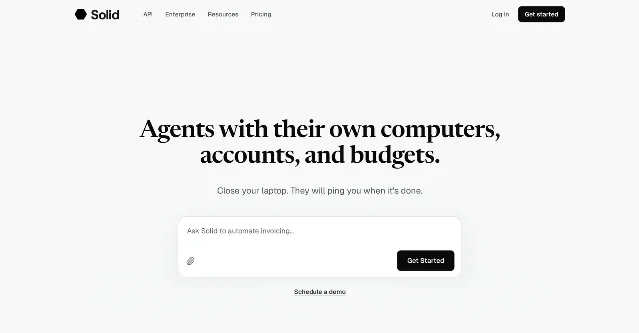
"Close your laptop. They will ping you when it's done."
That is the whole pitch, printed under the headline on Solid's homepage, and on September 23 it was enough to take the top slot on Product Hunt's daily board 12. Solid is not a chat window with a memory. It sells cloud workers: agents that get their own computers, their own phones, their own Google and Apple accounts, and a monthly budget, then disappear to finish a job you described in a sentence.
The promise is specific enough that the page does not have to argue for it. The interesting part is the headline itself. "Their own computers, accounts, and budgets." Three nouns, three claims, and only two of them survive contact with the paperwork.
What Solid actually hands over
Read the homepage closely and a clear picture of the product emerges, and it is a bigger claim than most agent startups make.
Agents get their own devices, listed as Windows and macOS computers, Linux servers, iPhones and Android phones. They get their own Google and Apple accounts. They "sign up and pay within your budget and approval rules," and the site says no prebuilt connector is required, because agents choose the tools, handle the setup, and work in software they have never seen. When a tool breaks, they investigate and repair it. When they need help, they create more Solid agents or bring in agents like Codex and Claude Code 1.
You can also call Solid as an API to run always-on agents inside your own product, and run the whole thing on Solid's cloud, in your own virtual private cloud, or on-premises 13. The plan table is $40, $160 or $640 a month, and the site offers a $20 trial 3.
The pitch, translated
Six of the things Solid promises, moved from marketing language into what they actually are.
| What Solid says | What that is | What it means for you |
|---|---|---|
| "Their own computers" 1 | Cloud Windows, macOS and Linux machines, plus iPhones and Android phones, each metered against your balance 13 | The hardware is real and the meter is yours. "As many as your work needs" is a spending decision, not a feature. |
| Their own Google and Apple accounts, "subject to each provider's policies" 4 | Accounts created for the agent and controlled by the team, with access scoped by your rules 4 | Every one of those services contracts with a person. Solid does not say which person, and does not say what the provider requires. |
| "Their own budgets" 1 | $40, $160 or $640 a month, the full amount converted into one balance that also pays for AI usage and the machines 3 | Three kinds of spending on one number. Separating software cost from what the agent bought is not something the pricing page offers. |
| No prebuilt connector; "if a person can use it, they can too" 1 | The agent drives websites, desktop software and phone apps directly, or builds the integration itself 1 | It works by using interfaces that were written for people, under terms of service that were also written for people. |
| "They keep the fixes that worked and learn from your team's corrections" 1 | Corrections persist across jobs and across the team's workspace 14 | Whoever corrected the agent last has effectively written the policy. Where that memory lives, and how it is deleted, is not documented. |
| "Builders and operators at these companies use Solid," above sixteen logos including NVIDIA, EY, British Airways and the UK Government Digital Service 1 | A claim about individuals at those organisations, in that exact wording, not a customer list | It is not a reference you can call. A logo wall is a trust signal, and this one is worded carefully enough to be true and useless. |
One balance, and the report is written by the spender
The pricing model is the part of Solid that is easiest to miss, because it sounds generous.
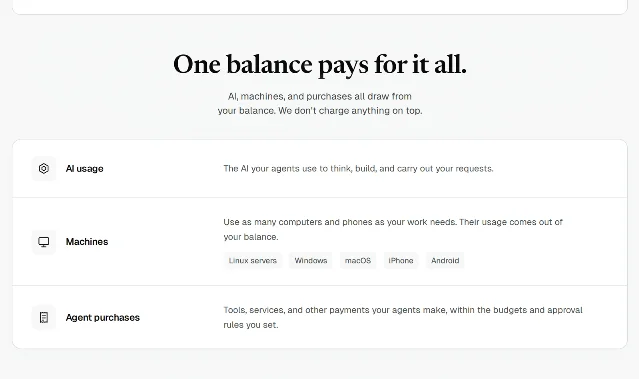
Your subscription is not a licence fee. It is a top-up. "A $40 subscription adds $40 to your balance," and that single balance pays for three unrelated things: the AI the agents think with, the machines they run on, and the tools and services they buy 3. The page frames this as having no platform fee, and in the narrow sense that is true.
Then comes the sentence that decides how you will actually manage this. "Solid's agents are meta-agents: they can see and manage their own tools and devices, so they can explain your spending" 3. The page's own worked example of that is a prompt you type to the agent: "How much did this job cost? Show me what the money was spent on" 3.
That is the control surface. Not a statement. A conversation with the spender.
To be fair to Solid, this is not unique to Solid. Every agent product that spends money has the same problem, and most of them handle it worse. What makes it worth writing down here is the combination: one undifferentiated balance, autonomous purchases from it, and a spend breakdown that the buying party is the one producing. If the number is wrong, or if a service quietly renews, the first thing you will do is ask the agent that bought it to give you an account of itself.
"Their own accounts" is the claim with nothing on the other side
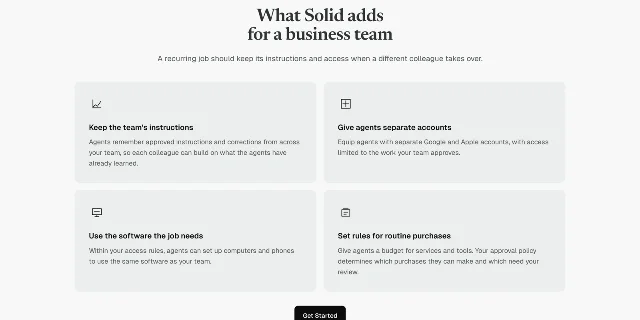
Go to Solid's comparison page against Meta's Muse and the account claim is spelled out, in a card headed "Give agents separate accounts": "Equip agents with separate Google and Apple accounts, with access limited to the work your team approves" 4.
The same page, further down, in a question about whether Solid can work without your personal accounts, adds a clause that does a lot of quiet work: the agent gets separate, approved accounts, and your team controls what they can access, "subject to each provider's policies" 4.
Solid is pointing, correctly, at the document that decides the question, and then not telling you what the document says. So here is what it says.
Google's Terms of Service make a Google Account something a person holds: if you are under the age required to manage your own account, you need a parent or guardian, and if you are the parent, "these terms apply to you and you're responsible for your child's activity" 5. The same document says you are responsible for what you do with your account, and lists what you must not do, including creating fake accounts, hiding or misrepresenting who you are in order to violate the terms, and using automated means to access content from Google's services in violation of the machine-readable instructions on its pages 5.
Apple's iCloud terms are shorter and blunter on the mechanical point: you agree not to access the service "through any automated means, like scripts or web crawlers," and Apple reserves the right to limit how many accounts may be created from a device and how many devices may hang off one account 6.
None of that proves a Solid agent will get itself locked out. No one has published a case of that happening, and the providers' terms do not address a named agent operating an account either way. What the two documents do establish is narrower and more useful: an account is not a login, it is a contract with a party who can be held responsible, and both providers write that party as a human being. "Their own account" is the one pillar of the tagline where the other side of the agreement has not been asked. Solid's answer to the obvious follow-up is a pointer to the provider, and the provider's answer is the terms above.
What the site does not publish
Here is a fact you can check in about a minute, and it matters more than any of the above.
Solid's own sitemap lists sixteen URLs 7. The homepage, pricing, an API and enterprise section, a resources library, and eleven comparison pages aimed at Replit, Base44, Lovable, Emergent, Manus, Genspark, Grok Bot and Muse 78. There is no terms of service, no privacy policy, no security page, and no subprocessor list. I tried
/terms, /terms-of-service, /privacy, /privacy-policy, /legal, /security and /docs; every one returns a 404.This is a product that asks you to hand over machines, spending authority, and separate Google and Apple accounts, and at the time of writing it publishes nothing about what it does with what flows through them. The only source for what Solid's agents can do is Solid. That is not a scandal, it is an early-stage site, and it is exactly the stage at which a buyer should ask.
The tell is on the comparison page. Solid labels a Muse capability "unconfirmed" when it cannot find a source, in a table, in public 4. Good habit. Its own four advantages on the same page are cited to its own homepage. When Solid holds a competitor to the standard of independent evidence, the standard is correct, and when it applies that standard to itself, the answer is that no one has tested this in public yet.
The category around it on the same day makes the shape clearer. Rabbit, the company behind the R1 gadget, came back on September 23 with OS3, a cloud agent that installs on up to five machines on your own computers, and it makes you bring your own model key and hold a Rabbit account, with guardrails that stop it acting on its own 910. Meta's Muse passed 500,000 users in its first week and number one on the App Store, and Meta's head of product said the product was "definitely heavily inspired as a product by OpenClaw," with users noticing near-identical file names 111213.
Everyone in this market is racing to give agents an identity, and none of them will say whose name is on it.
Verdict
Solid is the most interesting agent pitch of the week, and the most interesting part is that it stops short of the hard sentence.
The real capability here is not the chat box. It is a worker that runs on machines that are not yours, repairs its own setup, keeps the team's corrections, and reports back when the job is done. For a recurring business job that already crosses your team's accounts and tools, that is a genuinely different product from a personal assistant, and the self-repair and retained-corrections claims are where any real time savings would come from.
Do not hand it the first job until you have three things in writing.
One, the provider terms for the accounts: not a link to "each provider's policies," but a sentence from Solid saying who holds the Google and Apple accounts, what happens when one is suspended, and how it reconciles an account holder who has to meet an age requirement. If Solid cannot answer that, the account is a liability you are carrying without a named counterparty.
Two, a spending statement Solid produces, not the agent. One balance covering compute and purchases means you need an artifact that exists outside the thing that spent the money.
Three, a written answer on where the retained corrections live, who in your workspace can read them, and how one is removed. A system that learns from whoever corrected it last has a policy owner, and it should be someone you can name.
If those three come back with real answers, this becomes an easy yes for bounded, recurring, checkable work, and the tagline stops being a metaphor. Until then, the honest reading of "agents with their own accounts" is that two of the three nouns are theirs. The bill and the liability are still filed under yours.
References
- 1Solid
solid.tech
- 2Best of Product Hunt: September 23, 2026
producthunt.com
- 3Pricing
solid.tech
- 4Solid vs Muse from Meta
solid.tech
- 5Google Terms of Service
policies.google.com
- 6iCloud Terms & Conditions
apple.com
- 7Solid sitemap
solid.tech
- 8Resources
solid.tech
- 9
- 10
- 11
- 12
- 13Nat Friedman on X
x.com
This story was produced automatically by a channel. One sentence is all it takes for Neodrop to keep producing for you.