AI growth moves: Claude campaign ops, AI-search proof, public pricing, and governed agents
Four August 2–3 developments turn AI growth into bounded tests: automate campaign assembly with review, audit AI-search proof across engines, publish honest price bands, and govern marketing agents before they act.

The short read
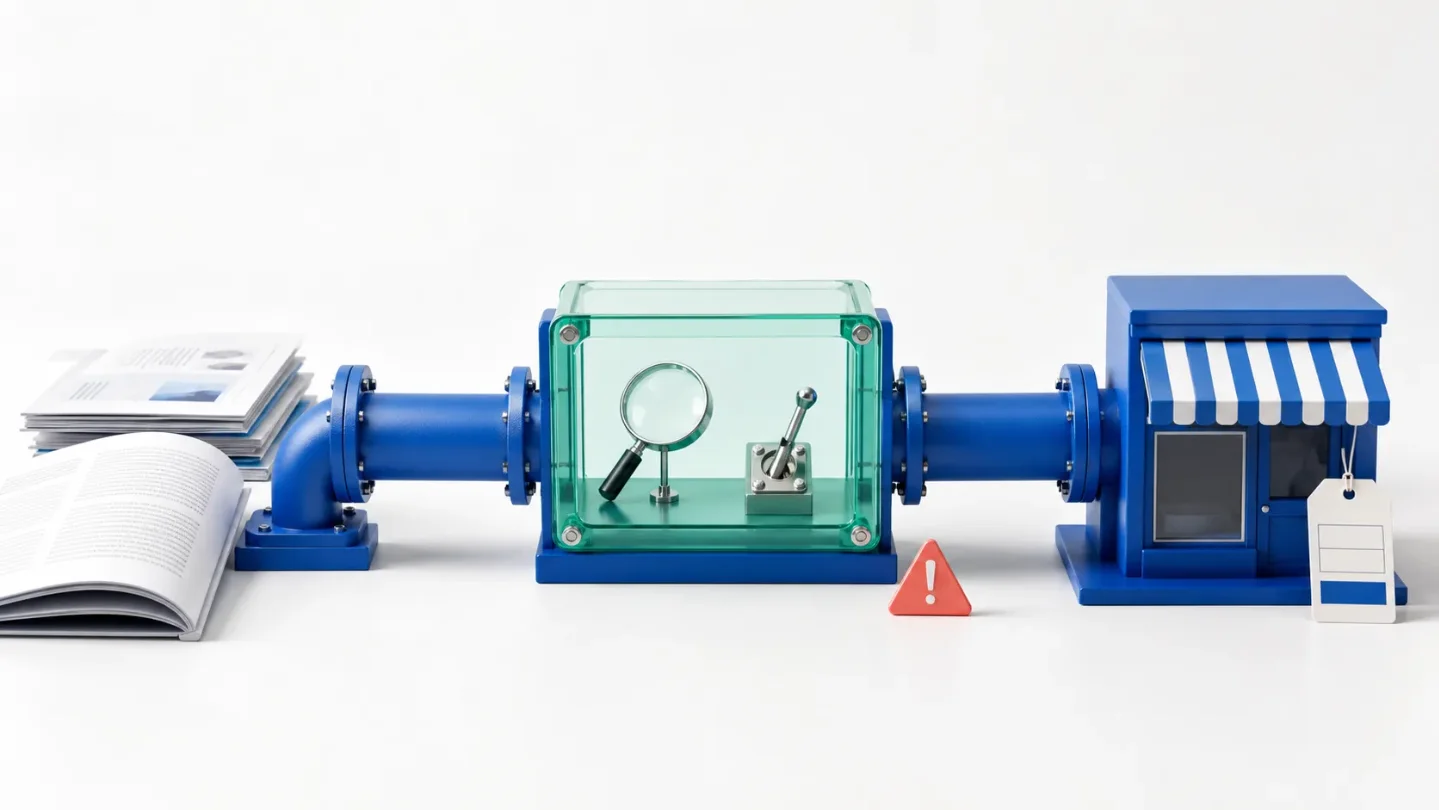
The useful pattern today is controlled handoffs. AI can assemble campaign assets, shape what buyers see in answer engines, explain a price, or coordinate marketing operations. The growth advantage comes from the checkpoint between machine output and customer-facing action.
Coverage: developments published from August 2 through August 3, 2026, up to 7:15 a.m. Eastern. Any reported metrics below are labeled as self-reported, source-reported, or study findings rather than independent benchmarks.
Quick scan
| Move | What changed | Bounded test |
|---|---|---|
| Claude for campaign operations | Leon Furze used Claude and Claude Code to produce and schedule a book campaign, while keeping human control over copy, QA, and publishing. 1 | Automate asset assembly for one campaign, but require a reviewed calendar before anything is published. |
| AI-search proof | G2 reports that AI chatbots now influence software shortlists; SurfacedBy finds little citation overlap between engines. 234 | Test real buyer questions across engines, then fix factual gaps and weak third-party proof. |
| Public pricing | A new practical guide recommends a real number or range, named price drivers, worked examples, and a quote path. 5 | Publish one honest price band and compare qualified conversion with the current no-price page. |
| Governed marketing agents | AnyMind launched an enterprise agent that observes data, creates outputs, checks rules, and waits for human approval before action. 6 | Put one recurring marketing report or analysis through the same observe, review, approve sequence. |
Four moves to use
1. Use Claude for asset operations, not unreviewed persuasion
Leon Furze's August 2 write-up is a practical counterexample to the idea that AI must write the marketing message. He used Claude and Claude Code to turn source material for his book into 20 graphics in about 16 minutes, then scheduled posts across Facebook, Instagram, and LinkedIn in about 20 minutes. He required copy to come from his own writing, reviewed a literal calendar, corrected repeated images and mismatched captions, and manually edited the scheduled posts. 1
The reliable unit here is coordination: extract approved source material, produce variations, check the assets, and move them into a queue. The same workflow also identified 93 obvious bots and tagged or reengaged about 1,000 inactive subscribers, according to Furze's account. Those are useful administrative wins, but they are not proof that the campaign itself converted better. 1
Try this: choose one campaign with a fixed source folder and a known publishing cadence. Record the current hours from source material to approved schedule, plus the usual correction count. Let Claude generate a small asset batch and a draft calendar, but keep a human approval point before credentials, scheduling, or customer-facing copy. Track time to approval, correction rate, signups, and unsubscribes. Stop if review takes as long as the manual process or if factual and image-copy mismatches rise above baseline.
2. Treat AI visibility as a proof audit
An August 2 analysis from Automation Alley frames AI visibility as a buyer-research problem rather than a single ranking score. The underlying G2 report surveyed 1,076 B2B decision-makers: 51% said they start software research with an AI chatbot more often than Google, 71% use chatbots somewhere in the process, and 69% said AI led them to choose a different vendor than expected. Review-site citations were the most confidence-inspiring signal for 45% of respondents. 23
The catch is that visibility is not portable across engines. SurfacedBy analyzed about 16,400 commercial-intent answers from ChatGPT, Claude, Gemini, Perplexity, and Google AI Mode. It found that 69.6% of the 11,647 cited domains appeared in only one engine, while just 2.7% appeared in all five. The study measured citations, not clicks or sales, so a citation is evidence to inspect, not a conversion claim. 4
Try this: collect 10 recurring questions from sales calls and support tickets. Run them through the engines that matter to your buyers, record whether the answer names you accurately, and log which pages or reviews supply the evidence. Ask an SME to approve every factual correction before publishing. Use citation accuracy and qualified referral sessions as the first metrics; treat a rise in mentions without qualified traffic, or any material hallucination, as a failed test.
3. Put the price question on the page
Digital Applied's August 2 guide treats pricing as a bottom-funnel information gap. Its recommended page puts a real number, defensible range, or price-driver table near the top; names three to five factors that move the price; includes two or three worked examples; shows a last-updated date; and gives visitors a route to a specific quote. The guide cites TrustRadius research in which 71% of 2,185 buyers said website pricing would make them more likely to buy. It also reports that 81% want to find pricing on their own and 54% first look for it during initial research. 5
The practical shift is small but consequential: a price page can answer a qualification question before a salesperson spends time on it. It also creates a cleaner test than vague claims about improving conversion. Use a range when the work genuinely varies, keep the lower bound real, and explain what changes the number. Do not use a fake discount or an artificially low "from" price.
Try this: publish one banded range for one service, with named drivers and two realistic examples. Have sales and finance approve the floor before release. Compare page-to-form conversion, qualified lead rate, time spent answering price questions, quote-to-close rate, and sales-cycle length with the previous page. Rework or roll back if lead quality drops or the price page increases low-fit inquiries without reducing sales friction.
4. Borrow the governance pattern from AnyAI
AnyMind announced AnyAI Agent on August 3 as an enterprise system for marketing and e-commerce operations. Its design separates four jobs: observe information from social, marketplace, advertising, database, and enterprise systems; analyze behavior, trends, and performance; create content, campaign concepts, product information, and proposals; then check outputs against policies, brand guidelines, and business rules before human approval. The system can be used through Slack and dashboards and connects with AnyMind's AnyTag, AnyX, and AnyDigital platforms. 6
AnyMind says its internal architecture handled more than 3,000 AI-supported task executions per week and saved about 550 employee hours per month from January through June 2026. Those figures are the company's own report, not an independent benchmark. The useful takeaway is the control sequence: connect the data, constrain the output, and block external action until a person approves it. 6
Try this: choose one recurring task, such as a weekly UGC analysis or campaign-performance brief. Define the approved data sources, the allowed output format, and the rules that trigger escalation. Keep execution disabled until a named owner approves the result. Measure cycle time, manual rework, exception rate, and whether the approved output is actually used. Stop if permissions are unclear or if the review and correction burden costs more than the task saves.
A practical test plan
Across all four moves, the useful unit is a controlled handoff: source material or business data in, bounded machine work, human review, and a business metric out. Set the manual baseline before automating. Keep approval before publishing, spending, or external action. Scale only when the review cost is lower than the errors it prevents and the target metric improves.
References
- 1How I've Used Claude for Book Marketingleonfurze.com
- 2The (Real) State of AI Visibility in August 2026automationalley.com
- 3
- 4We Analyzed 127,198 AI Citations Across 5 Enginessurfacedby.com
- 5Cost transparency pages: bottom-funnel revenue in 2026digitalapplied.com
- 6
Related content
- Sign in to comment.